

On August 5, 1941, the presidential yacht Potomac weighed anchor in Menemsha Bight, off Martha’s Vineyard and headed toward the Cape Cod Canal. A man with a cigarette holder in his mouth waved to spectators on shore, and they returned the gesture.
As far as the world was concerned, President Franklin D. Roosevelt was signaling to well-wishers that he was enjoying another of his many fishing trips. The U.S. Navy issued daily statements. On August 8, for example, it said, “Cruise uneventful and weather continues fair. President spent most of day working on official papers.” The yacht “moved close inshore today and received fuel, water and provisions.”
In reality, the man with the cigarette-holder was a Roosevelt look-alike. The real FDR had left the yacht at dawn on August 5 and boarded the Navy cruiser Augusta off Martha’s Vineyard. He was sailing to Placentia Bay, on the southern coast of Newfoundland, escorted by another cruiser and four destroyers.
“Curiously enough,” a mischievous Roosevelt wrote to his cousin Daisy Suckley, “the Potomac still flies my flag & tonight will be seen by thousands as she passes quietly through the Cape Cod Canal, guarded on shore by Secret Service and State Troopers while in fact the Pres. will be about 250 miles away. Even at my ripe old age I feel a thrill in making a get-away—especially from the American press. It is a smooth sea & a lovely day.”
It was, as Robert F. Cross observed in his 2003 book, Sailor in the White House, “a monumental charade, designed by Roosevelt himself.” On his sailing trips, FDR loved to elude the Secret Service and reporters as he navigated the foggy waters of New England.
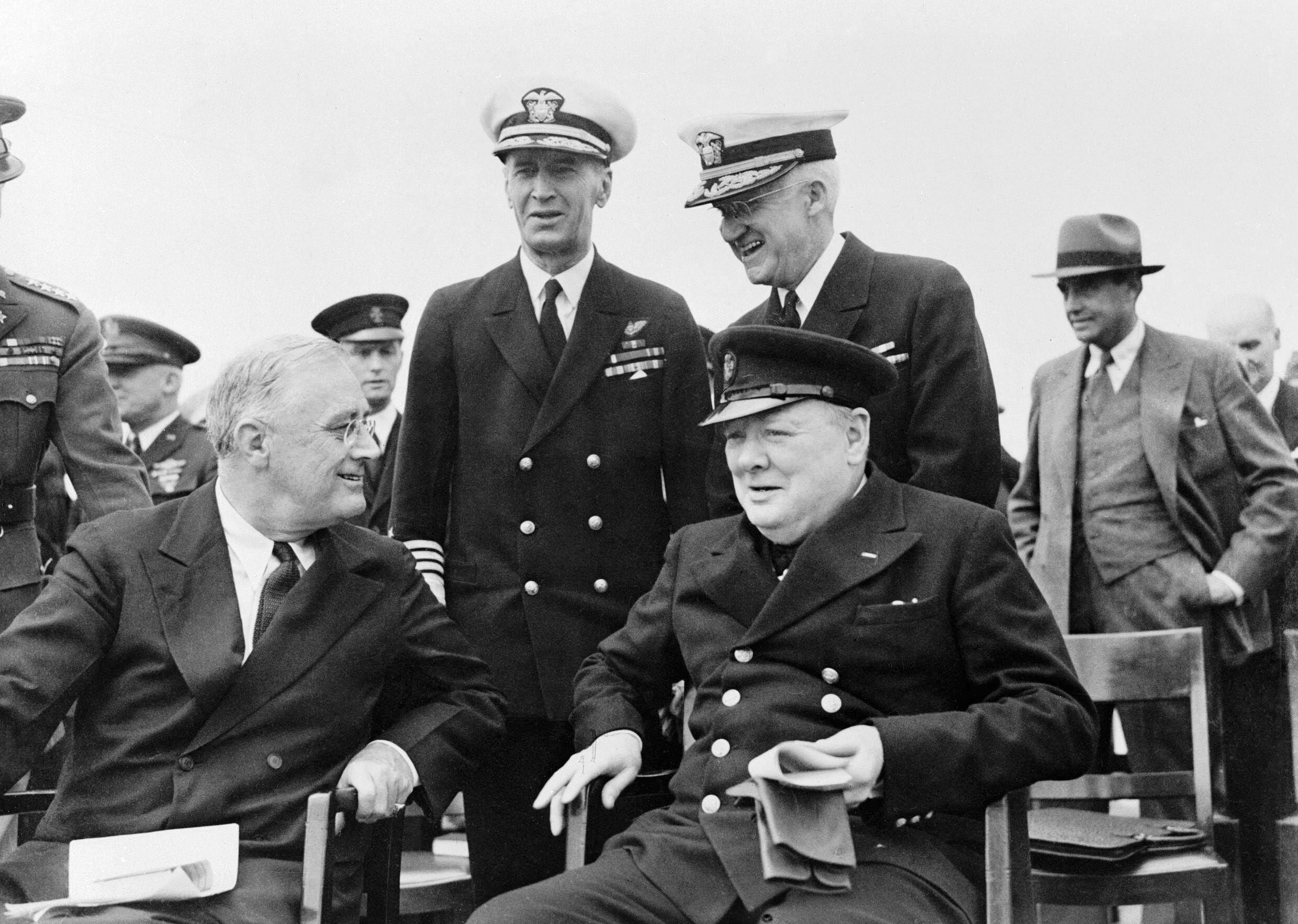
But this time the deception was more than a game. The real reason for the cruise was to meet with British Prime Minister Winston Churchill without alerting German U-boats to the presence of the two leaders.
Out of the meeting would come the Atlantic Charter, a document asserting that Britain, which was at war with Nazi Germany, and the still-officially-neutral United States, shared a belief in freedom, social welfare and self-determination for conquered nations. It was a vision for the postwar world.
On July 8 this year, President Donald Trump was the subject of another elaborate presidential deception: As the Washington Post reported, security officials decided that it was unsafe for the president to travel aboard the former Air Force One from Turkey to the U.K.
A credible assassination threat attributed to the Iranians resulted in a plan to have Trump board the plane, then walk to a concealed catering truck which took him to a smaller plane, according to officials.
As Peter Baker wrote in the New York Times, this year’s maneuver made many people decoys:
The threat to Air Force One was seen as so dire that they sneaked President Trump off the jet in a catering container to keep him safe. But the same dire threat did not stop them from then sending Air Force One into the skies anyway with a planeful of senior officials, government employees, reporters and military personnel serving as decoys, some unwittingly.
Among those on the decoy jet were Secretary of State Marco Rubio and White House senior aide Stephen Miller.
FDR’s long-planned meeting
By all accounts, the Trump presidential plane-switch was a hastily improvised plan and lasted a few hours. By contrast, the planning for the Roosevelt-Churchill meeting went on for months, and the deception lasted for days. But some reporters in Washington grew suspicious by August 7.
United Press reported that day:
Another message from the Potomac, the absence from Washington of four ranking naval and military leaders and the continued lack of official denials were thought by some here today to give color to reports that President Roosevelt might be meeting Prime Minister Churchill.
According to Nigel Hamilton’s book The Mantle of Command, FDR kept plans for the meeting secret from his secretaries of state, war and navy and even his own personal secretary.
The idea of the meeting originated with Roosevelt, whose envoy Harry Hopkins discussed it with Churchill in January, 1941. The British island of Bermuda was mentioned as a possible site. But in June, Britain’s Admiralty ordered up an emergency survey of water depths at Mortier Bay, on the west side of Placentia Bay. Ultimately, “a less exposed and deeper site was chosen on the east coast of Argentia Bay,” according to the Northern Mariner, a Canadian research journal.
But there was another reason that likely outweighed the oceanographical merits of the rival locations. Argentia Bay, which is on the east coast of Placentia Bay, was the site of a rapidly expanding U.S. naval air station. In 1940, the United States agreed to trade 50 old naval destroyers to Britain in return for the right to lease bases in British colonies, including Newfoundland.
Upon his arrival, Roosevelt expressed pleasure at seeing firsthand a flurry of activity at the newly created U.S. base. He loved being on the water — on boats of any kind. An attack of polio at age 39 deprived FDR of the use of his legs.
Churchill’s nation was locked in an existential struggle with Nazi Germany, and he believed American support was the key to victory. Roosevelt empathized with the British but knew of his own country’s strong isolationist streak and struggled to project an air of neutrality.
The British prime minister traveled to the meeting aboard the battleship HMS Prince of Wales. “He had ordered grouse and rare turtle soup as among the provisions he would take, as well as a full military band,” Hamilton noted. Churchill was hoping FDR would agree to join the war. Roosevelt had no such intention.
As Hamilton observed, the United States military could not credibly go to war, even if FDR could persuade Congress to declare it. “The fact was, for all the outward show of U.S. naval and air strength to impress the British visitors on their arrival at Placentia Bay,” the U.S. lacked an army, air force or navy yet able to effectively counter the Axis powers.
Instead of a plan for war, FDR wanted the conference to produce “a joint declaration of principles, or war aims, in order to inspire the peoples of the ‘enslaved’ countries and others,” according to Hamilton.
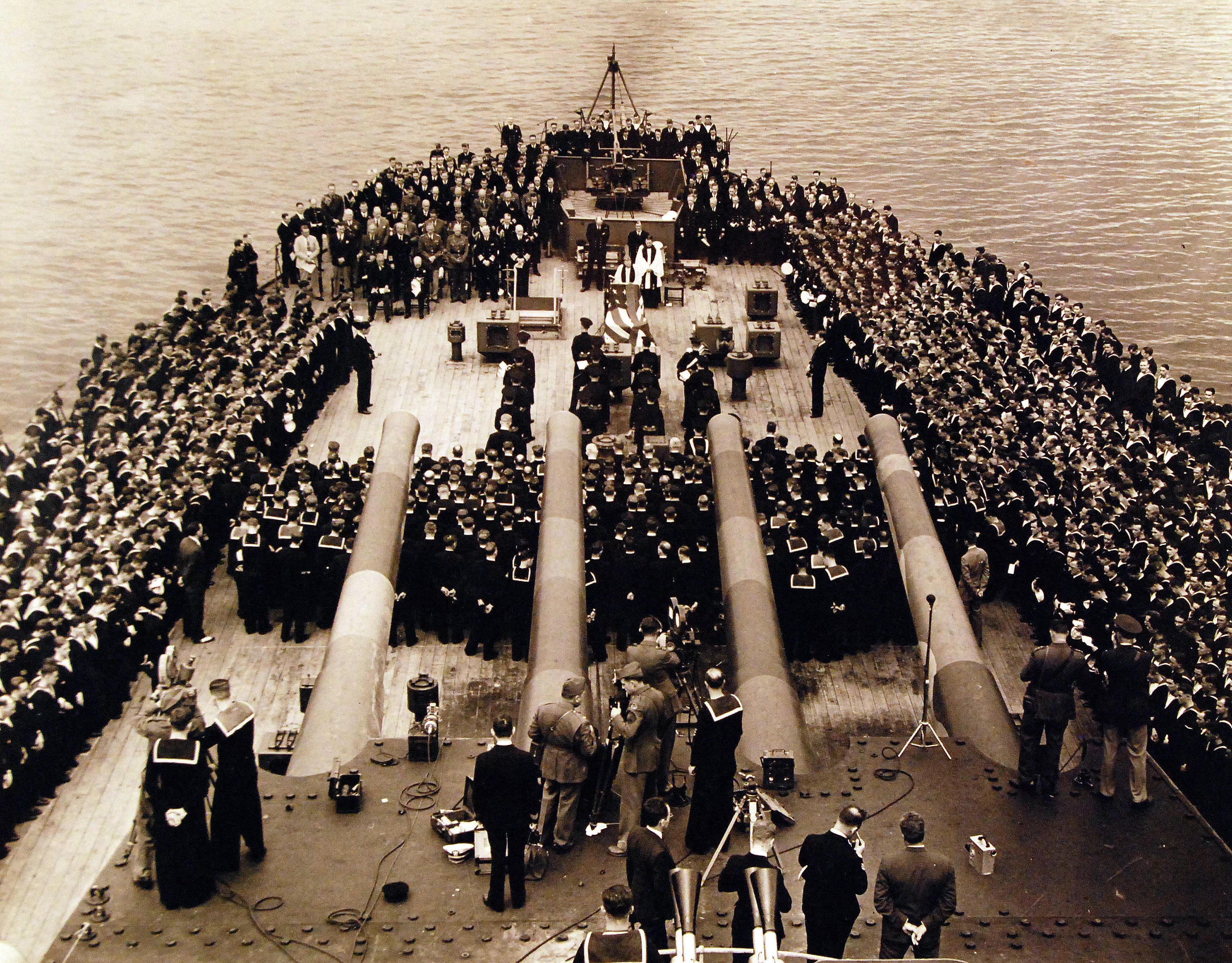
There was plenty of ceremony at the meeting: a lavish dinner on the Augusta, a church service with nearly 1,000 sailors on the Prince of Wales and a lunch banquet for the leaders of both nations. Meanwhile the two sides privately sparred over the wording of what became the Atlantic Charter, with FDR pressing the imperialist Churchill to swallow language “that guaranteed an eventual end to the British colonial system,” as Hamilton noted.
As a parting gift to the sailors on the Prince of Wales, Roosevelt “ordered two thousand cardboard boxes prepared, each containing a half pound package of cheese, several pieces of fruit, and a carton of cigarettes,” Cross noted. Each included a card saying, “The President of the United States sends his compliments and best wishes.”
The Prince of Wales departed at 5 PM on August 12. The Augusta steamed out of Argentia Bay 10 minutes later.
Two days after the conference ended, the two nations announced their agreement on the charter.
The document ended with a call for peace that still resonates in 2026:
…All of the nations of the world, for realistic as well as spiritual reasons, must come to the abandonment of the use of force. Since no future peace can be maintained if land, sea, or air armaments continue to be employed by nations which threaten, or may threaten, aggression outside of their frontiers, they believe, pending the establishment of a wider and permanent system of general security, that the disarmament of such nations is essential. They will likewise aid and encourage all other practicable measures which will lighten for peace-loving peoples the crushing burden of armaments.
Ahead would be four years of war.
Japan attacked the U.S. naval base at Pearl Harbor on December 7, 1941. Within days, the U.S. would be fighting on Britain’s side against Germany, Japan and Italy.
On December 10, Japanese planes attacked and sank — along with the battlecruiser HMS Repulse — the HMS Prince of Wales, the ship that had carried Churchill to Newfoundland. More than 840 British officers and crew died on the two ships.
Truly 1st rate, again dear Richard....a reminder of how effective subterfuge can be when in the service of right as well as might (or simple self-protection) and putting no others in jeopardy or hostage/targetpractice, positions !
What a terrific piece, Rich — adding historical depth to the ongoing conversation about this topic.