

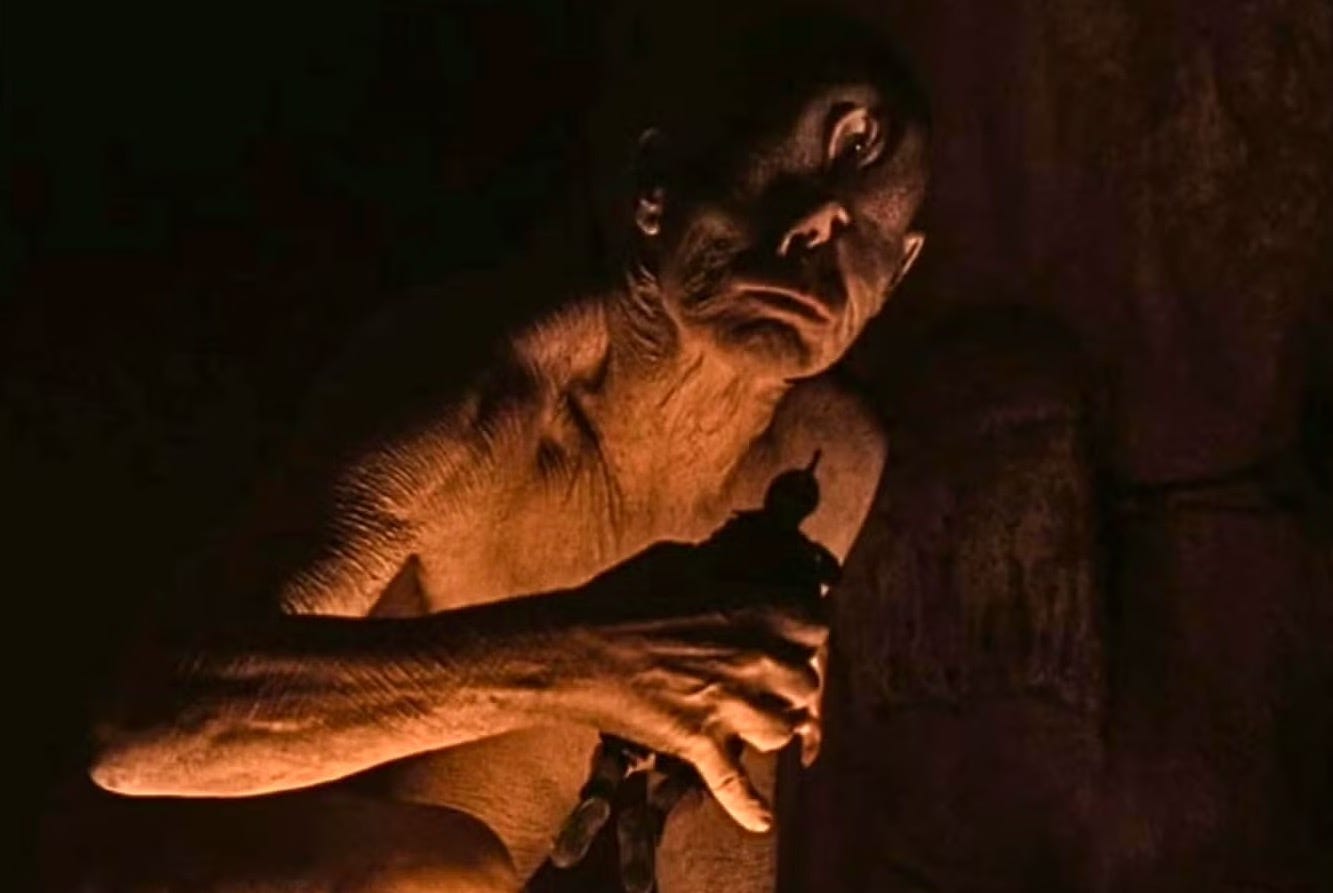
“Strangers! Now who are you?” The Cyclops spots men in his cave and asks, “Where did you sail from, over the running sea-lanes.”
A nervous Odysseus, gawking at the one-eyed giant Polyphemus, tells him they are returning from Troy and expect to receive the hospitality required by the law of Zeus.
“You must be a fool, stranger, or come from nowhere,” Polyphemus replies, in Book Nine of Homer’s Odyssey. “We Cyclops never blink at Zeus and Zeus’ shield of storm and thunder….we’ve got more force by far.”
As if to demonstrate, he grabs two of Odysseus’ crew. “Rapping them on the ground he knocked them dead like pups — their brains gushed out all over, soaked the floor — and ripping them limb from limb to fix his meal he bolted them down like a mountain-lion, left no scrap, devoured entrails, flesh and bones, marrow and all.”
When the hero demands a “guest gift” for visiting the home of Polyphemus, the giant replies that Odysseus’ “gift” will be to be eaten last.
Odysseus, described by Homer as a “man of craft,” devises a plan to save himself and his remaining crew. He had filled a goatskin with an extraordinary wine and now offers it to the Cyclops, who tastes and pronounces it “nectar and ambrosia—this flows from heaven!”
Odysseus tells the giant his name is “Nobody.” When Polyphemus tumbles to the floor of the cave, dead drunk, Odysseus puts the sharpened tip of an olive wood stake into the fire. He and his men then plunge it into the giant’s eye and twist. The Cyclops screams.
As other Cyclops rush to find out what is going on, Polyphemus tells them, “Nobody’s killing me now.”
The verbal trickery predates the famous Abbott and Costello routine, “Who’s on first” by more than two millennia but the joke is essentially the same.
What the movie misses
In Christopher Nolan’s hit film of The Odyssey, there is no “Nobody.” There is no tension-filled repartee between the Cyclops and the film’s hero.
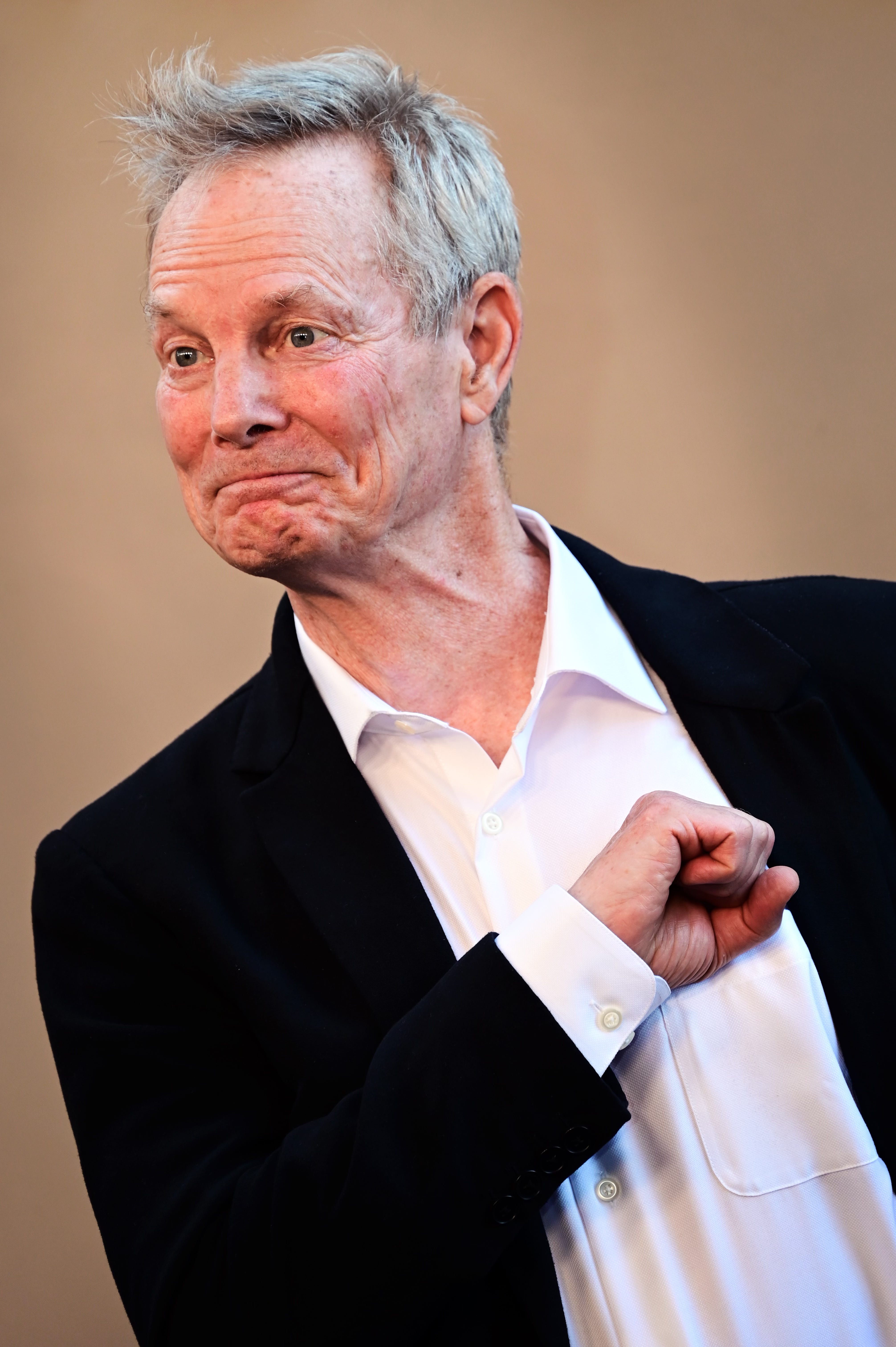
Nolan conveyed the frightful power and malevolence of the giant compellingly — without CGI — by constructing a 60-foot tall puppet and mashing that together with the acting of the gifted Bill Irwin. But Nolan left out the heart of the story. It’s only at the end of the movie’s Cyclops sequence that it becomes clear Polyphemus can speak — and by then, Odysseus says it’s far too late to resolve the conflict through conversation.
Asked by Jon Stewart about omitting the “Nobody” exchange between Odysseus and Polyphemus, Nolan said, “It’s a pun. Puns in translation are tough… I tried. It was not possible to work it in.”
The director’s handling of this encounter shows why literary critics may never be comfortable with film adaptations of Homer’s epics. What Nolan and other great directors deal in is scenes; what Homer reveled in was stories.
The Odyssey poem is chock full of them. Everyone seems to have an epic story to tell. Odysseus narrates much of the action through his own account of what befell him after the end of the Trojan War. But he also reels off fictional stories of his travels to fool enemies and at times, even his own family.
He visits the underworld, a device that lets him rediscover and tell the stories of Agamemnon, Oedipus, Achilles, Ajax, Tantalus, Sisyphus and Heracles. Not many of Homer’s stories can fit within the confines of a blockbuster movie, even one that is nearly three hours long.
Wilson’s take
In a now-famous 4,000-word critique in the London Review of Books, Odyssey translator Emily Wilson wrote, “Nolan’s spectacle threatens to drown out his story just as the towering waves of the wine-dark sea – more grey than purple – threaten to overwhelm his hero’s ship.” Wilson said she was “humbled to learn that Nolan has read at least the first line of my translation of The Odyssey into iambic pentameter.” (The one I’m using in this piece is by Robert Fagles.) But she says she would be ashamed to have written this script:
Nolan’s Odyssey lacks many of the elements that make the poem great. It has nothing convincing to say about time, memory, history, war, or about the relationship between one warrior’s glorious return and the lives of his family, adversaries, comrades, friends and neighbours. It lacks psychological, emotional, political and ethical depth. Its narrative structure is gimmicky. The writing is abysmal. None of the characters has convincing motivation for their actions or words. There are no sex scenes, and all the food looks horrible.
All of that is true, and yet Nolan succeeds on his own terms with spectacular set-pieces including the sack of Troy, Circe turning Odysseus’s men into pigs, the wreck of Odysseus’ ship and the killing of the suitors. Nolan “doesn’t know how to make an ugly image,” wrote the New York Times critic Manohla Dargis, who said the film “is filled with rapturous beauty.”
At times, Nolan’s imagination fails him. As the Economist wrote, “During the beach scenes with the nymph Calypso (Charlize Theron), Odysseus (Matt Damon) seems less to be in agonizing exile than on a Caribbean mini-break (they are wearing lots of linen). And the less said about the Cyclops, the better.” The Economist review was headlined, “A very silly adaptation of ‘The Odyssey.’”
Adapting a classic composed 2,700 years ago is challenging on any level. Nolan imagines an Odysseus who is so appalled by the slaughter that takes place after he engineers the sack of Troy that he questions the morality of war.
Yet the written version of the Odyssey centers around a hero who freely engages in remorseless battle even after 10 years of war. After Odysseus slays Penelope’s suitors, who occupied his castle and lived off his riches, he orders the killing of the men’s defenseless female slaves. At the book’s end, it is only the hand of the god Athena that stops Odysseus and Ithaca from an endless civil war.
Christopher Nolan has visited us with his personal vision of The Odyssey. If Zeus’ law applies, we have to treat him with hospitality, even though he lets the spectacle diminish the stories.
Funny, Richard, you landed at the same absent core of the Odysseus story as my sons and I did when we finally saw the Nolan film last night. "Nobody" was nowhere to be found. What a missed opportunity! As was the way Odysseus and his men ultimately escaped from the cave. Apart from the somnific wine they cleverly offered him, they tie themselves beneath individual sheep with rope while Odysseus himself, being the last of the lot, has to hang on for dear life underneath the biggest sheep of the flock by sheer force of willpower and muscle as the Cyclops blindly feels and flails as the sheep shuffle out. I remember being impressed by that Odysseus feat more than anything else when I first read the Odyssey those decades ago. Easy for a non filmmaker to say, especially one who believes almost 3 hours is beyond pushing the limit. Maybe he could have made a trilogy instead, to cover more bases more "accurately"...
All told, notwithstanding the many shortcomings, it's good to get people, especially young people, thinking of the greatest story of all time again.