
Donald Trump won't be thanking John Roberts
Tariff ruling ruptures relations between chief justice and president
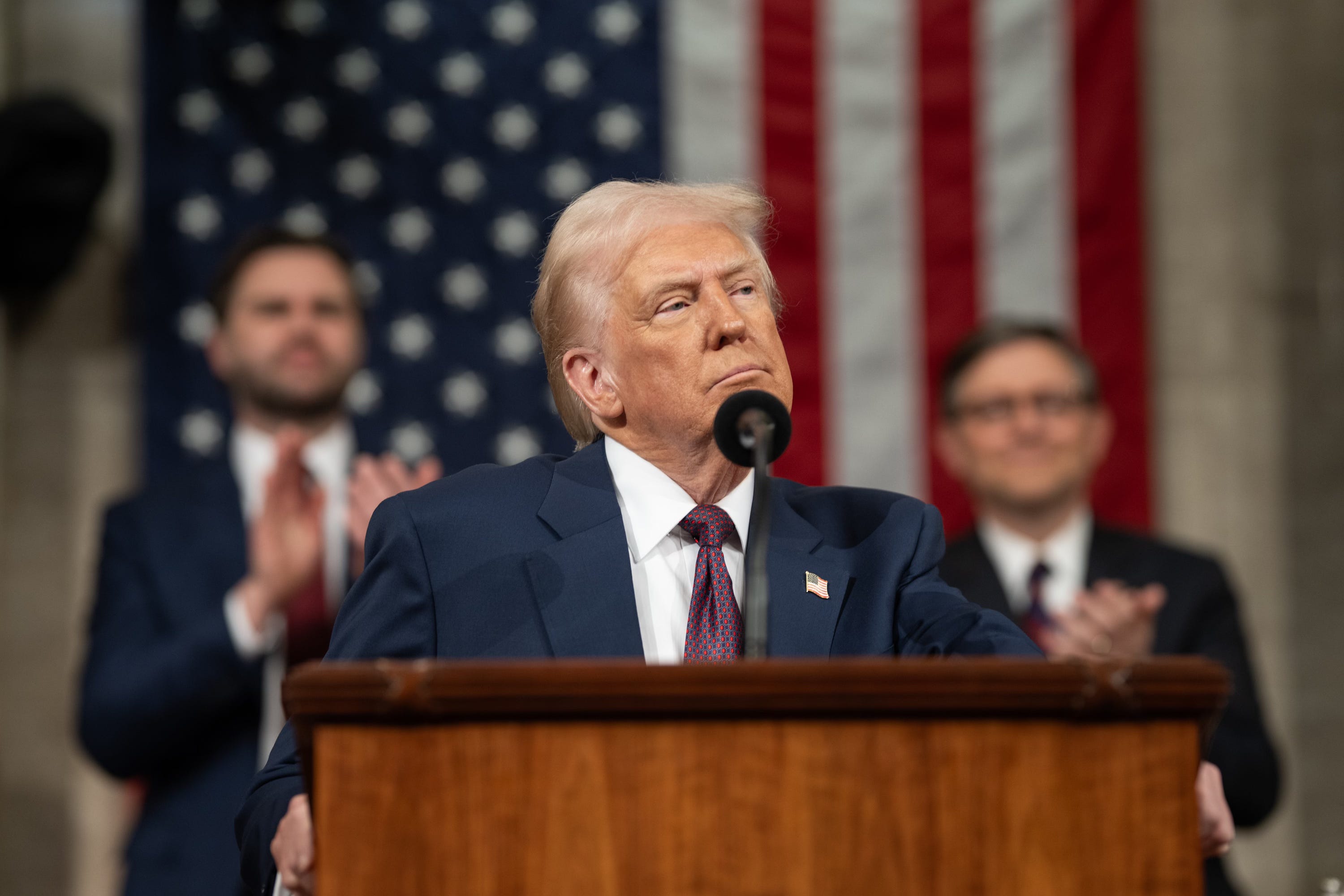
Nearly a year ago, President Donald Trump shook hands with Chief Justice John Roberts in the well of the House Chamber.
“Thank you again, thank you again,” the president said to Roberts, patting his black-robed arm. “Won’t forget it.”
The president was basking in the glow of his March 4 speech to a joint session of Congress, thanking and accepting greetings from justices, generals and members of his cabinet and Congress. Observers tried to parse his interaction with the chief justice.
What was the “it” Trump said he won’t forget? Some observers suggested his gratitude was to Roberts for writing the court’s 2024 decision granting presidents absolute immunity from prosecution for actions taken in their official capacity. Trump explained later that he was merely thanking Roberts for swearing him in on Inauguration Day.
Whatever the reason, “The exchange was so awkward,” Adam Serwer wrote in The Atlantic, “it should have been followed by the Curb Your Enthusiasm theme song.”
When Trump returns to the House podium Tuesday, Feb. 24 for his State of the Union address, he likely won’t be thanking John Roberts. The chief justice wrote the court’s devastating majority opinion Friday striking down the emergency tariffs Trump unilaterally imposed on most of the world’s countries. The ruling shredded Trump’s arguments that the International Emergency Economic Powers Act (IEEPA) of 1977 gave him authority to impose tariffs wherever and whenever he pleased, as long as he could declare a related emergency.
Trump lambasted the six justices who voted against him — including two who were appointed by him— as “fools and lapdogs for the RINOS [Republicans in name only] and the radical left Democrats” and said he was ashamed of them.
However, he did extend thanks to one justice, his other Supreme Court appointee Brett Kavanaugh, who voted to uphold his tariffs. Trump called him a “genius.”
The court’s decision invalidated tariffs that bring in hundreds of billions of dollars in revenue. But the ruling’s significance was far more about politics than economics. After all, as the court and Trump both pointed out, there are plenty of other much less controversial ways a president can seek to impose tariffs.
Here was a coequal branch of government delivering a final ruling for the first time in a major case that Trump’s autocratic assertion of executive power had violated the U.S. Constitution. Similar rulings could follow on other aspects of Trump’s second presidency.
The court’s emperor-has-no-clothes-moment included pointing out the obvious fact, denied by Trump, that tariffs are a tax on the American people. “A tariff is a tax levied on imported goods and services,” Roberts wrote, quoting the Congressional Research Service. Trump economic adviser Kevin Hassett made headlines this month when he asserted that New York Federal Reserve researchers should be “disciplined” for their study that found “nearly 90 percent of the tariffs’ economic burden fell on U.S. firms and consumers.”
Roberts’ opinion harked back to the founding of the U.S. republic 250 years ago. “Recognizing the taxing power’s unique importance, and having just fought a revolution motivated in large part by ‘taxation without representation,’ the Framers gave Congress ‘alone . . . access to the pockets of the people.’”
As the court noted, “Article I, Section 8, of the Constitution sets forth the powers of the Legislative Branch. The first Clause of that provision specifies that ‘The Congress shall have Power To lay and collect Taxes, Duties, Imposts and Excises.’ It is no accident that this power appears first. The power to tax was, Alexander Hamilton explained, ‘the most important of the authorities proposed to be conferred upon the Union.’ The Federalist No. 33, pp. 202–203 (C. Rossiter ed. 1961). It is both a ‘power to destroy,’ McCulloch v. Maryland, 4 Wheat. 316, 431 (1819), and a power ‘necessary to the existence and prosperity of a nation’—’the one great power upon which the whole national fabric is based.’” Nicol v. Ames, 173 U.S. 509, 515 (1899).

Between the lines, the court noted the mercurial nature of Trump’s tariff-making decisions:
Since imposing each set of tariffs, the President has issued several increases, reductions, and other modifications. One month after imposing the 10% drug trafficking tariffs on Chinese goods, he increased the rate to 20%. One month later, he removed a statutory exemption for Chinese goods under $800. Less than a week after imposing the reciprocal tariffs, the President increased the rate on Chinese goods from 34% to 84%. The very next day, he increased the rate further still, to 125%. This brought the total effective tariff rate on most Chinese goods to 145%. The President has also shifted sets of goods into and out of the reciprocal tariff framework…exempting from reciprocal tariffs beef, fruits, coffee, tea, spices, and some fertilizers…
No other president has tried to use the IEEPA law to impose tariffs, the court pointed out.
It also noted that Trump doesn’t try to justify his tariffs as an outgrowth of “the President’s warmaking powers.”
“The United States, after all,” Roberts wrote “ is not at war with every nation in the world.” (It only seems that way.)
IEEPA gives presidents the power to “regulate” trade, but taxing is a different power. If tariffs could be validly imposed under the act, “it would replace the longstanding executive-legislative collaboration over trade policy with unchecked presidential policymaking.”
Why it matters
This was the third branch of government affirming the centrality of another branch, a Congress that’s at risk of losing its vital place at the center of American democracy. If the court had upheld Trump’s tariffs, it would have amounted to a surrender of two thirds of the American Constitution to an unrestrained power grab by the remaining one third.
In the long span of battles over tariffs in U.S. history, the court wrote, one thing is clear: “When Congress grants the power to impose tariffs, it does so clearly and with careful constraints. It did neither here.”
Roberts added, in his concluding section: “The President asserts the extraordinary power to unilaterally impose tariffs of unlimited amount, duration, and scope. In light of the breadth, history, and constitutional context of that asserted authority, he must identify clear congressional authorization to exercise it.”
This week the U.S. Department of Justice, an agency that has striven (and often fallen short) to administer justice impartially, publicly demonstrated that it has become a different kind of organization. It hung a banner on its headquarters with Trump’s glowering face and the slogan, “Make America Safe Again.”
With their ruling striking down the Trump tariffs, six members of the U.S. Supreme Court made clear that, unlike Attorney General Pam Bondi, they are not buying in to the president’s cult of personality.
A reporter asked Trump Friday afternoon if the Supreme Court justices who voted against him are still invited to Tuesday’s State of the Union. “They’re barely invited,” he said. “I couldn’t care less if they come.”
For more background on IEEPA, here’s a post I wrote last June:


