
Donald Trump's Greenland gamble
The ultimate short-sighted move

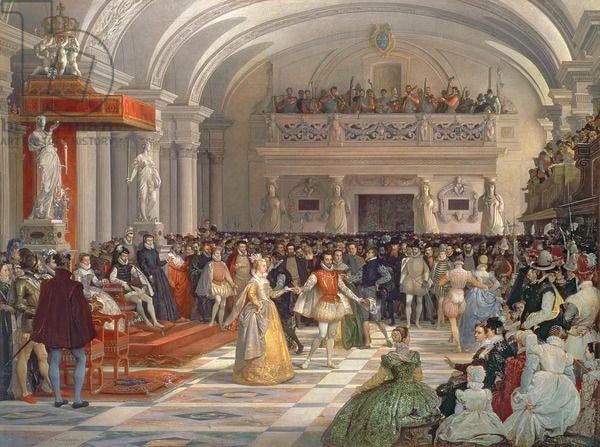
On August 18, 1572, ten years into a bloody religious war between the Catholics and Huguenots of France, the future King Henry IV married Marguerite de Valois.
It was a tense moment, since the two 19-year-olds were of different faiths: Henry was a Protestant and Marguerite a Catholic, and thus they could not both be present at a mass.
So the wedding vows were exchanged outside Notre Dame Cathedral on a platform “hung with cloth of gold,” the bride would later recall. “I wore a crown on my head…and I blazed in diamonds.” Cardinal de Bourbon conducted the ceremony at the church’s door. Once wed, the couple separated: The bride went into the cathedral for mass while Henry, the groom, left the church.
The illusion that the interfaith wedding of Henry and Marguerite would bring an end to the war between France’s Catholics and Protestants was shattered six days later on St. Bartholomew’s Day. The wedding provided an opportunity — not for tolerance, but for murder. The attempted assassination of a Huguenot military official spiraled into a citywide massacre of Protestants, in which thousands died, followed by months of violence outside Paris that claimed as many as 10,000 lives.
The wedding would become known as the “scarlet nuptials,” or “red wedding,” though it wasn’t the one that inspired a similar event in George R. R. Martin’s Game of Thrones. (That was based on Scottish history, Martin said.)
This is a story of the events that led up to one of the smartest decisions a ruler has ever made — and of the events that followed the undoing of that decision decades later.
‘My own morality’
It’s timely now at a point when the risky decisions of leaders including President Donald Trump and Iran’s Ayatollah Ali Khamenei increasingly threaten global stability. After authorizing a special forces operation to take custody of Venezuelan president Nicolás Maduro, Donald Trump was asked by the New York Times if there are any limits to his global power. “Yeah, there is one thing. My own morality. My own mind. It’s the only thing that can stop me.”
He’s demonstrating the Napoleonic reach of this philosophy by demanding the acquisition of Greenland and threatening new tariffs against any European nation that opposes the land grab.
The Council on Foreign Relations recently asked members of the Society for Historians of American Foreign Relations to pick the 10 best and worst decisions ever made in U.S. foreign policy. In the first year of his second term as president, Trump has taken steps that could undo two of the 10 best — the creation of the United Nations and of NATO.
In his first term, Trump was personally responsible for one of the 10 worst decisions — the U.S. withdrawal from the Paris climate accords.
If Trump were to seize Greenland, which is a self-governing part of NATO-member Denmark, he could deal a death blow to the alliance.
Khamanei presides over a regime that periodically suppresses protests with brutal shows of force and pitiless executions. Its economy is collapsing, its legitimacy eroding and yet it repeatedly rejects policies that could help cure its problems. Thousands died in this month’s protests which were suppressed by the regime’s security forces. There seems to be no plan for the future, except more of the same.
A convert
By the time Henry returned to Notre Dame for a service of thanksgiving in March, 1594 as King Henry IV, he had converted to Catholicism. He had changed his faith multiple times by that point: baptized as a Catholic, he had been raised as a Protestant, forced to convert to Catholicism after the St. Bartholomew’s Massacre and then returned to Protestantism when he fled Paris in 1576.
“Paris was well worth a mass,” goes the famous, and possibly apocryphal, saying of the French monarch upon his latest conversion.
The more important words he uttered were those of the Edict of Nantes. In 1598, Henry granted Protestants the right to practice their religion in parts of France, though not in Paris itself. This was a “perpetual and irrevocable” proclamation. Henry said his aim was “the establishment of a good peace and tranquil repose for which we have always hoped and prayed, and which is the reward that we desire for the many pains and travails through which we have passed in the course of our life.”
This eminently wise and tolerant policy prevailed in France for 87 years — until in 1685, Henry’s grandson, Louis XIV, made the catastrophic decision to overturn it.
“The magnitude of this disaster can scarcely be overestimated,” wrote Olivier Bernier, in Louis XIV: A Royal Life. “There can be no excuse for Louis XIV’s decision to force his own brand of Christianity on his unwilling subjects: all rulers make mistakes, but this is an ineradicable moral stain.”
Philip Mansel noted in King of the World: The Life of Louis XIV:
All remaining Protestant churches and schools were destroyed, beginning with the Temple at Charenton, a few miles east of Paris, and its surrounding graveyard. All Protestant assemblies and forms of worship were forbidden, all priests expelled. The possessions of all French Protestants abroad were confiscated. All Protestant children had henceforth to receive Catholic baptism and instruction or their parents would be fined. Even the graveyard for foreign Protestants outside Paris, to the horror of the Danish envoy, was destroyed.
While Louis forbade Protestants to leave France without permission, as many as 200,000 left, and many of those were among the nation’s best artisans, shipbuilders, lawyers and doctors. Roughly 20,000 members of the military were among those who fled.
The decision created a festering wound in the soul of France and contributed to the eventual demise of the Bourbon monarchy a century later.
In her 1984 book,The March of Folly, Barbara Tuchman wrote that by the Protestants’ “rejection of the King’s right to impose religious unity, the divine right of royal authority everywhere was laid open to question … When Louis XIV, outliving son and grandson, died in 1715 after a reign of 72 years, he bequeathed, not the national unity that had been his objective, but an enlivened and embittered dissent, not national aggrandizement in wealth and power but a weakened disordered and impoverished state. Never had so self-centered a ruler so effectively despoiled self-interest.”
The sun king
King Louis XIV likely never said “L’État, c’est moi (I am the state)." But he often governed as if he believed it. “His irremediable error,” wrote Philippe Erlanger for the Encyclopedia Brittanica, “was to have concentrated all the machinery of the state in his own person, thus making of the monarchy a burden beyond human strength.”
Louis was the product of a frosty marriage between Louis XIII and Anne of Austria. Her successful delivery of their first child, Louis, 23 years into their marriage, was proclaimed as a miracle, and “his birth was compared to that of Jesus Christ— also born after a miraculous conception,” wrote Mansel. “The young Louis was voracious, with strong teeth, and hurt his wet nurses’ nipples: he would run through eight nurses in all.”
Louis was only four years old when his father died. The young prince was suddenly king, but in name only. His mother Queen Anne outmaneuvered rivals to gain control of the regency, and she selected Cardinal Jules Mazarin as the preeminent minister of her government.
It was only in 1660, after Mazarin’s death, that Louis took effective control of France in his own right. He ruled absolutely, as Bernier noted — he set taxes, declared war, negotiated treaties, promulgated the laws, commanded the military, awarded noble titles, censored the media, decided who to arrest and imprison and appointed the clergy and government ministers.
Under those rules, he had the right to revoke his grandfather’s Edict of Nantes, which allowed Protestants to worship. Taking away that freedom was an extremely popular decision for Louis among his subjects, as ruinous as it would turn out to be. The king also thought that persecuting the Protestants would win him advantage internationally with other leading Catholic rulers, but there were also other motives for his decision.
“He believed that he was doing God’s work, and that revocation would save Protestants’ souls,” wrote Mansel. “Louis XIV had been educated by a mother and a tutor who had practiced a policy of mercy... but in his decade of megalomania Louis XIV preferred violence to gentleness.”
The lasting question
Why do powerful people, who are acutely focused on their own interests, so often make self-defeating mistakes? That’s the focus of Tuchman’s book.
She wonders why, at least in the mythical story, the Trojans accepted the wooden horse hiding Greek warriors rather than destroy it. Why did Napoleon and Hitler both risk invading Russia, where their armies were destroyed by cold and distance? Why didn’t the Aztec Emperor Montezuma overpower the small party of Spanish adventurers led by Hernán Cortés rather than submit to them?
Tuchman quotes President John Adams, saying, “While all other sciences have advanced, government is at a stand; little better practiced now than three or four thousand years ago.”
She added:
Wooden-headedness, the source of self-deception, is a factor that plays a remarkably large role in government. It consists in assessing a situation in terms of preconceived fixed notions while ignoring or rejecting any contrary signs. It is acting according to wish while not allowing oneself to be deflected by the facts. It is epitomised in a historian’s statement about Philip II of Spain, the surpassing wooden-head of all sovereigns: ‘No experience of the failure of his policy could shake his belief in its essential excellence.’
“Acting according to wish while not allowing oneself to be deflected by the facts,” could have been written last week, rather than four decades ago, as it was by Tuchman.
It’s a succinct summation of the international instincts of the Trump White House. And it raises the question of why the world’s most powerful country would cast aside the friendship and support of the allies who helped make America great in the second world war and in the 80 years since? Grabbing control of Greenland, where the U.S. already has a free hand under treaty to deploy its military, makes no sense..
In the Atlantic, Robert Kagan wrote on January 18, that “the American order is over because the United States has decided it no longer wishes to play its historically unprecedented role of providing global security.” In the new, post-American world, he added, “The U.S. will have no reliable friends or allies and will have to depend entirely on its own strength to survive and prosper.”
Trump announced that he was imposing 10% tariffs on eight European countries —Denmark, Norway, Sweden, France, Germany, the U.K., the Netherlands and Finland — starting next month and would raise those to 25% in June if they continued to oppose a U.S. takeover of Greenland.
In response, France’s President Emmanuel Macron said his nation was “committed to the sovereignty and independence of nations…no intimidation nor threat will influence us, neither in Ukraine, nor in Greenland, nor anywhere else in the world when we are confronted with such situations.”
I think Barbara Tuchman didn’t get it quite right when she attributed leaders’ fatal mistakes to their “wooden-headedness.” What separates a wise government official from a foolish one isn’t what surrounds their brain but what they see through their eyes: it is farsightedness.
Seizing Greenland would be the ultimate in short-sighted ventures — a sugar high for Trump and Fox News that won’t wear well over time.
When Henry IV agreed to let Protestants practice their religion, he was looking into the future and seeing that a nation no longer divided would be measurably stronger.
When the grandson he never knew, Louis XIV, revoked that policy of tolerance, the king saw the short-term gains he could reap from his decision. But Louis never looked ahead to the price France would pay in the long term.


This parrallel between Louis XIV and modern geopolitics is brillaint. The idea that revoking tolerance cost France 200k of its best minds is wild bc we often think about short-term wins over long-term stability. I've seen in my own strategy work how doubling down on control can feel right in the moment but ends up weakenng the system. The farsightedness vs wooden-headedness distinction really cuts to the core of leadership failure.