

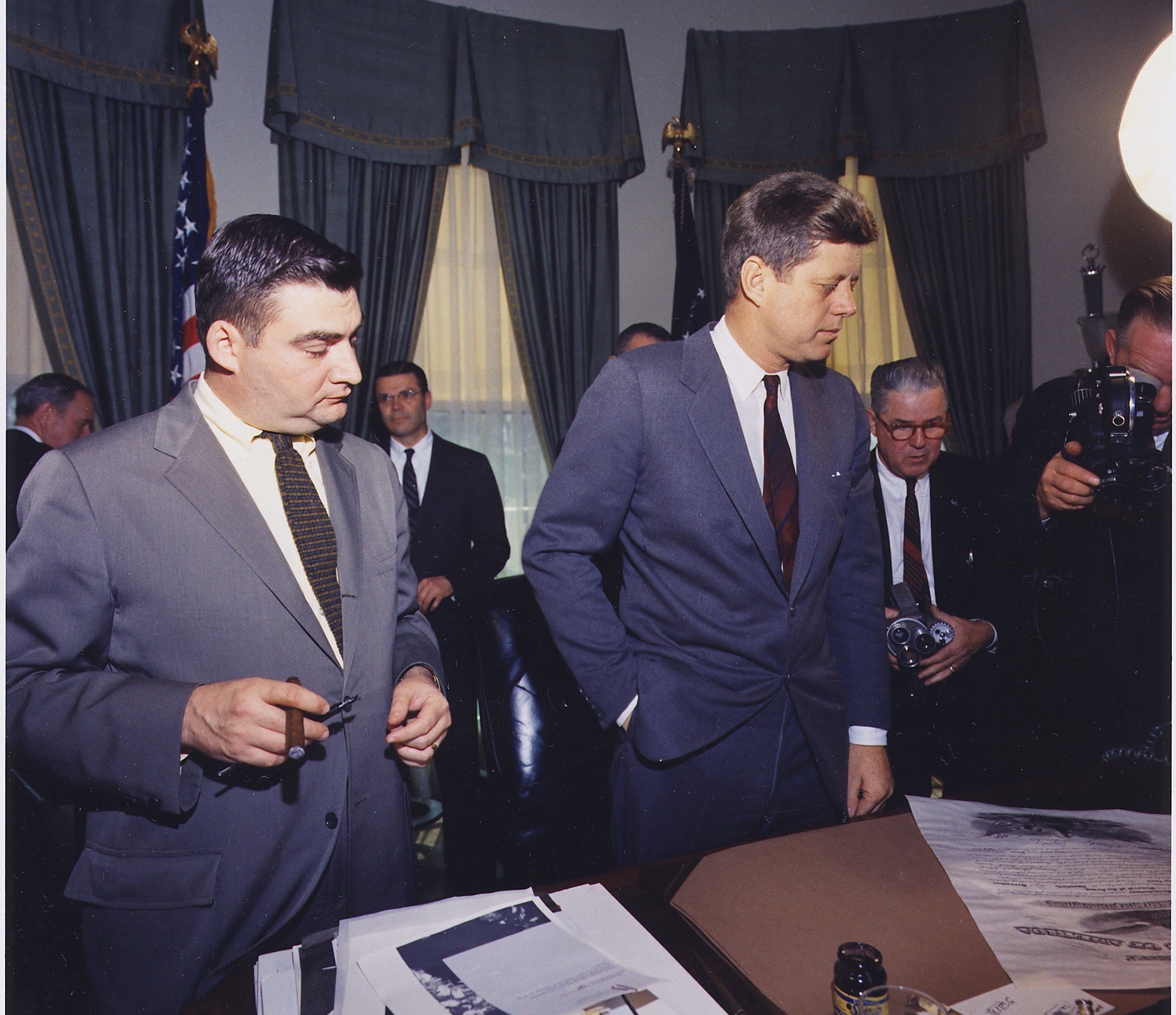
Soon after John F. Kennedy took office as president in 1961, the first lady’s press secretary sent a draft news release to Jacqueline Kennedy for approval.
“If this is o.k….would you send it back to me, so that I can give it to Plucky Pierre,” wrote Pamela Turnure, on White House stationery, in a note preserved in the files of the John F. Kennedy Presidential Library and Museum.
Plucky Pierre was Pierre Salinger, the president’s press secretary. The press release would announce Jacqueline Kennedy’s “most interesting discovery” in her search for historic treasures for the White House: the Resolute Desk, which I covered in last week’s Now It’s History post.
My aim here isn’t to retell the story of the desk, constructed from the timbers of the HMS Resolute. It’s to uncover how the White House, the New York Times, LIFE Magazine and the JFK Library all botched a key date in the desk’s history.
The mistake began with that draft press release. In a sentence pointing out that the desk was presented to President Rutherford B. Hayes, someone jotted: “in 1878.” In fact, the desk arrived at the White House as a gift from Queen Victoria in 1880. It’s a minor error, but its persistence in the public record makes it worth exploring.
It’s not clear who inserted the incorrect date into that draft. In any event, Jackie Kennedy wrote on Pamela Turnure’s note: “Have Pierre save it for a day when we have no news—not today….maybe Monday.”
On Monday, two days after the Resolute desk was moved into the Oval Office, Plucky Pierre sent out the news release. The error spread widely, landing in a front-page New York Times article by Bess Furman and in many other news outlets.
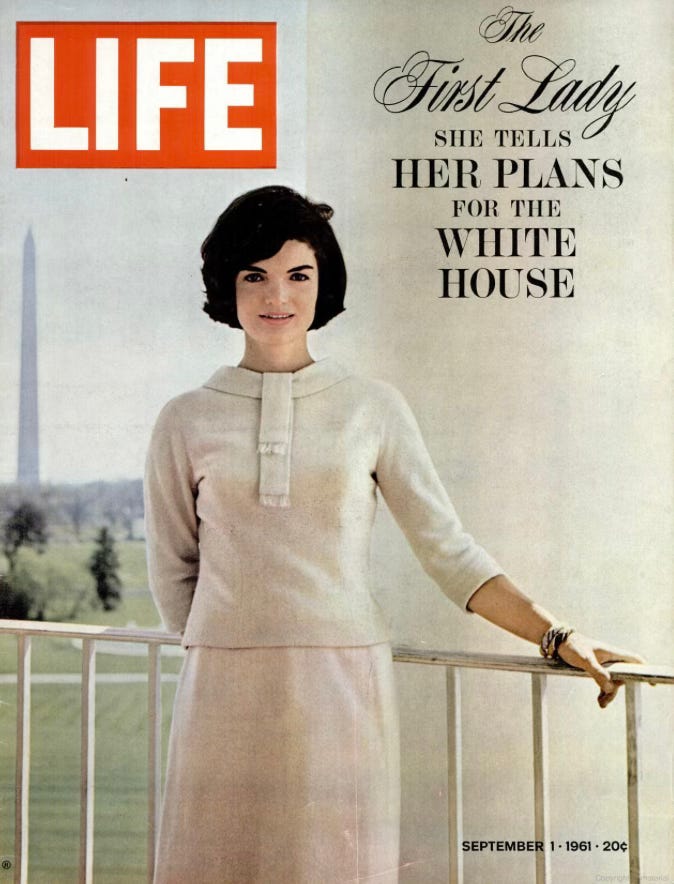
A September 1, 1961 cover story in LIFE magazine followed suit. The article, which originated with a draft submitted by the First Lady’s staff and was rewritten by journalist Hugh Sidey and the magazine’s editors, said, “A carved inscription identified the desk as a gift sent to President [Rutherford B.] Hayes by Queen Victoria in 1878.”
In fact there’s no date — not 1878 or 1880 — given for the Queen’s gift in the brass plaque on the desk.
The mistake lived on into the 21st century, appearing on the website of the JFK Library until the end of last month. I pointed it out to an archivist at the library on July 29 and by the next morning, the library’s website listed the correct date of 1880. (The incorrect date still appears on the website of the National Archives Foundation.)
Pinning it down
When exactly did Queen Victoria’s gift arrive at the White House? Resolute, a comprehensive history of the ship by Martin W. Sandler, published in 2006, states that the desk arrived at the White House on November 2, 1880. The year is correct, but the day of the month is not.
How to pin it down? The most definitive source is the Rutherford B. Hayes Presidential Library in Fremont, Ohio. Julie Mayle, the library’s curator of manuscripts, sent me a file with multiple documents and news reports showing that the 1,300-lb. desk arrived at the White House on November 23, 1880.
Among them is the text of a letter President Hayes sent that same day to historian George Bancroft:
It says, in part:
My Dear Mr Bancroft:
Mrs Hayes wishes me to thank you for the English newspapers containing good words about the administration of her husband. It gives me pleasure to say that I do it in the first note written on the desk made from the timbers of the Resolute sent by Queen Victoria to the President…
Sincerely,
R. B. Hayes
The FDR myth
The Resolute Desk is the subject of a more significant historical mistake. As Sarah Fling wrote for the White House Historical Association, it appears to be a myth that President Franklin D. Roosevelt ordered a wooden panel made to conceal his leg braces as he sat behind the desk.
The panel, bearing the presidential coat of arms, was indeed constructed, but it was designed two months after FDR died in 1945. There are many reasons to doubt that FDR ordered the panel: His leg braces were ordinarily concealed inside his trousers. He didn’t use the Resolute Desk in the Oval Office, but in the oval room upstairs where he met privately with advisers who were well aware that his legs had been paralyzed by polio. And the desk he did use in the Oval Office had an open front, with FDR’s legs clearly visible.
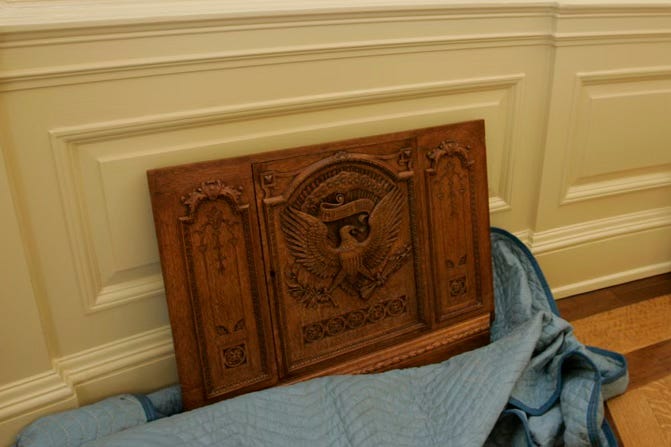
Fling noted that “even if Roosevelt had requested the panel, there is no evidence to suggest the decision was tied to his disability and President Harry S. Truman was the first president to use the newly outfitted Resolute Desk. From the famous photograph of John F. Kennedy Jr. popping out of the kneehole in 1963 to the panel’s role in popular culture, the Resolute Desk has become a recognizable symbol of the presidency and a national icon.”
The National Park Service designer who carved the panel claimed in 1962 that it had been made to hide FDR’s disability, but Fling says the evidence strongly suggests otherwise.
Nevertheless, in the 2007 Disney film National Treasure: Book of Secrets, a character played by Jon Voight says, “FDR had that put in so that guests couldn’t see his wheelchair.”
When history makes mistakes
The willful spreading of misinformation afflicts our lives: To know that, you only have to look at the consequences of Donald Trump’s lie that he won the 2020 presidential election.
Yet even innocent errors can cloud our understanding of history, though their impact can be much smaller. Both the White House’s 1878 date error and the dubious story of FDR’s desk panel are examples of the staying power of such mistakes in the telling of history. Once normally authoritative people and organizations err, their assertions take on a life of their own.
Thus skepticism is always a useful tool. In The Historian’s Craft, Marc Bloch wrote that “The most naive policeman knows that a witness should not always be taken at his word…Similarly, it has been many a day since men first took it into their heads not to accept all historical evidence blindly. An experience almost as old as mankind has taught us that more than one manuscript has falsified its date or origin, that all the accounts are not true, and that even the physical evidences can be faked.”
Misinformation abounds. In an introduction to the paperback edition of Regret the Error, author Craig Silverman cited a 2007 study by Scott Maier which found that only two percent of 1,200 factual errors he found in newspapers had been corrected by those papers.
Cleaning up mistakes in the telling of history could well become a full-time job, particularly in the age of AI. Perhaps this is a task for the “Library Cop,” the central figure in a celebrated episode of Seinfeld. Character actor Philip Baker Hall played the role in the style of Dragnet’s Sgt. Joe Friday.
Naturally the library cop was named Lt. Bookman, of the New York Public Library. The NYPL cleverly got in on the joke in 2021 by announcing Bookman’s “retirement” when the institution eliminated late fines for returning books.
In the sitcom episode, Lt. Bookman shows up in a tie, jacket and raincoat at Jerry Seinfeld’s apartment to inquire about an overdue book. Seinfeld insists he returned it in 1971.
BOOKMAN: Yeah, ‘71. That was my first year on the job. Bad year for libraries.
Bad year for America. Hippies burning library cards, Abbie Hoffman
telling everybody to steal books. I don’t judge a man by the length of
his hair or the kind of music he listens to. Rock was never my bag. But
you put on a pair of shoes when you walk into the New York Public
Library, fella.
JERRY: Look, Mr. Bookman. I--I returned that book. I remember it very
specifically.
BOOKMAN: You’re a comedian, you make people laugh.
JERRY: I try.
BOOKMAN: You think this is all a big joke, don’t you?
Jackie’s joke
Jackie Kennedy had a mischievous sense of humor too, though it didn’t reach Seinfeldian heights. The document supplied to me by the JFK Library containing Pamela Turnure’s note to the First Lady had this at the bottom, written in Jackie’s handwriting:
Another release for Pierre:
To save money at her musicales Mrs. K has decided that instead of Lawrence Welk Pierre Salinger will play at her musicales in East Room and Miss Turnure will turn the pages for him and hold container to catch his ashes while he plays.
When the Kennedys began hosting after-dinner musicales at the White House, the performers were world-renowned classical musicians, including Pablo Casals, Leonard Bernstein and Isaac Stern.
The uncool Lawrence Welk, who was popular during the Eisenhower years, wasn’t invited to perform.
Nor was Pierre Salinger.
That was one news release that the cigar-smoking Plucky Pierre never sent out.
Note: Thanks to archivist Corbin Apkin of the JFK Library for locating the appropriate documents from the John F. Kennedy Presidential Library and Museum. They are used courtesy of the John F. Kennedy Library Foundation, which holds the copyright to these materials. The Rutherford B. Hayes documents are courtesy of the Rutherford B. Hayes Presidential Library & Museums in Fremont, Ohio.
Bravo, Richard...the work of an immenely talented historian....alternatively, you have a great future ahead of you as a FactChecker....only sad that so few such positions remain in American journlaism... ;0-((
Thanks Rich. Fun to see what's happening behind the scenes at what once was our White House. Especially when it involves the Kennedys. Gorgeous photo of Jackie O on the cover of Life. Different world.