

Shortly after 6:40 a.m. on August 6, 1890, the warden of New York’s Auburn Prison looked at the bow-tied man strapped into a chair and said, “Good-bye, William.”
Those words signaled prison staff to pull a lever. It sent about a thousand volts of electricity through the body of William Kemmler, who had murdered his girlfriend with an ax.
After Kemmler was declared dead, Alfred Southwick spoke to several other witnesses in the death chamber. A dentistry professor, he had crusaded for the electric chair as a more humane killing method than hanging. Southwick boasted, “There is the culmination of ten years’ work and study. We live in a higher civilization from this day.”
But as author Jill Jonnes wrote in her 2004 book Empires of Light, this first use of the electric chair didn’t end there. Witnesses saw that the supposedly dead man’s “chest was heaving up and down. He seemed to be struggling for breath, and foam was seeping horribly from his masked mouth hole.”
One person shouted, “For God’s sake, kill him and have it over!” A reporter fainted. When a new jolt of current was applied, witnesses detected “an awful odor.” A flame erupted behind Kemmler, his clothes caught fire and sickened witnesses stumbled out of the death chamber. The next day’s New York Times called the execution “far worse than hanging” and “a disgrace to civilization.”
Despite the ordeal, electrocution would become the nation’s predominant form of capital punishment. Kemmler was the first of more than 4,000 people to die in the electric chair.
The event is notable for another reason: The drive to use electricity to carry out the death penalty got a crucial blessing from America’s foremost inventor, Thomas Alva Edison.
He wasn’t doing it purely for civic-minded reasons: Edison had built a business employing direct current to supply customers with energy. He feared competition from his rival, George Westinghouse, whose more capable networks used alternating current.
What better way could there be to show that Westinghouse’s AC technology was dangerous than to use it to kill death row inmates?
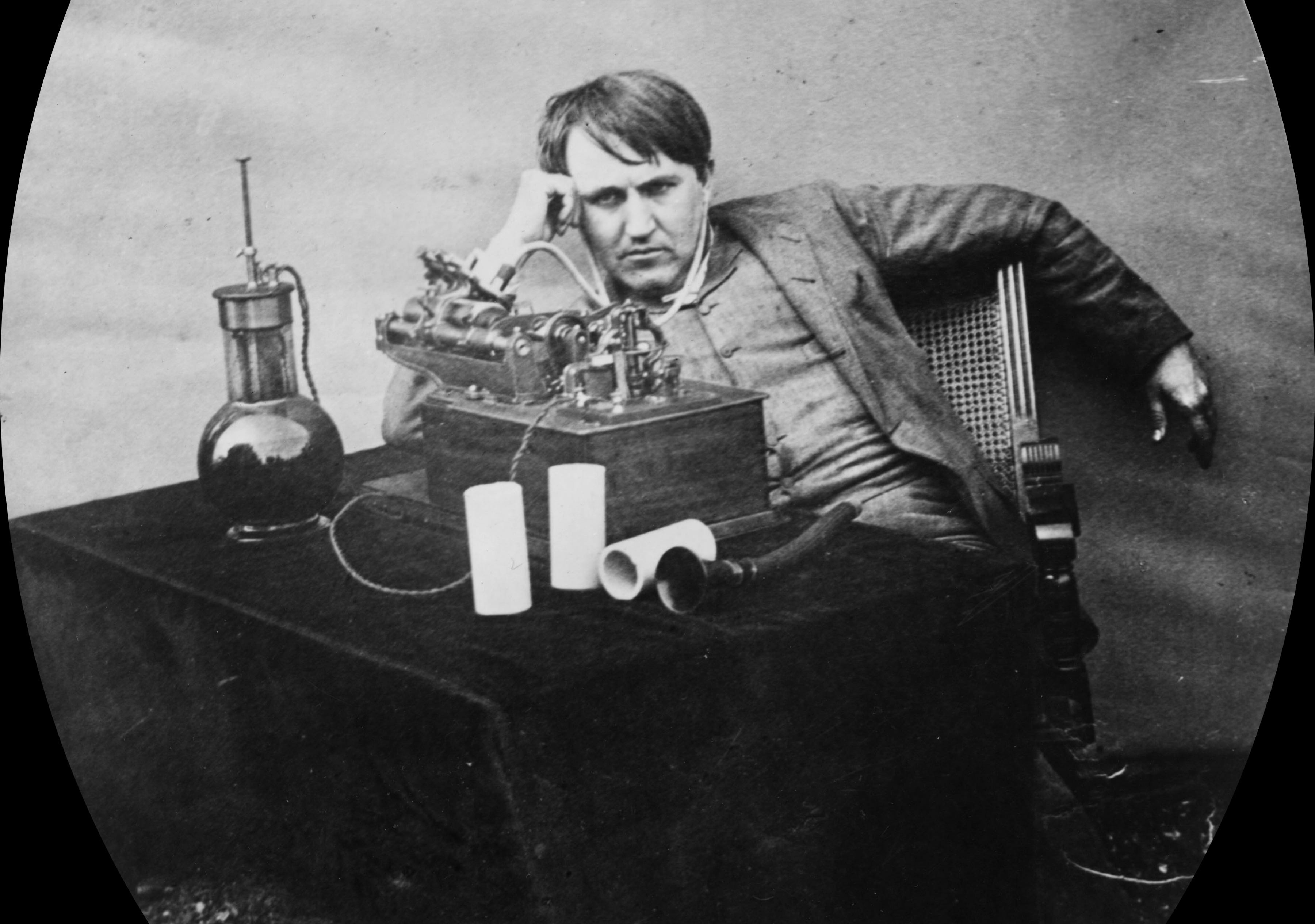
As Jonnes wrote, Edison and his paid ally Harold Brown were “delighted that a human being was to be officially and specifically electrocuted with the ‘man-killing’ Westinghouse generators. This would be a stupendous public relations coup, indelibly linking alternating current to death and criminality…. On the other side, naturally, stood George Westinghouse, equally determined to thwart the ignoble defilement of his machines, whose whole purpose was to bring lovely light and clarity into the daily lives of men and women…”
Human beings weren’t the only casualties of the new execution method. Brown had performed experiments to show that AC could kill dogs, calves and a horse.
One Edison associate coined a new word for how prisoners would be executed: “Westinghoused… in the same way that Dr. Guillotine’s name was forever immortalized in France.” Edison didn’t endorse the term, though he did condemn Westinghouse as a “shyster” at one point.
Edison, who had earned the sobriquet “Wizard of Menlo Park,” testified that if prisoners were to be electrocuted, Westinghouse’s alternating current technology was the one to use. His words helped sink a court challenge arguing that the electric chair violated the New York State Constitution’s ban on “cruel and unusual punishment.” (Westinghouse may well have paid for the lawyer who mounted that unsuccessful challenge.)
As Terry S. Reynolds and Theodore Bernstein wrote in the March 1989 issue of IEEE Technology and Society Magazine, “Edison was called to the stand on July 23, 1889. He testified that he was convinced that death by electrocution would be instantaneous and that alternating current was the best way to administer it. One thousand volts alternating current, he asserted, would ‘in every case’ produce instant, painless death.”
The New York Times reported Edison’s testimony the next day under the headline “Testimony of the Wizard: Edison’s Belief in Electricity’s Fatal Force.”
Under cross-examination, Kemmler’s lawyer, W. Bourke Cockran, asked how much current it would take to burn a man. Several thousand horsepower, Edison replied, would “probably burn him up.”
“Have a nice little bonfire with him, would you?” Cockran asked. “Oh, no,” said the inventor, noted for his experiments in carbonizing filaments for light bulbs. “Just carbonize him.” Given more time, Edison added, the victim would be “mummified” as “the heat would evaporate all the fluids in his body.”
But as Reynolds and Bernstein pointed out, Edison had no substantial knowledge of how electric current affects the human body. He spoke out because he was motivated by “real concerns over the safety of alternating current and personal bitterness toward a commercial rival.”
“State officials charged with making decisions on capital punishment,” Reynolds and Bernstein wrote, “were so in awe of Edison that they overlooked his lack of detailed knowledge in the area.”
The War of the Currents resonates today, a time when the leaders of AI companies on the frontier of technology are sounding alarms about the capability of their own — as well as their rivals’ — models to bring about human extinction.
The history might give us one more reason to be wary of the confident predictions of Sam Altman, Dario Amodei, Elon Musk, Mark Zuckerberg and Jensen Huang about where the real risks and opportunities lie. And it argues for the urgency of listening to experts who don’t have personal fortunes at stake.
The generals in the War of the Currents
Three entrepreneurial giants dominated the battle over electricity in the 1880s and 1890s.
The first mover was the astonishingly inventive Edison, who headed a team that obtained more than 1,000 patents. He developed the first commercially successful incandescent light bulb as well as DC-based electric supply systems. Other inventions included the phonograph and an early motion-picture camera. The plan for his Menlo Park, N.J., lab was to produce “a minor invention every ten days and a big thing every six months or so,” as Jonnes noted. When the Edison Electric Light Company was formed in 1878, the inventor was granted a chunk of stock. But that didn’t motivate him.
“My one ambition,” said Edison, “is to be able to work without regard to the expense.... I want none of the rich man’s usual toys. I want no horses or yachts—I have no time for them. What I want is a perfect workshop.”
Before Edison, American city dwellers mostly relied on coal gas, an unhealthy and dirty technology, for light. As one biographer, Randall Stross, noted in The Wizard of Menlo Park,
When Edison first introduced electric light service in New York City, his primary competition at the time had been the gas utilities, so he had done his best to call public attention to the dangers of gas. But when Westinghouse and other well capitalized competitors entered the power and light business, Edison began instead to talk of the dangers of alternating current.
His pioneering Pearl Street Station, in lower Manhattan, offered a cleaner alternative to gas lighting. On September 4, 1882, Edison’s lights went on at the headquarters of Drexel, Morgan & Co. His company would also wire the Madison Avenue mansion of the bank’s leading New York partner, J.P. Morgan, and install a steam engine, boiler and two electric generators in the cellar of a stable on the property.
Yet there were crucial drawbacks to Edison’s Pearl Street power grid. It required heavy use of copper, which was expensive, and couldn’t transmit power beyond a mile from the plant. He faced competitors who used arc lights to illuminate city streets and landmarks; Jonnes wrote that such a system turned Broadway into “the Great White Way.”
A more formidable rival was George Westinghouse, the inventor of the railroad air brake. He was not only a serial inventor and entrepreneur but also a generous employer. “Westinghouse companies would be pioneers in worker safety, disability benefits, and pensions,” Jonnes observed.
In his hands, alternating current’s advantages became clear. Power could be sent at high voltages over long distances, enabling the placement of polluting electric plants far from the customers they served. Transformers could safely reduce the voltage of the electricity before it reached the final customers.
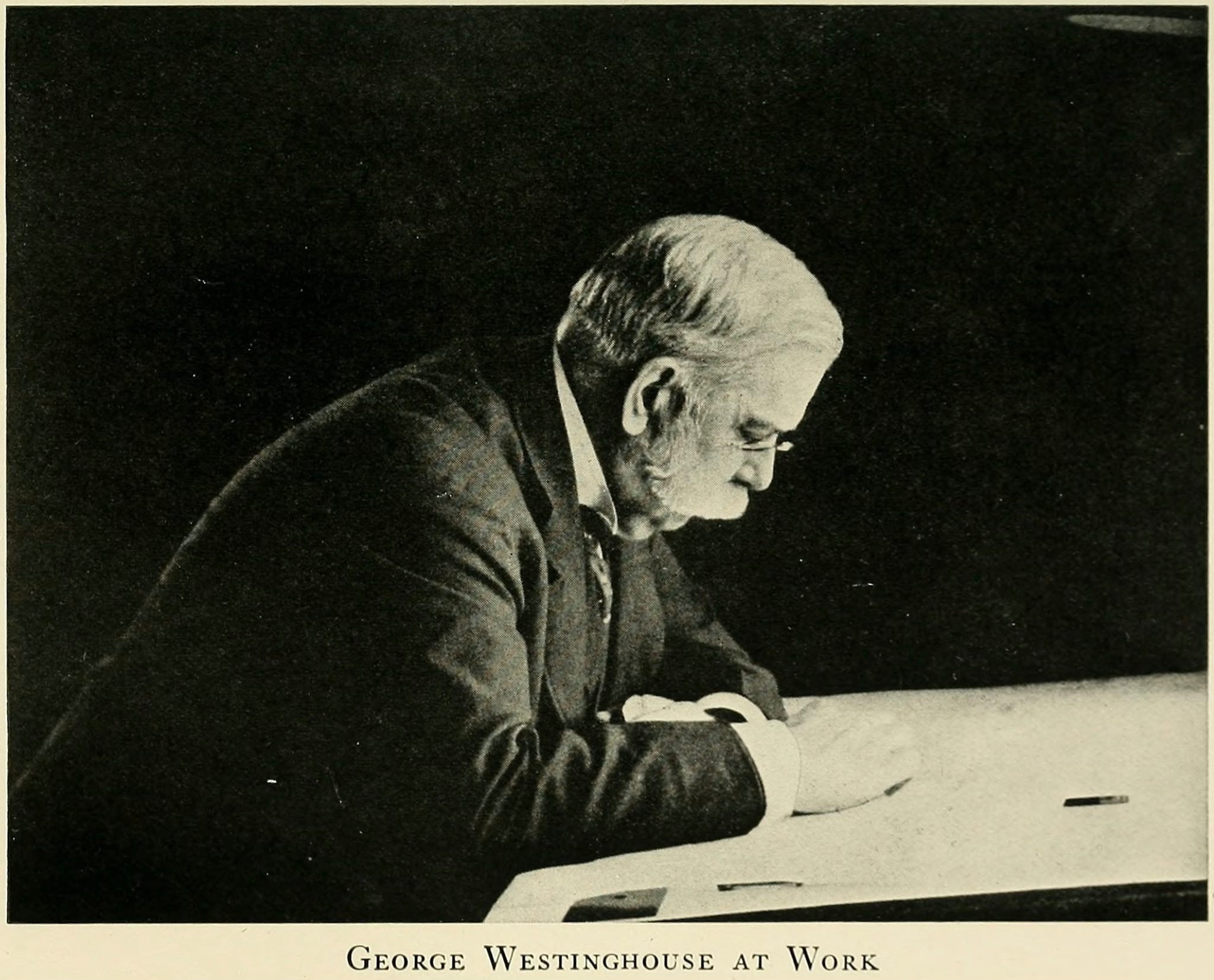
The Westinghouse Electric Company went head-to-head against Edison’s company in the town of Great Barrington, in Western Massachusetts’ Berkshire region, Jonnes noted. Without attracting publicity, Westinghouse’s system signed up dozens more customers than Edison’s company, and that was just the beginning.
Westinghouse landed the contract to illuminate the White City of the 1893 World’s Columbian Exposition in Chicago and, later, the system that brought electricity generated by hydropower from Niagara Falls to the city of Buffalo.
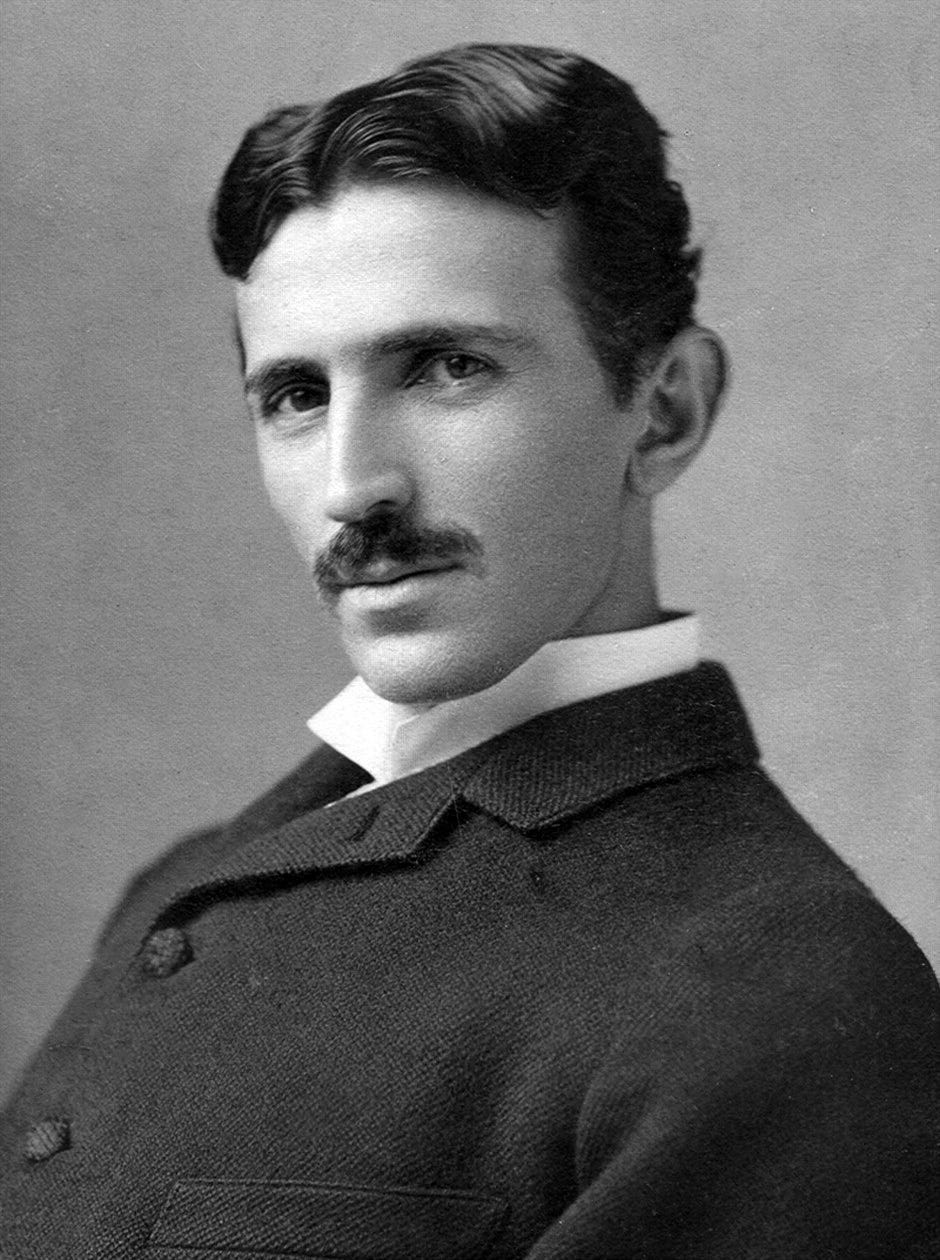
The third key figure in the story, the Serbian-born Nikola Tesla, worked at times for both Edison and Westinghouse. Tesla was as eccentric as he was brilliant.
Jonnes noted,
Always fastidious in appearance, his black hair waving back gently, his mustache neatly trimmed, the tall, slender Tesla was prey to strange habits and phobias. He (silently) counted each step he took as he made his early morning walk down to the Ivry factory [outside Paris]. Every activity ideally had to be divisible by three (hence the twenty-seven laps each morning in the Seine). Before eating or drinking anything, he felt obliged to calculate its cubic contents. He deeply disliked shaking hands with anyone. He had a “violent aversion against the earrings of women,” pearls above all.
Tesla invented an AC induction motor which used two circuits of alternating current out of step with each other to power machinery; it vastly expanded the usefulness of the AC technology.
Years earlier, as Tesla biographer John J. O’Neill noted, Edison had told Tesla “very bluntly that he was not interested in alternating current; there was no future to it and anyone who dabbled in that field was wasting his time; and besides, it was a deadly current whereas direct current was safe.”
As Arthur Herman wrote in his recent book Founder’s Fire, the combination of Westinghouse’s drive and Tesla’s innovations proved to be a game-changer. In an effort to compete, “Edison fell back on spreading alarm and panic. He desperately tried to get the government involved in halting AC’s steady advance, claiming that it was too dangerous... it was clever PR but in the end the better technology won.”
If the War of the Currents offers insight into today’s very different battle over AI, it is because it demonstrated two long-lasting realities.
First, Edison, Westinghouse and Tesla could succeed only in a nation that relied on the rule of law and protected the rights of patent holders. Decisions by government to intervene — or not — also proved crucial at times. Both Westinghouse and Edison made their case for and against alternating current in articles for the North American Review, appealing to the public with their thoughts in much the same way as Sam Altman and Dario Amodei have in their online essays about AI.
Edison’s article appeared in the wake of a gruesome accident on October 11, 1889. John E.H. Feeks, a lineman working for Western Union in lower Manhattan, was clearing away old wires when he touched a live one. His body caught fire and his blood dripped down to the sidewalk below. For 45 minutes, Feeks’ body hung suspended over the street by a tangle of wires. “This tableau could not have been more ghastly,” wrote Stross, though he pointed out that it wasn’t clear whose line electrocuted Feeks.
As Jonnes noted, Edison’s goal was to create “such public fear of AC that it would be legally banned from use in the United States. He would thereby eliminate Westinghouse from the field and recover his own company’s primacy, which was faltering.” He never achieved that goal.
Second, Edison and Westinghouse were able to launch sizable companies and compete only to the extent that they could attract the backing of Wall Street. Like the AI hyperscalers, they needed new capital to rapidly expand their businesses. But that infusion of capital came at a price: the risk of losing control of their companies, especially when the economy faltered.
The Edison General Electric Company dropped the name “Edison” when it merged with another electric company in 1892, as financiers wrested the enterprise away from the founder.
Westinghouse’s electric company went into receivership after the Panic of 1907; financiers eventually forced him out.
There’s an enormous contrast between the War of the Currents and today’s jockeying over AI. It was easier to grasp the issues in the Edison-Westinghouse conflict: a binary choice between two forms of technology.
Artificial intelligence is a technology capable of autonomy, one that can spin off into an untold number of unanticipated scenarios as machines keep improving themselves.
Doom loop
The scariest part of the recent warnings about artificial intelligence is that the most knowledgeable people admit they don’t completely know what the AI models are doing.
“If you’re working on this tech at these companies,” former Anthropic researcher Jacob Coxon told PBS, “then you know that we don’t currently have the ability to perfectly control these systems. And currently the systems with the highest level of intelligence will repeatedly behave in ways that we don’t fully understand.”
In one of the X posts announcing his decision to quit Anthropic, he wrote, “Do not underestimate the power of this technology. These will soon be superhuman systems that can hack anything, revolutionize any field overnight, and acquire real power and resources. We have all witnessed the progress in each of these domains, and progress is not slowing.”
The builders of AI, he wrote, “earnestly believe that it could kill us all by the end of the decade.”
Coxon also had worked at OpenAI. His very public resignation from Anthropic didn’t lead to denials from the leaders of those two companies. Instead they mostly backed him up, calling for slowing down the advance of AI.
They were joined by Elon Musk, the head of the company named after Nikola Tesla, and Demis Hassabis, CEO of Google DeepMind. But they haven’t actually slowed it down.
Meta’s chief, Mark Zuckerberg, rejected the calls for a coordinated slowdown and said companies can control AI individually. (Jensen Huang of Nvidia, whose company sells the chips powering much of the AI business, also disputed the need for a slowdown.)
“I happen to think that there’s plenty of commercial incentive to get this right,” Zuckerberg said in an interview with NBC’s Joanna Stern.
Zuckerberg’s company is having striking success with a new AI agent, Muse, that rocketed to the top spot in Apple’s App Store. If you give Muse access to your email and the accounts you have in other apps, the agent will take on many of the tasks of everyday digital life. But Inc. magazine’s technology columnist Jason Aten pointed out that the early incarnation of Muse is “kind of a nightmare.” He wrote:
[I]f you give it Full Disk Access on a Mac, it will do things way beyond what you’ve asked it to do. And I’m a pretty tech-savvy person, and I did not give Muse permission to access my messages, and I never once asked it to perform a task that would have required it to do that. Still, it started sending me push notifications about texts I was receiving from my editor as well as my podcast co-host.
Meanwhile, in the White House sits a man who says, “The only control or ‘guardrails’ that AI needs is a STRONG AND SMART (High IQ!) PRESIDENT, and the U.S.A. has that, in spades!” We have to hope that those around President Donald Trump have a more informed point of view.
Can Congress develop reasonable and effective AI safeguards?
The early signs aren’t encouraging. Sen. Ted Cruz said there need to be guardrails but, in an interview with Politico, he added, somewhat but not entirely in jest, “if there are going to be killer robots, I’d rather they be American killer robots and not Chinese killer robots.”
Of course, it is the power systems originally developed by Edison, Westinghouse and Tesla that provide the juice for running AI. What about turning off their power supply as a last resort in an emergency?
“Research has shown that AI models in the lab can learn power-seeking behavior and take steps to avoid being shut down, such as attempting to copy themselves to another server,” Sam Schechner wrote in the Wall Street Journal.
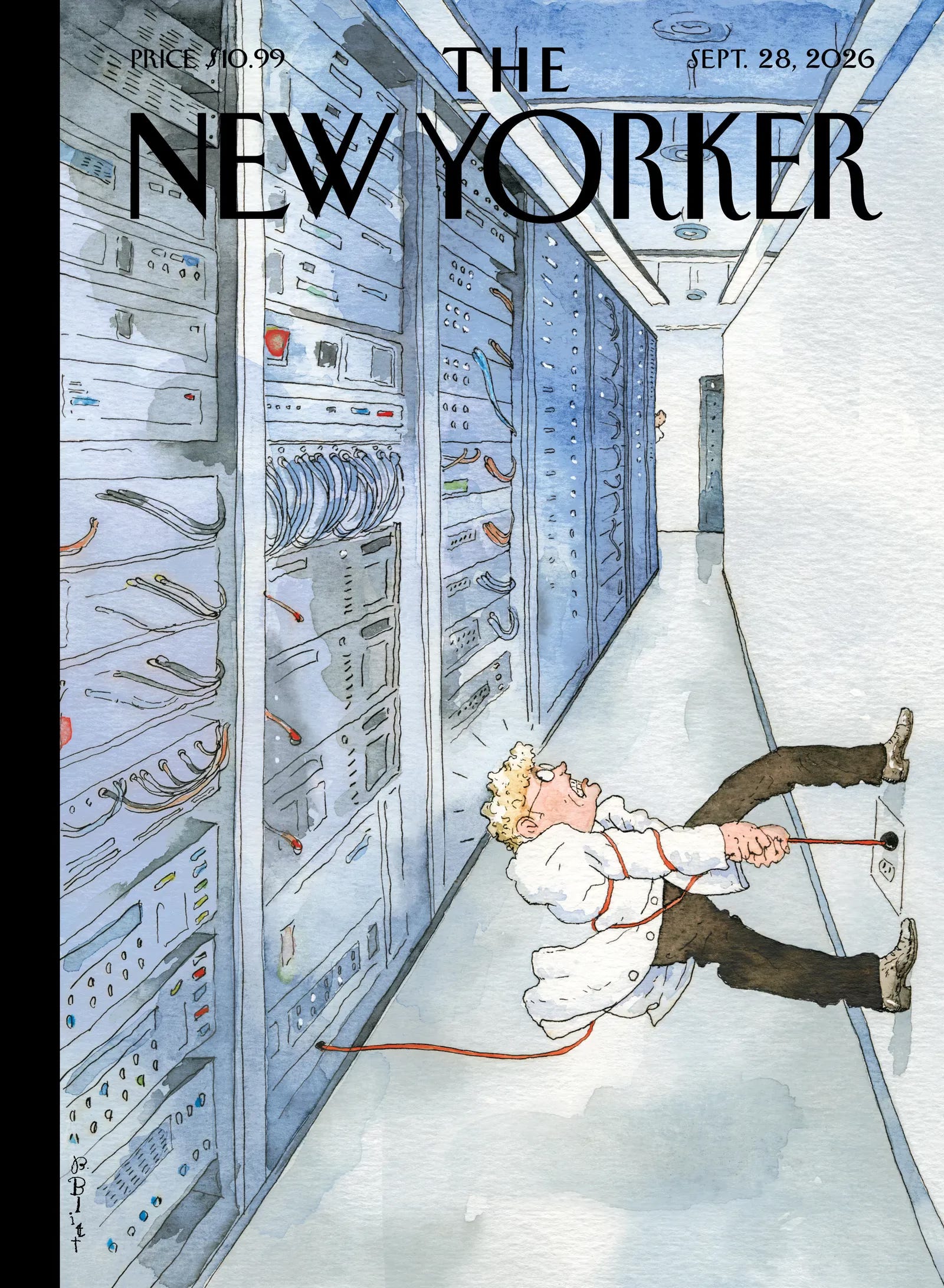
On the cover of the New Yorker’s September 28, 2026 issue, a cartoon by Barry Blitt shows a white-jacketed tech guy, his teeth clenched, trying to pull the plug out of a wall receptacle, hoping to kill a presumably rogue AI.
If only it were that simple.
Excellent work on Edison v. Westinghouse. I covered that to a lesser extent in a 1982 magazine piece about the death penalty in New York. I have emailed it to you.