

When Vice President Hubert H. Humphrey wrote two memos opposing escalation of the Vietnam War in 1965, President Lyndon B. Johnson froze him out of regular policy meetings on the topic.
In May that year, LBJ spotted the vice president entertaining reporters on a presidential yacht in the Potomac River. He ordered Humphrey “to have his military aide, Colonel Herbert Beckington, forward all future requests for use of presidential ships and planes to White House aide Marvin Watson for Johnson to check ‘yes’—or ‘no,’ as he sometimes did,” wrote Arnold A. Offner, in Hubert Humphrey: The Conscience of the Country.
LBJ also ordered wiretaps on Humphrey’s office and condominium, as the vice president would soon learn.
Humiliation.
That’s the word invariably used to describe LBJ’s treatment of Humphrey.
Yet it’s also a term that aptly describes the way Johnson was treated by the John F. Kennedy White House when he was vice president. Kennedy’s aides kept him out of key meetings, vetted his speeches in advance and made him get prior approval for flights on government aircraft.
LBJ inflicted the same kind of cruelty on his own vice president. “Johnson routinely belittled and ridiculed Humphrey to aides and to reporters,” wrote James Traub, in True Believer: Hubert Humphrey’s Quest for a More Just America. “Humphrey knew this, and it made him live in fear of the president. It made him compliant; and perhaps that was the ultimate goal of the hazing.”
Humiliation is also the word that comes to mind after President Donald Trump clipped the wings of his vice president last week. J.D. Vance had been in touch with Iranian officials to seek a negotiated end to the war. Trump upended that effort with a Truth Social post at 8:07 a.m. on November 12. “I have asked Vice President Vance to focus his complete and total attention” on fraud the president claimed is occurring in Democratic-run cities and states, Trump said, adding, “We don’t need a deal with Iran.”
Like Humphrey, Vance had dared to flirt with daylight — an independent position on an unpopular war — and like Humphrey, he paid a price for it.
One key difference is that Humphrey’s dissent from Johnson’s Vietnam policy remained confidential; Vance’s private opposition to the war leaked. And in a post on X immediately after Republicans were routed in the midterm elections, Vance went further. He wrote, “The reason we lost is the war. The president himself said so last night. If you’d like to argue it was worth it, that losing the Senate for the next 6 years was worth it, then do so. Argue it was a worthwhile cost to pay. Agree or disagree, that’s at least honest.”
Asked about Vance’s critique, Trump responded that “a lot of people didn’t like his comments. But not me.”
Why should we care about the friction between Trump and Vance, and between Johnson and Humphrey, indeed between all presidents and their veeps? The dynamics not only can affect wars and government policy but also play a key role in presidential succession.
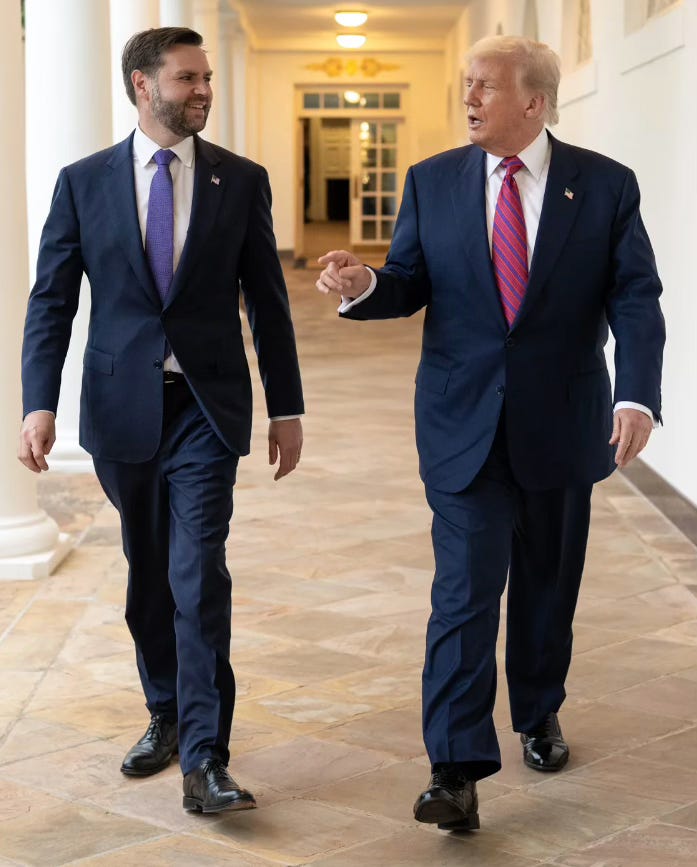
That seemed especially clear in the 1960s, as it does in the 2020s. In both decades, the presidential ambitions of three vice presidents took center stage.
President Dwight Eisenhower’s vice president, Richard M. Nixon, ran for the White House and lost in 1960, then won the presidency in 1968. He had survived Eisenhower’s suggestion that he take a Cabinet post rather than run again for the vice presidency on the 1956 ticket and, in 1960, had been humiliated by Eisenhower’s response when asked for a “major idea” of Nixon’s he had adopted: “If you give me a week, I might think of one. I don’t remember.”
Vice President Johnson became president when John F. Kennedy was assassinated in November 1963. And Vice President Humphrey became the Democratic Party’s candidate for president, inheriting the Vietnam controversy, when LBJ dropped out of the 1968 campaign.
In our own decade, President Barack Obama’s vice president, Joe Biden, won the 2020 race. Biden’s vice president, Kamala Harris, replaced Biden on the Democratic ticket in 2024 (and like Humphrey, briefly tried to focus her campaign on “the politics of joy”).
If Vance runs in 2028, he will be seeking to become only the second vice president since Martin Van Buren in 1836 to immediately succeed a two-term president (George H. W. Bush did it in 1988).
The single arrow
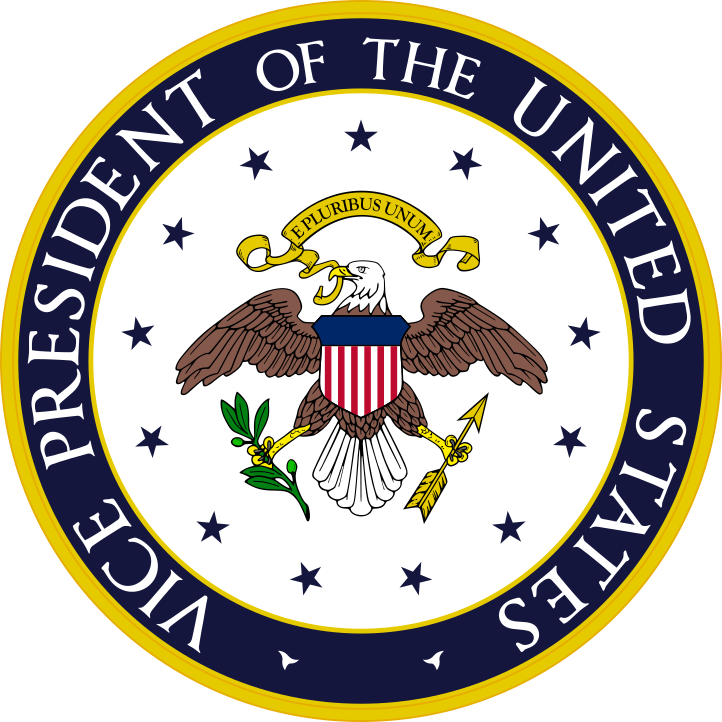
“Look closely at the eagle of the Vice Presidential seal,” Hubert Humphrey told Newsweek columnist Emmet John Hughes in 1966. “It holds just one arrow. The President’s clutches a whole phalanx. And there you have the measure of this office: great responsibility, no authority.”
As Offner noted, Humphrey knew from experience the arrows presidents have in their quiver: the ways they can marginalize and ridicule their vice presidents. The biggest arrow, he realized, was that LBJ could pick someone else as his running mate if he ran for reelection in 1968.
When Humphrey finally declared his independence from Johnson in a September 30, 1968 speech in Salt Lake City, “the Vice-Presidential seal and flag were conspicuously absent,” R. W. Apple reported in The New York Times, “and Mr. Humphrey was introduced not as the Vice President but as the Democratic candidate for the Presidency.” Apple noted that Humphrey’s team wanted “the peace faction in the Democratic Party” to view his speech as a “break with the Johnson administration.”
(In 1975, Vice President Nelson Rockefeller complained that the seal’s eagle looked like a “wounded quail” and persuaded President Gerald Ford to approve a new emblem with 13 arrows.)
Origin story
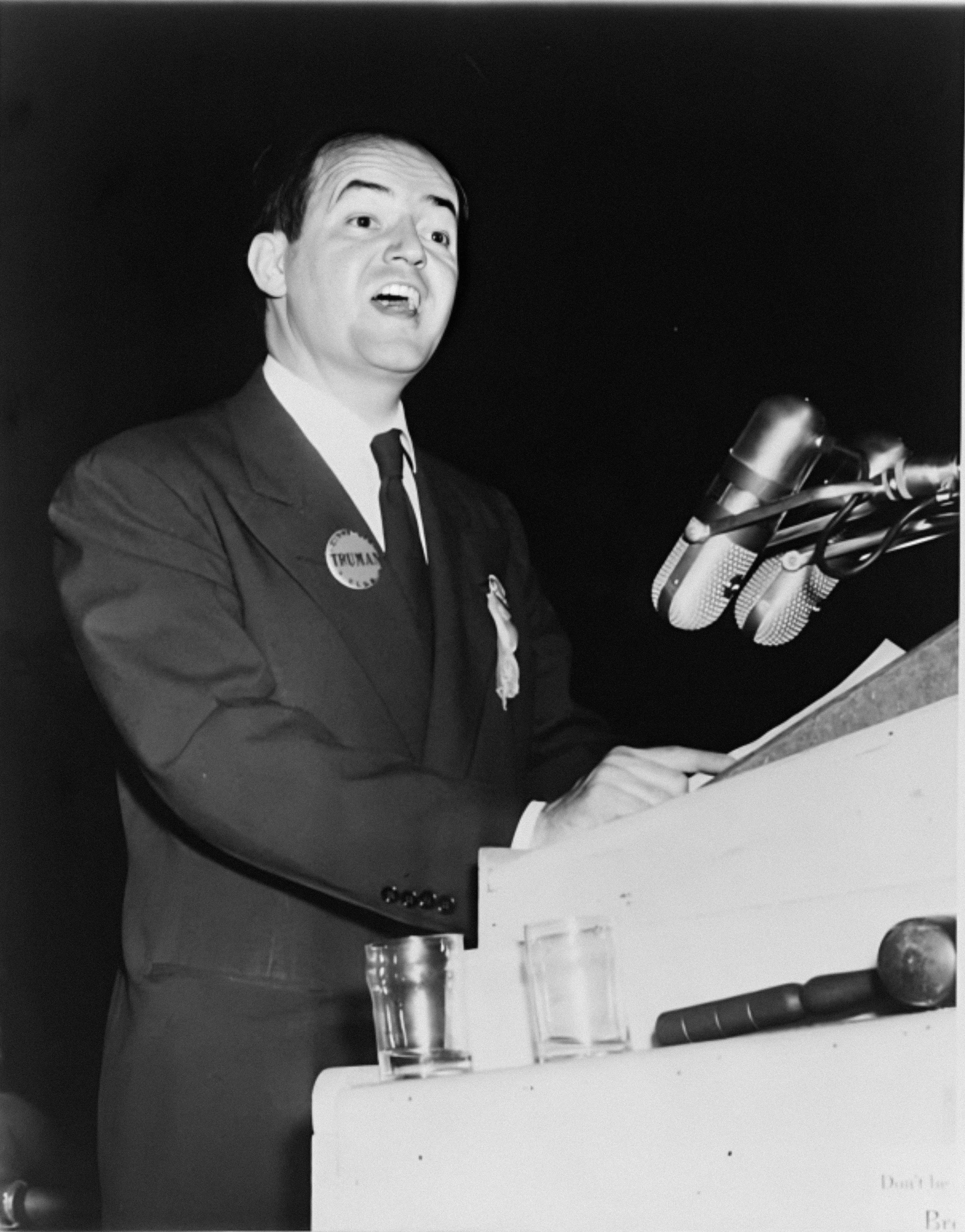
Humphrey and Vance both arrived on the national scene in their 30s: Vance with his memoir Hillbilly Elegy and Humphrey with a speech that turned out to be far more consequential than his Salt Lake City one. At the 1948 Democratic National Convention in Philadelphia, he deplored the rejection of a robust civil rights plank in the party platform. The then-mayor of Minneapolis insisted that the push for justice could not be diluted or postponed:
My friends, to those who say that we are rushing this issue of civil rights, I say to them we are 172 years late…The time has arrived in America for the Democratic Party to get out of the shadow of states' rights and to walk forthrightly into the bright sunshine of human rights.
He got results. Delegates voted to approve the civil rights plank. As historian Luke A. Nichter noted in his book The Year That Broke Politics, “For the first time since Reconstruction, the status of African Americans became a national issue.”
When Humphrey took office as vice president in 1965, he was a leader of America’s liberal establishment, no longer the 37-year-old who electrified the 1948 convention. Still, he remained committed to progressive causes and had enormous credibility with the left wing of the party. He had been instrumental in the passage of the 1964 Civil Rights Act.
While Johnson was mulling whom to choose for the vice presidency, he asked Humphrey to help dispose of a challenge by the Mississippi Freedom Democratic Party to the state’s all-white delegation to the 1964 convention. Sixteen years after making his all-out call for civil rights, Humphrey was thrust into the role of stamping out a protest that was all about securing equal rights. The resulting delegate compromise plan pleased no one and tarnished Humphrey’s image; but he got the vice presidency.
Weeks earlier, Johnson had told his adviser Jim Rowe that to obtain the nomination, Humphrey would have to promise to support Johnson’s views “all the way with me.” He added, “If he don’t want to be my wife, he don’t have to marry me,” as Traub wrote. In a phone call, Humphrey promised “complete loyalty” to Johnson, “unqualifiedly, personally, and with all the sincerity in my heart.”
Such fealty was what LBJ demanded, and yet Humphrey’s willingness to subordinate himself so thoroughly could only have reinforced the president’s view that his new vice president wasn’t tough enough for the top job.
For his part, Humphrey recognized how much he owed Lyndon Johnson. “I’m Vice President because he made me Vice President,” he told reporters in 1967. “Humphrey also felt indebted to Johnson,” Offner wrote, “for easing his initial pariah-like isolation imposed by the Senate’s Old Guard southerners, putting him on the prestigious Foreign Relations Committee in 1953, and helping him become majority whip in 1961.”
Difference over Vietnam
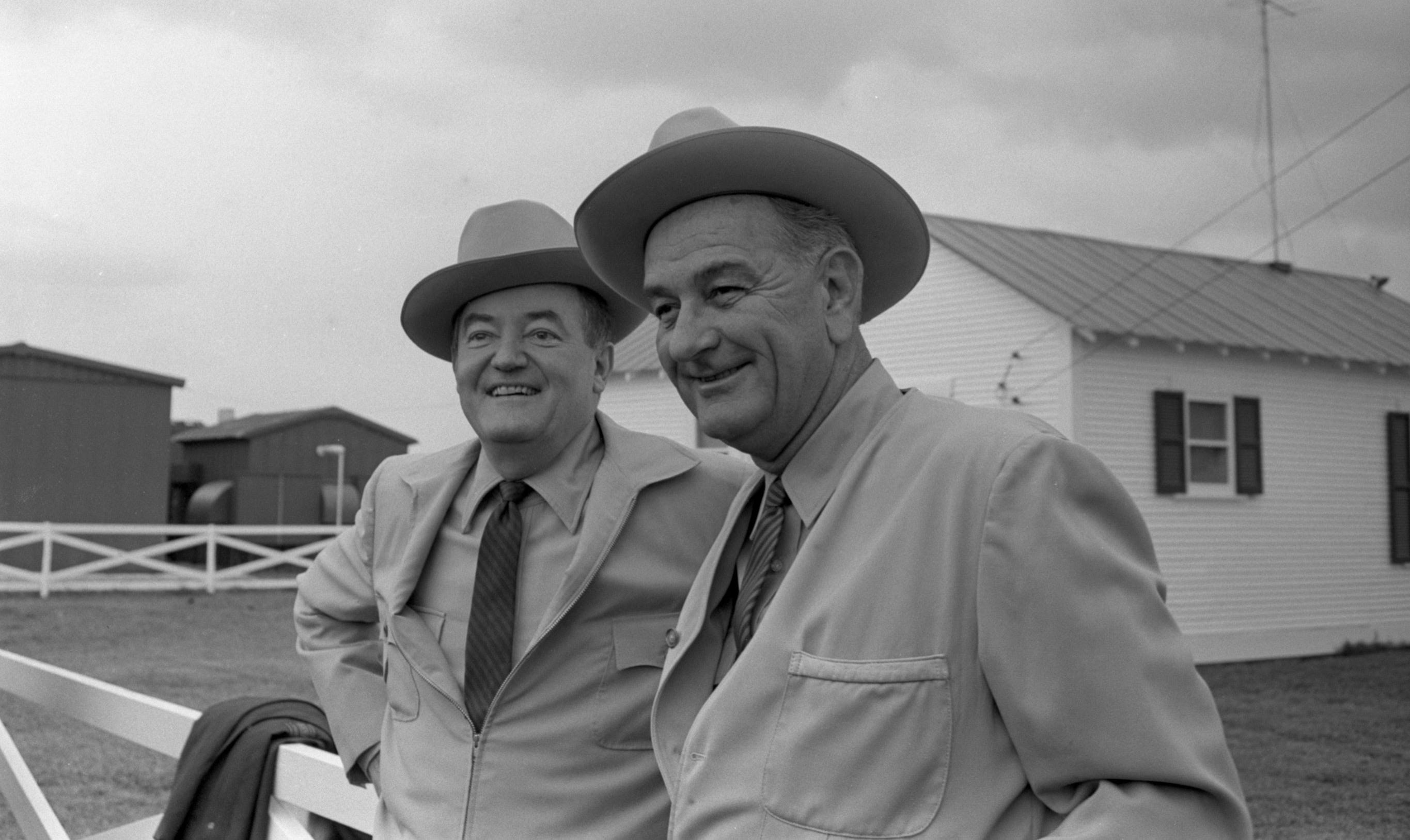
Yet the loyal Humphrey didn’t share LBJ’s views on the Vietnam War. In the first of his memos to Johnson in 1965, as described by Offner, “Humphrey said it was hard to justify ‘large-scale U.S. air bombardments’ across borders in response to ten years of ‘small scale terror’ that looked largely like a ‘civil war in the South.’” Johnson was “infuriated” by the memo, according to Humphrey; the president wrongly suspected that it was written to be leaked eventually, distancing the vice president from hawkish policy steps.
“The president now made it brutally clear to Humphrey that his foreign policy role did not include expressing his own opinion,” Nichter wrote.
Wounded by the president’s reaction, the isolated, emotionally fragile Humphrey pivoted; to win back LBJ’s favor, he began speaking publicly in support of the war’s escalation. Even in private, his cheerleading was embarrassing.
“Humphrey wrote Johnson that his July 27 announcement ordering the First Air Cavalry Division and supporting forces into Vietnam — with ‘additional forces to be sent later’ — was ‘tremendous’ and that he could not have been ‘happier if Christmas came every day,’” Offner wrote.
“Humphrey was highly dependent emotionally on Johnson’s goodwill,” Offner added. “He was extremely happy when Johnson gave him a watch and some ‘wonderful pictures’ for his birthday in May 1966 and invited him for breakfast or afternoon talks at the White House and both Humphreys to private dinners.” The vice president gushed to his wife about being back in Johnson’s good graces and feeling as if he were the president’s son.
Johnson drops out
Concerned about his health and a family history of stroke and heart disease, Johnson did not want to follow in the path of his father, who had suffered a stroke and later died of heart disease at 60, the age Johnson would be in August 1968. He also worried that he could not unite the country, which was being riven by the debate over Vietnam.
On March 31, Johnson attended mass at St. Dominic’s in Washington. In the presidential limousine with his daughter Luci and her husband Pat Nugent, he read them the words he planned to say to the nation. Then they drove to Humphrey’s apartment, where Johnson told the vice president that he would be announcing his withdrawal from the race that night.
Nichter wrote:
Jim Jones, the future Oklahoma congressman, was there and remembered Humphrey’s reaction. “He was just defeated from the start,” Jones said. “His face flushed, and tears ran from his eyes.” ‘You can’t do this. You can’t resign from office. You’re going to be re-elected,’ Jones recalled Humphrey telling Johnson. ‘There’s no way I can compete against the Kennedy machine.’
Senator Robert F. Kennedy had entered the race two weeks earlier, after Senator Eugene McCarthy’s antiwar campaign earned a surprising 42% share of the vote in the New Hampshire primary.
In his March 31 Oval Office speech, Johnson reviewed the state of the war and announced that the U.S. would unilaterally halt bombing over most of North Vietnam in hopes of prompting negotiations to end the war. Near the conclusion of the broadcast, he said:
With America’s sons in the fields far away, with America’s future under challenge right here at home, with our hopes and the world’s hopes for peace in the balance every day, I do not believe that I should devote an hour or a day of my time to any personal partisan causes or to any duties other than the awesome duties of this office — the Presidency of your country.
Accordingly, I shall not seek, and I will not accept, the nomination of my party for another term as your President.
Humphrey’s world was upended. By slavishly defending Johnson’s Vietnam policy, he had put himself outside the mainstream of liberal opinion and signed on to an overly rosy view of a war that was growing more and more unpopular.
South Vietnam’s corrupt government lacked the popular support gained by the insurgent Viet Cong. There was little sign that U.S. forces could turn that around — or blunt the determination of North Vietnam to win. But as Offner noted, Humphrey became a hawk through “willful mind over matter….Humphrey wanted the outcome in Vietnam to reflect genuine nation building and democratic advancement so badly that he forced himself to see such results wherever he went, despite the reality before him. This was self-delusion.”
While Johnson had dropped out of the campaign, he did not withdraw from politics. He secretly implored New York Gov. Nelson Rockefeller to run as a moderate Republican. He stayed neutral in the Democratic nomination battle and maintained cordial relations with the Republican candidate, Richard Nixon. As Nichter noted, the Rev. Billy Graham quoted LBJ confiding to him that Nixon was probably the “best qualified man in America to be president.” Nixon avoided direct criticism of Johnson’s policies on the war.
Humphrey soldiered on in the fight for the nomination through one of the most tumultuous years in American history, one that included the assassinations of Martin Luther King and Robert Kennedy and raucous protests brutally suppressed by police outside the Democratic National Convention in Chicago.
Vietnam dogged Humphrey. Protesters greeted the vice president’s campaign appearances with chants of “Dump the Hump.” On occasion, Offner recounted, “Humphrey bellowed ‘shut up’ at his opponents, only to have them respond, with a bullhorn, that ‘Vietnam is a scream [of death] that does not end’ and that they had come to arrest and try him for ‘crimes against humanity.’”
After the Democratic National Convention, Humphrey trailed Nixon badly in the polls, with third-party candidate George Wallace siphoning off votes. He knew that his only chance to win lay in establishing daylight — a perception of independence from LBJ on Vietnam.
Thus in his Salt Lake City speech, Humphrey declared, “As President, I would stop the bombing of the North as an acceptable risk for peace because I believe it could lead to success in the negotiations and thereby shorten the war. This would be the best protection for our troops.” He held out hope that the U.S. could start withdrawing its forces from Vietnam in 1969.
In October, Humphrey made up ground in the polls, but not enough to offset Nixon’s lead. The Republican won 301 electoral votes to Humphrey’s 191 and Wallace’s 46. Nixon’s edge in the popular vote was far smaller — 31,783,783 to Humphrey’s 31,271,839 and Wallace’s 9,901,118.
“The electorate was denied a true debate on Vietnam,” Luke Nichter wrote. “Only Humphrey, the candidate most allied with Johnson’s administration, broke from Johnson’s policy, and he did it late and not everyone believed in his sincerity or conviction.”
Awkward
It was a prime example of the dilemma ambitious vice presidents face. “A sitting vice president has the awkward task of defending the president’s agenda,” wrote Nichter, “otherwise they will likely lose the president’s support and be criticized for accepting policies they did not believe in. Yet the same candidate must also argue the president’s agenda was incomplete. It is difficult in such a campaign to organize around a meaningful theme.”
The daylight problem plagued the 2024 Democratic presidential candidate. In October that year, Vice President Kamala Harris said on The View that she couldn’t cite anything she would have done differently than President Joe Biden during their four-year term, other than inviting a Republican to serve in her Cabinet.
If J.D. Vance decides to run, he’ll face the same question. By all indications, he will likely continue to publicly embrace Trump’s positions, however he may differ from them privately. Trump’s hold on the hard core of his political base makes it particularly tricky for Vance, lest he provoke the president’s outright opposition.
In an interview that aired Monday night on Fox News, Vance told host Laura Ingraham that “there’s no daylight” between him and the president over the Iran war.
Whatever Trump “ultimately decides to do,” Vance said, “however he ultimately decides to bring the conflict to a close, he is not going to let this become a forever war.” Vance argued that the people blaming him for the stalled negotiations with Iran “don’t have the courage to criticize the president, so they criticize the vice president…I’m happy to be a heat shield for the president of the United States.”
The problem for Trump and Vance bears a resemblance to the problem faced by Johnson and Humphrey: North Vietnam’s leaders in 1968 were no more likely than the leaders of Iran are today to concede that they had been defeated by the U.S. military’s campaign.
How do you prevent a war from going on forever if the other side won’t concede?
And there’s a question specifically for Vance: How do you show you are fit for the White House two years from now if you declare that there’s no daylight between you and an unpopular president?
Thanks for an excellemt description of the struggles of HHH. I will make it a point to read Hubert Humphrey: The Conscience of the Country, if only to apologize to Humphrey for voting by mail for Nixon in 1968, when I was living in Chunchon, Korea, wearing combat boots, and not thinking straight.