
King Charles, Queen Camilla and the Horrible Heffalump
We love the U.K. but they still can't have Winnie-the-Pooh
When British Prime Minister Tony Blair visited the U.S. in 1998 to meet with President Bill Clinton, his fellow Labour Party MP Gwyneth Dunwoody sensed an opportunity.
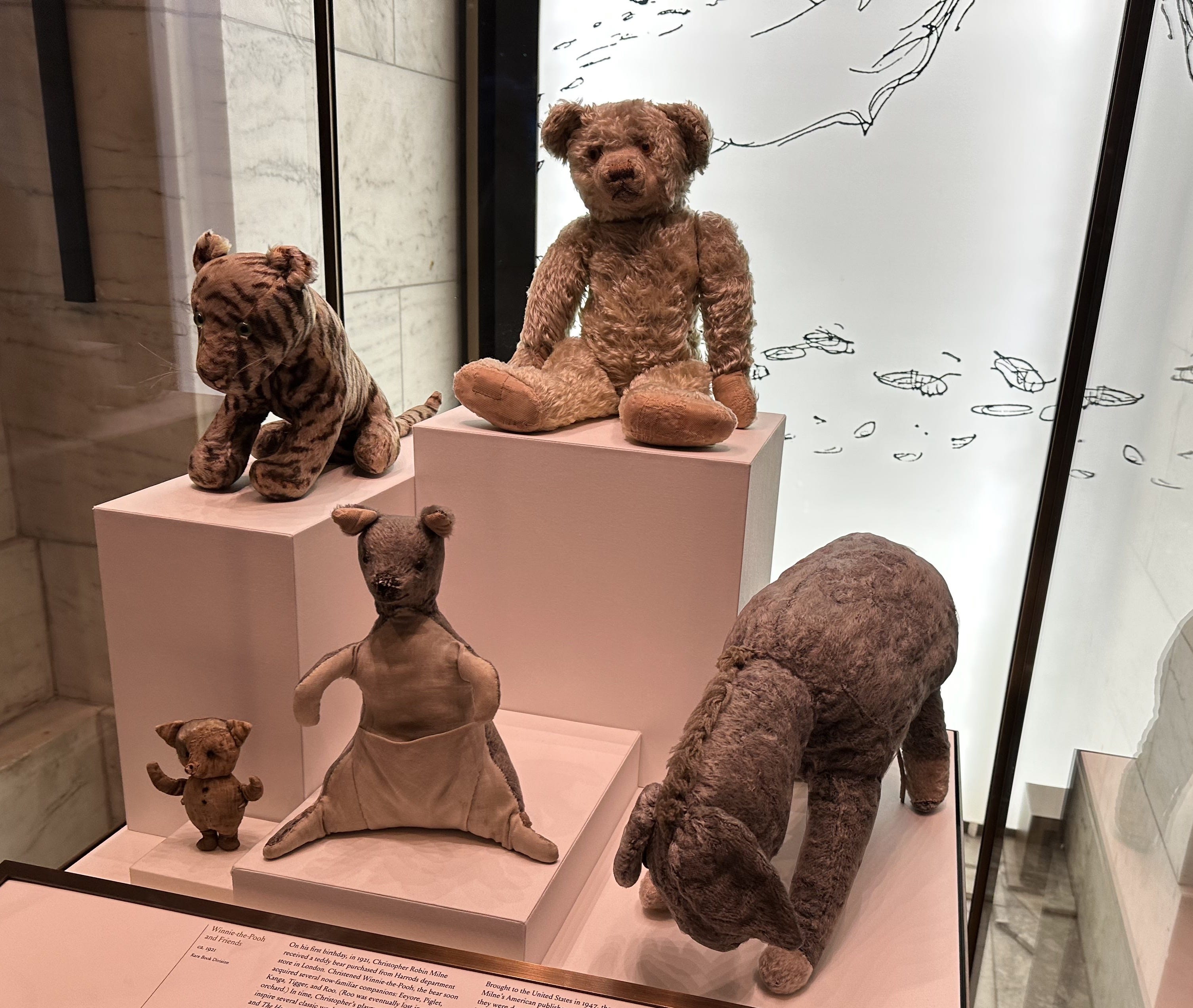
She called on the prime minister to demand the return to the U.K. of the stuffed animals that inspired the characters in Winnie-the-Pooh, A. A. Milne’s immortal children’s book. The author bought the bear from London’s Harrods department store as a first-birthday gift for his son, Christopher Robin, who would become the central human character in the stories.
Pooh and the others were then residing at the Donnell Library, part of the New York Public Library system. “I saw them recently and they look very unhappy indeed,” Dunwoody said. “I am not surprised, considering they have been incarcerated in a glass case in a foreign country for all these years.”
She compared the imprisoned Pooh and friends to the frieze from the Parthenon that Britons stubbornly retain despite requests from Greece for its return.
“Just like the Greeks want their Elgin marbles back so we want our Winnie the Pooh back, along with all his splendid friends,” Dunwoody observed. “This is where they belong. They plainly want to come home after 70 wasted years exile.” Milne’s U.S. publisher had donated the toys to the library.
In what may have been an early sign that Tony Blair would function as “America’s poodle,” the prime minister signaled complete indifference to the fate of the Pooh stuffed toys. “I’m sure they are perfectly well looked after where they are,” he said.
This week, as part of the centenary of Winnie-the-Pooh’s publication, Queen Camilla is compounding Blair’s crime by visiting the public library to donate a stuffed animal representing Roo, the baby kangaroo in Milne’s tales and to call attention to her charity, the Queen’s Reading Room. The original “Roo was lost in an apple orchard,” according to an inscription at the public library. The new Roo will join Pooh, Eeyore, Piglet, Kanga and Tigger.
Since 1998, the stuffed creatures have moved up in the world, to the library’s landmark home on Fifth Avenue and 42nd St. The scruffy creatures still sit in a glass box. But they’re in a gallery of “Treasures,” where Charles Dickens’ writing desk and copies of the Gutenberg Bible and John James Audubon’s The Birds of America are displayed.
Tigger is in fairly good shape, but Winnie and the others look like they’ve just lost a bar fight or emerged from a washing machine. The library explains, “Not only Christopher Robin played with the toys; so, apparently, did the family dog, which may have contributed to their well-worn appearance.”
New York’s mayor appeared diffident about the royals visiting New York Wednesday but couldn’t help sharing his thoughts on who should own a different treasure. Jeff Mays of The New York Times reported, “When asked what he would tell the king if they spoke, Mayor Zohran Mamdani said that he ‘would probably encourage him to return the Koh-i-Noor diamond.’ The 105.6-carat diamond was taken from an 11-year-old Indian prince in the 1840s and presented to Queen Victoria. India has long lobbied for its return.”
Such controversies aside, the visit by King Charles and Queen Camilla to the U.S. is the latest in a long line of transatlantic missions to maintain and often repair the fabric of the “special relationship” between the two countries, 250 years after the colonies divorced themselves from King George’s realm.
Tony to the rescue
Tony Blair’s February 1998 trip was ostensibly designed to discuss peace in Northern Ireland, conflict with Saddam Hussein’s Iraq and the international order. But it was widely interpreted as a show of support from the “New Labour” prime minister for Bill Clinton, then under investigation by an independent counsel over his affair with a White House intern. Both were telegenic, nimble politicians who had broken with the longtime orthodoxy of their political parties.
It was a far cry from today’s strained Anglo-American relationship. President Donald Trump and Prime Minister Keir Starmer clashed over the U.S. and Israeli attack on Iran and Britain’s initial failure to permit the U.S. to use its Diego Garcia base in the military effort. “This is not Winston Churchill that we’re dealing with,” Trump said in March. A Starmer excursion to Washington would only risk exacerbating the dispute.
Instead it was the royals who came for a state visit, with the king joking about how Trump’s demolition of the East Wing compares to British troops’ “small attempt at real estate development of the White House in 1814,” the year they set fire to the president’s residence. The state dinner, Charles said, was a “very considerable improvement on the Boston Tea Party.”
A lifelong fan of the British monarchy, Trump thanked the U.K. for providing “the richest inheritance that any nation has ever given to another.”
Of course, there was a subtext to this royal visit. It was hard not to see the imprint of Keir Starmer’s government on King Charles’ speech to a joint session of Congress. Much media coverage of that well-received address made it seem as if it was only the monarch who was subtly rebuking Trump’s policies. Charles spoke of the need for preserving NATO, defending Ukraine, fortifying the rule of law, protecting the environment and maintaining checks on executive power.
Yes, the citing of these priorities ran counter to many recent statements from Trump, and many of them no doubt harmonize with the king’s own instincts. But the decision to highlight these points before Congress was heavily influenced by the British government’s worldview.
Under the “Cardinal Convention,” the views any British monarch articulates “must stay firmly within the boundaries of government policy,” according to Francesca Jackson, writing for the U.K. Constitutional Law Association. Jackson pointed to a letter sent in 1986 to the Times of London by the Queen’s private secretary Sir William Heseltine. He wrote that the monarch “must act on the advice of her ministers, whatever her own opinions may be.”
The king’s speech rightly condemned the shooter who was tackled by law enforcement agents Saturday as he headed toward the hotel ballroom at which the White House Correspondents Dinner was being held:
We meet, too, in the aftermath of the incident not far from this great building that sought to harm the leadership of your Nation and to foment wider fear and discord. Let me say with unshakeable resolve: such acts of violence will never succeed. Whatever our differences, whatever disagreements we may have, we stand united in our commitment to uphold democracy, to protect all our people from harm, and to salute the courage of those who daily risk their lives in the service of our countries.
A. A. Milne
In 1924, the popular playwright A. A. Milne published When We Were Very Young, a book of light verse he had written for Christopher Robin, illustrated by Ernest H. Shepard. It was a huge hit, going through multiple printings and leading to three other children’s books.
Milne’s humor, like that of Lewis Carroll, was rooted in absurdity. “You may wonder sometimes who is supposed to be saying the verses,” Milne wrote in the preface to When We Were Very Young. “Is it the Author, that strange but uninteresting person, or is it Christopher Robin, or some other boy or girl, or Nurse, or Hoo? … If you are not quite sure, then it is probably Hoo. I don’t know if you have ever met Hoo, but he is one of those curious children who look four on Monday, and eight on Tuesday, and are really twenty-eight on Saturday, and you never know whether it is the day when he can pronounce his “r’s.” Echoes of Milne’s inventive silliness can be seen in the comedy of Monty Python and Sacha Baron Cohen.
Near the end of the book, Milne introduced Winnie:
A bear, however hard he tries,
Grows tubby without exercise.
Our Teddy Bear is short and fat
Which is not to be wondered at;
He gets what exercise he can
By falling off the ottoman,
But generally seems to lack
The energy to clamber back.
In 1926, Milne’s Winnie-the-Pooh enlarged the cast of Christopher Robin’s animal friends. In one chapter, Winnie and Piglet try to trap a Heffalump (a sort-of elephant) by placing a mostly eaten pot of honey at the bottom of a big hole in the ground. But a sleepless Winnie sneaks off to lick the last of the honey and gets his head stuck in the pot. Piglet mistakes the honey-pot-headed Winnie for the creature they were stalking.
“Help, help!” cried Piglet, “a Heffalump, a Horrible Heffalump!” and he scampered off as hard as he could, still crying out, “Help help, a Herrible Hoffalump! Hoff, Hoff, a Hellible Horralump! Holl, Holl, a Hoffable Hellerump!” And he didn’t stop crying and scampering until he got to Christopher Robin’s house.”
The enormous success of the Winnie books didn’t bring Milne and his son Christopher unalloyed joy. As the Guardian noted, “Winnie-the-Pooh may have secured a place in the hearts of children worldwide and made his creator a millionaire, but author AA Milne resented the way the bear of little brain undermined his reputation as a serious writer.”
As for Christopher, who grew up to be a bookseller, he told journalist Gyles Brandreth that his life with Pooh “has been something of a love-hate relationship down the years.”
Christopher told me that, until he was eight or nine, he ‘quite liked being famous’. He corresponded with his fans, made public appearances, even made a record. ‘It was exciting and made me feel grand and important’. He felt differently when he went away to boarding school where he was teased and bullied as the little boy kneeling at the foot of his bed saying his prayers with his little gold head. ‘Hush, hush,’ cried the other boys, ‘nobody cares, Christopher Robin has fallen down stairs.’
After Cambridge and the army during the war years, Christopher failed to find his place in the world and held his parents responsible. For a time he believed that ‘my father had got where he was by climbing on my infant shoulders, that he had filched from me my good name and had left me with nothing but the empty fame of being his son.’
But Christopher Milne reconciled himself with the books, if not with his father. “Believe it or not, I can look at those four books without flinching,” he told Brandreth. “I’m quite fond of them really.”
Brandreth added:
And the other thing he didn’t mind, by the way, was the money. When he was young, it didn’t interest him. When he was older, he was grateful for his share of the millions that came with the Disney acquisition of the rights to Pooh & Co. Christopher and Lesley’s only daughter, Clare, who died in 2012, had cerebral palsy and the money helped her parents care for her and establish a charity for people with disabilities that does good work in the West Country to this day.
Uncommon destiny
At the outset of his speech to Congress, King Charles noted, “our destinies as nations have been interlinked. As Oscar Wilde said, ‘We have really everything in common with America nowadays except, of course, language.’”
But sharing a cultural heritage and an overlapping history doesn’t mean the U.S. and U.K. are on the same trajectory. There is a MAGA-like movement in Britain’s Reform Party, led by Nigel Farage. It’s topping the polls, but at 25% support, it’s weaker than Trump’s Republican party, and the next general election isn’t likely until 2029.
In the U.S., many independent and even some Republican voters have buyer’s remorse over their support for Trump in 2024, primarily due to the continuing trend of inflation and the war against Iran. The chaos surrounding the administration and its continual testing of democratic norms is contributing to the erosion of support for Trump.
Like Winnie-the-Pooh, the administration has gotten its head stuck in a pot of honey and can’t figure a way out.


