

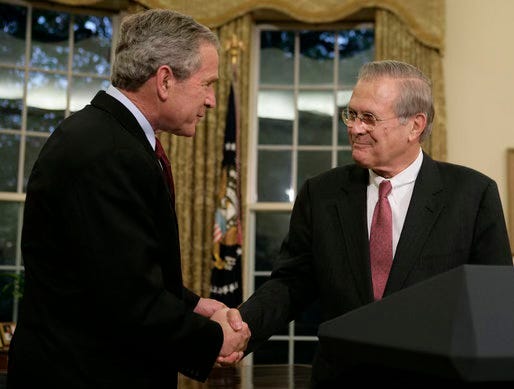
“Why all the glum faces?” With those words President George W. Bush began a White House press conference on Wednesday, November 8, 2006. A day earlier, Americans had voted Republican legislators out of office around the country, handing control of Congress to the Democrats.
Bush had more reason to be glum than anyone in the room. His party had taken a “thumping” — driven partly by the unpopularity of his Iraq war. So Bush promised change on Iraq, and to prove it, he announced that Secretary of Defense Donald Rumsfeld would be replaced by Robert Gates.
Rumsfeld’s defenestration from the Pentagon had been weeks in the making. Bush had turned down earlier bids by Rumsfeld to resign. But now Bush made clear in his announcement that he would have replaced the defense secretary “win or lose” — no matter how the midterm elections turned out.
It could be awfully tempting for President Donald Trump to similarly fire his controversial “secretary of war,” Pete Hegseth, next week, if the midterms turn into the Democratic rout many pollsters are expecting. And if Hegseth remains in office, some of his congressional critics are vowing to impeach him.
Both Hegseth and Rumsfeld attempted to transform the Pentagon, but in different ways. For better or worse, each had a vision for the Department of Defense. Neither won the hearts and minds of the nearly three-million strong department workforce.
Rumsfeld’s reputation foundered in the aftermath of the disastrous war in Iraq as he got the blame for many of the Bush administration’s strategic errors. Hegseth may pay a heavy price for the unintended consequences of the Iran war, launched by Trump with little apparent forethought.
The two men were high school athletes who went on to Princeton and the military: Rumsfeld reached the rank of captain in the Naval Reserve, Hegseth rose to major in the Army National Guard. The similarities between the two mostly end there.

Success story
If Rumsfeld hadn’t accepted the defense secretary post at the age of 68 after George W. Bush’s election as president in 2000, he might have gone down in history as a true American success story.
Donald Henry Rumsfeld was born in Chicago on July 9, 1932, in the midst of the Depression. In his memoir, Known and Unknown, Rumsfeld recalls listening to Captain Midnight and The Lone Ranger on the radio, joining the Cub Scouts and buying a red Schwinn bicycle with the money he made mowing lawns, selling magazine subscriptions and delivering newspapers.
“I guess because my parents were energetic people,” Rumsfeld wrote, “I must have inherited that characteristic at an early age.” His father was a real estate salesman, his mother trained as a teacher.
Dad never wasted time, Rumsfeld noted. “Sometimes he’d take me to the public golf course near twilight for his version of speed golf—playing nine holes in what I remember to be less than 45 minutes, never stopping to take a practice swing.”
After Japan attacked Pearl Harbor on December 7, 1941, his 38-year-old father enlisted in the Navy. When word spread at Coronado Junior High School that President Franklin D. Roosevelt had died suddenly in April 1945, Rumsfeld cried.
Rumsfeld excelled at wrestling in high school, helping power the team to a state championship. He got to know the love of his life, Marion Joyce Pierson, after they were both elected as class officers in their junior year.
At Princeton, Rumsfeld joined the Naval ROTC, which helped cover his college expenses. He fulfilled his three-and-a-half-year commitment to the Navy by training as a pilot and qualifying as a flight instructor.
When he moved to reserve status, he landed a job as an administrative assistant to a U.S. congressman from Ohio. At 29, he mounted his own campaign for Congress — and won.
Rumsfeld and his Republican colleagues, labeled “Young Turks” and “Rumsfeld’s Raiders,” struggled to revive the Republican brand in the early 1960s, a time when the political tide was running in favor of the youthful administration of President John F. Kennedy. He made connections that would benefit his career for decades — with future president Rep. Gerald Ford and future vice president Dick Cheney, among others — along with surprising friendships with Democrats John Dingell and Allard Lowenstein. Like many other Republican legislators, Rumsfeld voted for the Civil Rights Act of 1964.
President Richard Nixon named Rumsfeld director of the Office of Economic Opportunity (where he hired Cheney as an assistant) and later, U.S. Ambassador to NATO. Under President Ford, Rumsfeld served as coordinator of the White House staff and, in 1975, became the youngest defense secretary in U.S. history. (When George W. Bush sent him back to the Pentagon in 2001, Rumsfeld became the oldest defense secretary.)
After the election of President Jimmy Carter in 1976 drove Republicans out of power in Washington, Rumsfeld was named CEO of G.D. Searle & Company. He refocused the company, pruned it of 20 ancillary businesses, helped gain government approval for its artificial sweetener aspartame and eventually sold it to Monsanto. Searle’s stock price had shot up from $12.50 to $65 under Rumsfeld’s leadership, he noted.
Rumsfeld served as special ambassador to the Middle East for President Ronald Reagan. On one trip to the region, he met Iraqi dictator Saddam Hussein ("As odd as it might sound,” Rumsfeld wrote, “he came across as rather reasonable.”)
Sharp elbows — and snowflakes
In his government posts, Rumsfeld gained a reputation as an efficient administrator, though one with sharp elbows. Nelson Rockefeller blamed him for Ford’s failure to pick the former New York governor as his running mate in 1976. George H.W. Bush and Henry Kissinger also had gripes about him, which Rumsfeld attempted to rebut in his memoir.
Rumsfeld practiced a top-down approach to management. He reveled in his practice of firing off short memos to his staff, asking so many questions and issuing so many directives that his notes were called “snowflakes.” The blizzard of memos ran into the many thousands over time.
Individually, the memos could effectuate change. Collectively, they became an intolerable burden on his staff.
Paul Bremer, the U.S. official in charge of Iraq after the ouster of Saddam Hussein, nominally reported to Rumsfeld, but routinely went around him. He complained to President George W. Bush about Rumsfeld’s “micromanagement.” Rumsfeld quotes Bremer telling Bush, “Don terrifies his civilian subordinates. I can rarely get any decisions out of anyone but him. This works out all right, but isn’t ideal.” In his book, Rumsfeld doesn’t admit to being a micromanager. Instead he blames himself for not providing enough oversight to Bremer.
The reality is that anyone running a government bureaucracy as big as the Pentagon can’t do it with a blizzard of snowflakes. Rumsfeld’s memos were so numerous that most proved to have the lifespan and impact of a single real snowflake.
Sharing his observations had become a lifelong habit for Rumsfeld. His collection of pithy sayings started out on note cards. When he was serving in the Ford White House, the president suggested that Rumsfeld’s Rules should be distributed to the staff. As Ross Douthat noted in The Atlantic in 2004, in the midst of the chaos that followed the conquest of Iraq, some of the rules were particularly apt, though not flattering at the time to Rumsfeld. Among them were:
“Don’t do or say things you would not like to see on the front page of the Washington Post.”
“If you foul up, tell the president and correct it fast. Delay only compounds mistakes.”
“Be able to resign. It will improve your value to the president and do wonders for your performance.”
“Your performance depends on your people. Select the best, train them, and back them. When errors occur, give sharper guidance. If errors persist or if the fit feels wrong, help them move on.”
“It is easier to get into something than to get out of it.”
Leadership
The key to success for a defense secretary isn’t steering management by rules or memos, but finding a path to leadership that convinces others to follow. A leader sets broad standards, inculcates values, rewards outstanding performance and oversees the crafting of strategy.
At one point in his memoir, Rumsfeld appears to recognize the problem with his approach:
An executive who holds on to everything too tightly can lose sight of the larger issues. ‘Find ways to decentralize’ is a guideline I included in Rumsfeld’s Rules. ‘Move decision-making authority down and out. Encourage a more entrepreneurial approach.’ No one person can make all the necessary decisions in a large and complex enterprise.
Rumsfeld’s memoir also reveals a man determined to settle scores with the other main players in the George W. Bush administration: in his account, Colin Powell too often represented the State Department’s viewpoint to the president rather than seeing his role as selling the president’s views to the State Department. Condoleezza Rice, he argued, drove the national security process to reach consensus among the principal Bush aides rather than let their views filter up to the president for decision.
Bush himself comes in for a fair amount of Rumsfeldian criticism. Throughout his account, the smartest person in the room is inevitably Rumsfeld, and he wasn’t shy about letting everyone else know that he thought as much.
Rumsfeld devotes a big chunk of his memoir to countering the key criticism of the Iraq War. The Bush team launched the war with the claim that Saddam Hussein had active stockpiles of “WMD” — weapons of mass destruction. But U.S. and allied troops failed to find evidence to back that up.
When asked in February 2002, before the war, about the absence of evidence of ties between Saddam and terrorists intent on using WMD, Rumsfeld got philosophical:
Reports that say something hasn’t happened are always interesting to me because as we know, there are known knowns: there are things we know we know. We also know there are known unknowns: that is to say we know there are some things [we know] we do not know. But there are also unknown unknowns — the ones we don’t know we don’t know. And if one looks throughout the history of our country and other free countries, it is the latter category that tends to be the difficult one.
By that standard, the possibility of Rumsfeld’s firing by Bush was a known unknown. It was something people knew could (and likely would) happen, but they didn’t know when it would happen.
Something similar could be said of the likelihood that Trump will fire Hegseth if and when he feels he needs a scapegoat for the failure to defeat Iran.
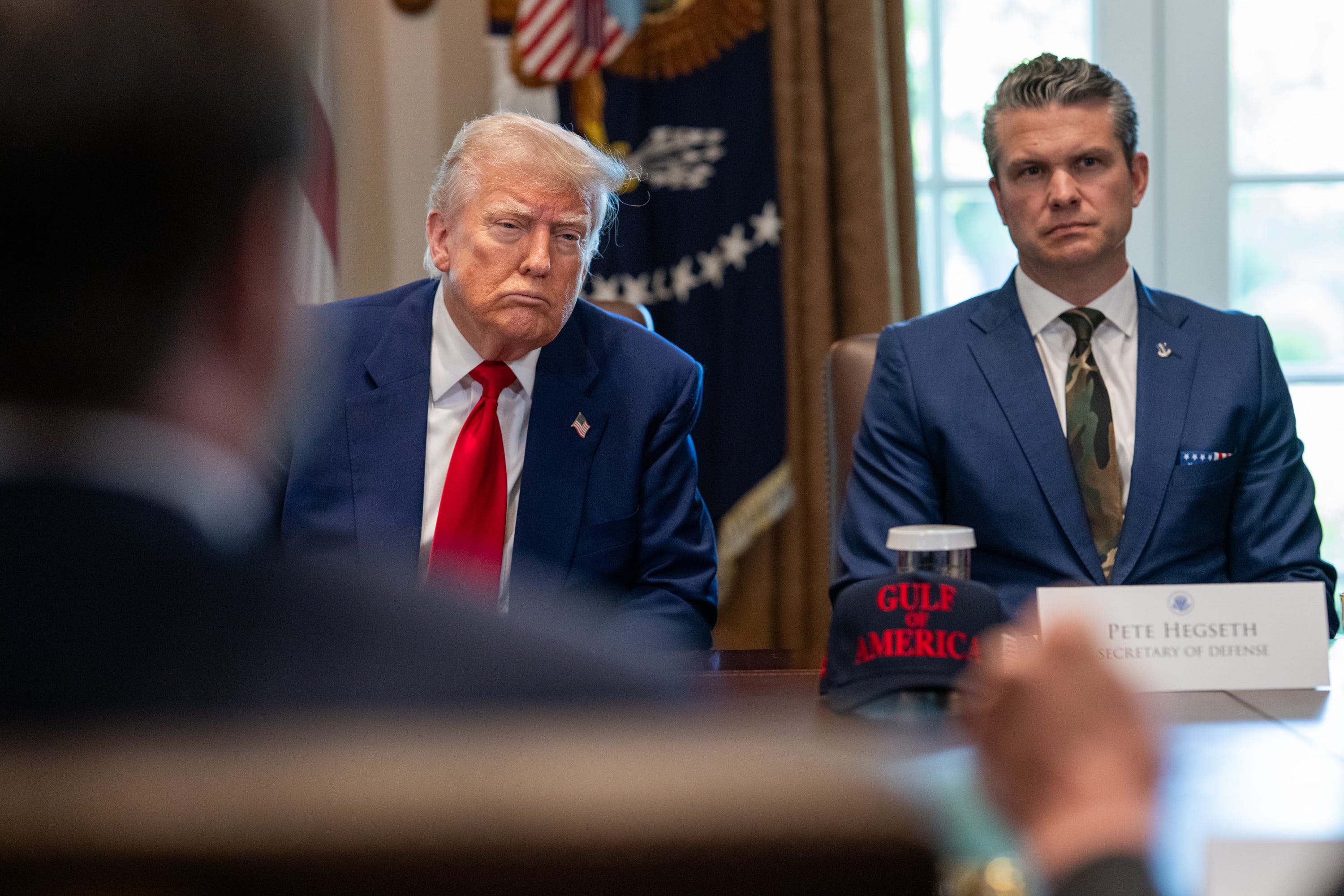
‘No beardos, no weirdos’
To Pete Hegseth, the U.S. military should be a testosterone-infused tribe of warriors, shorn of political correctness and the diversity the Defense Department has championed for decades. In September, he told a gathering of hundreds of officers and enlisted troops that the new ethos was, “No fatties, no trannies, no beardos, no weirdos, no wimps, no radicals. Just warriors.” He added, “The ideological clowns are out. The patriotic cowboys are in, with testosterone testing on top.”
He has moved aggressively to prune the flag officer corps, derailing the careers of many, including notable Black and female generals and admirals.
Donald Rumsfeld had his own critique of the lumbering military hierarchy and also sought to influence the selection of senior officers. He wrote that he was guided by a campaign statement from George W. Bush: “Our forces in the next century must be agile, lethal, readily deployable, and require a minimum of logistical support. We must be able to project our power over long distances, in days or weeks rather than months.”
After Iraq’s descent into chaos following the U.S. invasion of 2003, Rumsfeld took the brunt of the blame for launching the war with a lighter footprint of troops than proved necessary to maintain order following Saddam’s ouster. In his memoir, Rumsfeld disputes the view that Gen. Eric Shinseki pushed for a larger force than the defense secretary wanted in order to ensure stability in the power vacuum that followed the toppling of Saddam Hussein.
President Bush addressed Rumsfeld’s performance as defense secretary in his own memoir, Decision Points. He praised the secretary’s “valuable experience” and noted that he “shared my view of the war on terror as a long-term ideological struggle.” But Bush also observed:
At times, Don frustrated me with his abruptness toward military leaders and members of my staff. I felt he’d made a mistake by skipping the retirement ceremony of General Eric Shinseki, the four-star Army chief of staff who stepped down in 2003 after an honorable career. Don’s decision helped feed the false impression that the general had been fired for policy disagreements over Iraq.
Rumsfeld said he hadn’t been invited to Shinseki’s retirement ceremony. But he agreed with Bush that it was time for “fresh eyes” on the Iraq war strategy. Bush’s high school friend Jack Morrison suggested replacing Rumsfeld with Bob Gates. And with that, Rummy was done.
The weakness lesson
One overriding strategic concept Rumsfeld learned over his career — and repeated throughout his memoir — was that “weakness is provocative.”
“I knew America must not lose the will and the heart to persevere in long and difficult struggles,” he wrote.
At his farewell ceremony as defense secretary, he warned:
A conclusion by our enemies that the United States lacks the will or the resolve to carry out missions that demand sacrifice and demand patience is every bit as dangerous as an imbalance of conventional military power.
What Rumsfeld failed to learn — and what Hegseth may be finding out to his cost — is that launching a war without sufficient reason and in the absence of smart strategy is another way of demonstrating weakness. It also invites enemies to pounce.