
Pope Leo gets the last laugh
What Trump doesn't know about papal history fills volumes
Pope Gregory VII’s register for the year 1075 includes a set of 27 “dictates” that set out a sweeping view of papal authority.
Popes can depose emperors, the document asserted. They can free people from an obligation to follow immoral leaders. No one can judge a pope. His name must be recited in church. And the pope is the only figure whose feet must be kissed by kings.
Leave it to France’s Cardinal Richelieu, the minister to King Louis XIII, to come up with the appropriate riposte six centuries later. If the attribution to him is correct, the cardinal quipped, “We kiss the pope’s feet — and bind his hands.”
The struggle between popes and secular leaders for pre-eminence has been going on for a very long time. But it has been a while since it surfaced in as crude a form as it did, according to the Free Press, at a January Pentagon meeting attended by Pope Leo XIV’s U.S. representative. In the National Catholic Reporter, Aleja Hertzler-McCain referred to it as a “peculiar meeting.”
One Pentagon official, objecting to papal criticism of President Donald Trump’s foreign policy, reportedly tried to intimidate the pope’s nuncio by mentioning the move — under royal pressure — of the papal seat from Rome to what is now the southern French city of Avignon in the 14th century.
There, seven popes under the shadow of France’s monarchy ruled the church for 68 years. And for four decades after that, rival claimants to the papacy simultaneously sat in Rome and Avignon. It was an ordeal that forever doomed the grandiose conception of the papacy sketched out by Pope Gregory VII’s dictates. (None of the principals who attended the meeting has publicly confirmed the Free Press account.)
Last week, President Trump made a much more public — and much less subtle — attack on the Pope. “Pope Leo is WEAK on Crime and terrible for Foreign Policy,” Trump posted on Truth Social. The president stirred the pot further by disseminating the now-famous (and now-removed) post with a drawing of Trump as a Jesus-like figure healing the sick.
The pope has spoken out against Trump’s immigration crackdown, the U.S. war with Iran and the president’s threat to eliminate Iran’s civilization. “I have no fear of the Trump administration or speaking out loudly of the message of the gospel, which is what I believe I am here to do, what the church is here to do,” the Chicago-born Leo said. He has since told reporters he is not trying to debate the president, “which is not in my interest at all.”
Without evidence, Trump asserted that Leo wouldn’t be pope if Trump wasn’t in the White House, suggesting that the cardinal electors may have thought it useful to have an American in the role at a time when Trump is disrupting the world order. That is a somewhat similar thought to the process that led to the election of the seven French popes who served in Avignon at a time of rocky relations with the kings of France.
My former Newsday colleague Bob Keeler, a Pulitzer-Prize winning religion writer, pointed to Pope Francis’s choice of Cardinal Robert Francis Prevost to head the church’s office for selecting bishops as the likely credential that won him the papacy. “The election of Leo XIV has a lot to do with his predecessor and nothing to do with Trump,” wrote Keeler.
Trump’s overreaction to criticism from Pope Leo reflects his shaky grasp on history, as well as his insecurity.
When the Bush administration was heading to war against Iraq in 2003, Pope John Paul II publicly told diplomats at the Vatican, “No to war!” Popes have sounded that theme for more than a century. Andrea Tornielli wrote for Vatican News:
From the 1917 letter to the belligerent nations by Pope Benedict XV, which described the First World War as a “useless slaughter,” to the efforts of Pope Pius XII to prevent the outbreak of the Second World War; from the words of Pope John XXIII in Pacem in Terris (1963), who wrote that “it is almost impossible to think that in the atomic era war could be used as an instrument of justice,” to the cry of Pope Paul VI at the United Nations, “No more war!” — and the often unheard appeals of Pope John Paul II to prevent disastrous conflicts in the Middle East: the Successors of Peter have consistently raised their voices with both prophetic insight and realism, though sadly they have often gone unheard.
It’s important to note that these Popes were speaking as leaders of the church, not attempting to intervene in any material way — and that is a marked change from the times, centuries ago, when popes asserted the right to overrule kings. Catholic doctrine permits wars of self-defense but under strict conditions.
Should popes be discouraged from speaking out on moral issues such as war? Vatican history provides a vivid example of the consequences.
In the 1930s, with the rise of Fascism and Communism, Pope Pius XI had issued three denunciations of totalitarianism. While suffering from heart disease in 1938, the 81-year-old pope summoned an American Jesuit priest to draft a fourth encyclical. As another former Newsday journalist Peter Eisner wrote in The Pope’s Last Crusade, Pius wanted him “to write a papal declaration such as never had been seen before, one that firmly and categorically represented the Church's vision of the conflagration facing Europe. This would be the church's strongest statement ever, an encyclical that rejected anti-Semitism and the Nazi doctrine that espoused it.”
But Pius died of a heart attack in February, 1939 with the draft of the encyclical and a similarly themed speech sitting on his desk. His successor, a longtime church diplomat who took the name of Pius XII, shrank from such a public repudiation of Nazism.
As Frank J. Coppa wrote, the new pope “scrupulously avoided partisanship and shunned public condemnations. By nature shy, reserved, and gentle, Pius XII lacked the fighting spirit of his predecessor.”
The oldest institution
Papal history is an enormous compendium. As Thomas F.X. Noble of Notre Dame University has pointed out in a series of lectures, the church was already on its 250th pope when George Washington was elected as U.S. president in 1789. “The papacy is the oldest continuously functioning institution in the world,” Noble said.
It has survived so long by adapting, trying to find new relevance as circumstances change. Some of the early popes experimented with asserting a grand view of their authority. Pope Gelasius, who reigned from 492 to 496, wrote to the Eastern Roman emperor that “there are two powers by which this world is chiefly ruled: the sacred authority of the priesthood and the authority of kings.” And which of these is superior? “The authority of the priests is so much the weightier, as they must render before the tribunal of God an account even for the kings of men.”
Nicholas I, who served as pope from 858 to 867, thought along similar lines. He refused to let King Lothar of Lorraine divorce his wife on a trumped-up charge of adultery and deposed two archbishops who had supported the king’s bid for approval. In response, Lothar besieged Rome, but the pope and king eventually reconciled (although the king stayed with his new wife).
It wasn’t until the period from the election of Gregory VII in 1073 until the death of Boniface VIII in 1303 that “the papacy attained the height of its power, prestige and influence,” Noble said.
The period has been termed “the papal monarchy.”
As Colin Morris wrote in a book with that title in 1991, “In the proper sense of the words, papal monarchy was impossible. A pope could no more rule a kingdom than a king could say mass.” But, he added:
The ineffectiveness of state power at the beginning of our period meant that the clergy supervised activities which in the ancient or the modern world alike have been the business of the state or voluntary societies. These included the provision of hospitals and schools, jurisdiction over marriage and probate, the defence of Christendom against the infidel, and the preservation of peace within its borders. As the supreme authority within the church popes had final responsibility for all these matters, and it is striking to find how many major initiatives were undertaken directly by the Roman Church: the history of the crusades, of the friars, and of the inquisition, for example, was shaped by papal decisions.
The church’s responsibility to care for the souls of laymen gave it apparent supremacy over kings, Morris noted. “Many writers were prepared to see in the papacy an authority above earthly kings, and such language was not always rejected by the lay powers, however carefully they defended their customary rights.”
Crossing the Alps
In 1076, Pope Gregory clashed with Emperor Henry IV over which potentate had the right to appoint the bishops of German cities. Zealously guarding his prerogatives as pope, Gregory deposed and excommunicated Emperor Henry IV, telling his subjects they didn’t have to obey him. The German princes gave the emperor a deadline of February 22, 1077 to persuade the pope to reinstate him — or they would replace Henry.
Despite one of the worst winters in memory, Henry set out to cross the Alps and beg the pope’s forgiveness. He hired local guides, but the snow, ice and cold were fierce.
As Peter Konieczny wrote, a medieval chronicler captured the stress of the trip:
In that situation the men tried to overcome every danger using their own strength, now crawling on their hands and feet, now clinging to the shoulders of their guides and also occasionally, when a foot slipped on an icy surface, falling and rolling down for a considerable distance. At last with difficulty and for a time at serious risk of their lives they reached the plains. The queen and the other women who were in her service were placed in the hides of oxen and the guides who had been hired to lead the expedition dragged them down behind them.
That was how Henry’s entourage limped up to the castle of Canossa, owned by Matilda, the Countess of Tuscany.
Pope Gregory, who was staying there, described what Henry did next:
Once arrived, he presented himself at the gate of the castle, barefoot and clad only in wretched woollen garments, beseeching us with tears to grant him absolution and forgiveness. This he continued to do for three days, until all those about us were moved to compassion at his plight and interceded for him with tears and prayers.
The pope relented, absolved Henry and had dinner with him. But the truce didn’t last. Gregory would excommunicate Henry a second time; a resulting war forced Gregory to flee Rome and he died in Salerno.
The zenith of papal power came in the reign of Innocent III, from 1198 to 1216. He dramatically expanded the Papal States, gaining the approval of cities near to Rome — and far away — to the pope’s temporal rule as well as his spiritual one. To those cities, Innocent wrote letters describing his conception of power.
“Papal authority was represented by the Sun, and the Moon signified the power of lay princes,” the Encyclopedia Britannica noted. “Both powers were established by God, he explained, but, just as the Moon received its splendour from the Sun, royal power acquired its greatness and dignity from papal authority.”
Avignon
With such a muscular history of papal power, why is it that Trump can decide on war and Leo can’t stop him? Simply put, it’s the history of the last eight centuries — and particularly what happened at Avignon.
In the midst of a war with England, French King Philip IV started imposing taxes on French clergy to raise money, even though the practice violated a church decree. In 1296, Pope Boniface issued a bull declaring that no ruler could tax members of the church without papal approval. The king responded by cutting off revenues the church had been receiving from France. It was a smart move: Boniface backed down and gave Philip approval to tax the clergy without seeking permission.
As in the case of the clash between Gregory and Henry, this resolution wouldn’t last. A new dispute erupted when Philip arrested a bishop sent to the king by the pope to admonish the monarch. Before the bishop was released, the pope had issued bulls against Philip, one of which a French courtier threw into the fireplace in front of the pope’s representative. The king’s supporters then forged a papal bull to make the pope look bad.
The pope was losing patience. As Andrew Latham wrote, Boniface’s next move “came in the form of a bull, Unam sanctam, that mentioned neither Philip nor France, but that instead articulated in general terms the theological case for papal supremacy.”
It was all downhill from here. The king’s supporters accused the pope of heresy; the pope excommunicated some French clergy and asserted that he would fill vacant positions in the French church.
King Philip’s soldiers, joined by Roman enemies of the pope, confronted Boniface in the town of Anagni, southeast of Rome. “It is likely that he was physically assaulted by the soldiers,” Latham wrote. The “Slap of Anagni” would shake the western world. Yet Boniface held on to his papal seat, managing to return to Rome on September 25, 1303. The pontiff, believed to be between 68 and 73 years old at the time, died of a fever 17 days later.
Benedict XI, who succeeded Boniface, died within a year. The cardinals, taking no chance, elected a pope from France, Clement V. He chose to reside at Avignon, which though near to France was then controlled by the King of Naples, rather than travel to Rome.
The seven popes who reigned in Avignon from 1309 to 1377 were all French; when a pope finally returned to Rome, it didn’t heal the church’s wounds. The church Council of Constance finally resolved the dispute with the election of a new pope in 1417.
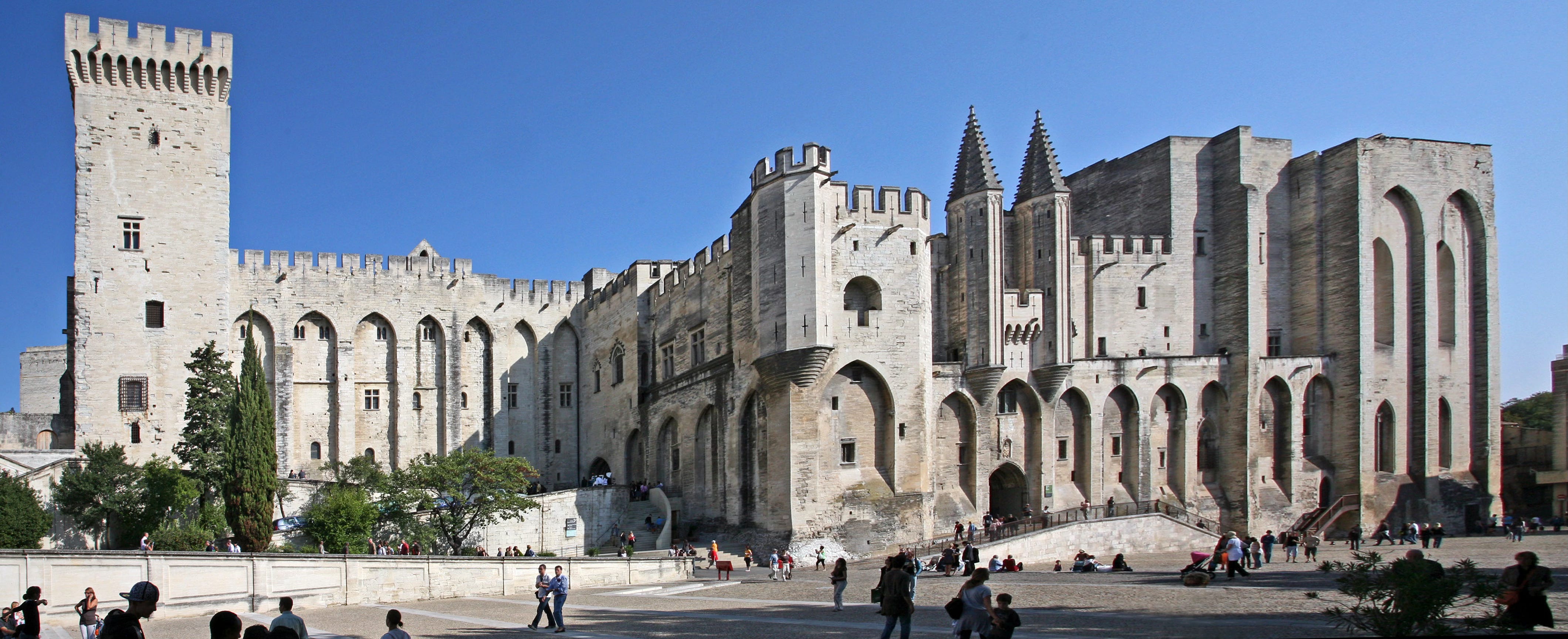
There are still signs of the church’s exile, sometimes referred to as the “Babylonian captivity,” in southern France. You can visit the hulking Gothic Palais des Papes and at nearby restaurants, sip Châteauneuf-du-Pape, the potent red wine named for the nearby village where the Avignon popes built their summer residence.
The experience of the exile left a less pleasing imprint on church history. So you can understand why even hinting that Pope Leo risks an Avignon-like schism in the church would be distressing to him and the Roman curia.
Still, the pope may have had the last laugh. When he was asked about Trump’s posts on Truth Social, he said, "It's ironic — the name of the site itself. Say no more."


