

In a December 7, 1957 interview with ABC’s Mike Wallace, syndicated columnist Drew Pearson talked about Joseph P. Kennedy’s efforts to position his son John for the 1960 Democratic nomination.
“Now, Jack Kennedy’s a fine young man, a very personable fellow,” Pearson said. “But he isn’t as good as the public relations campaign makes him out to be. He’s the only man in history that I know who won a Pulitzer Prize on a book which was ghostwritten for him, which indicates the kind of a public relations buildup he’s had.”
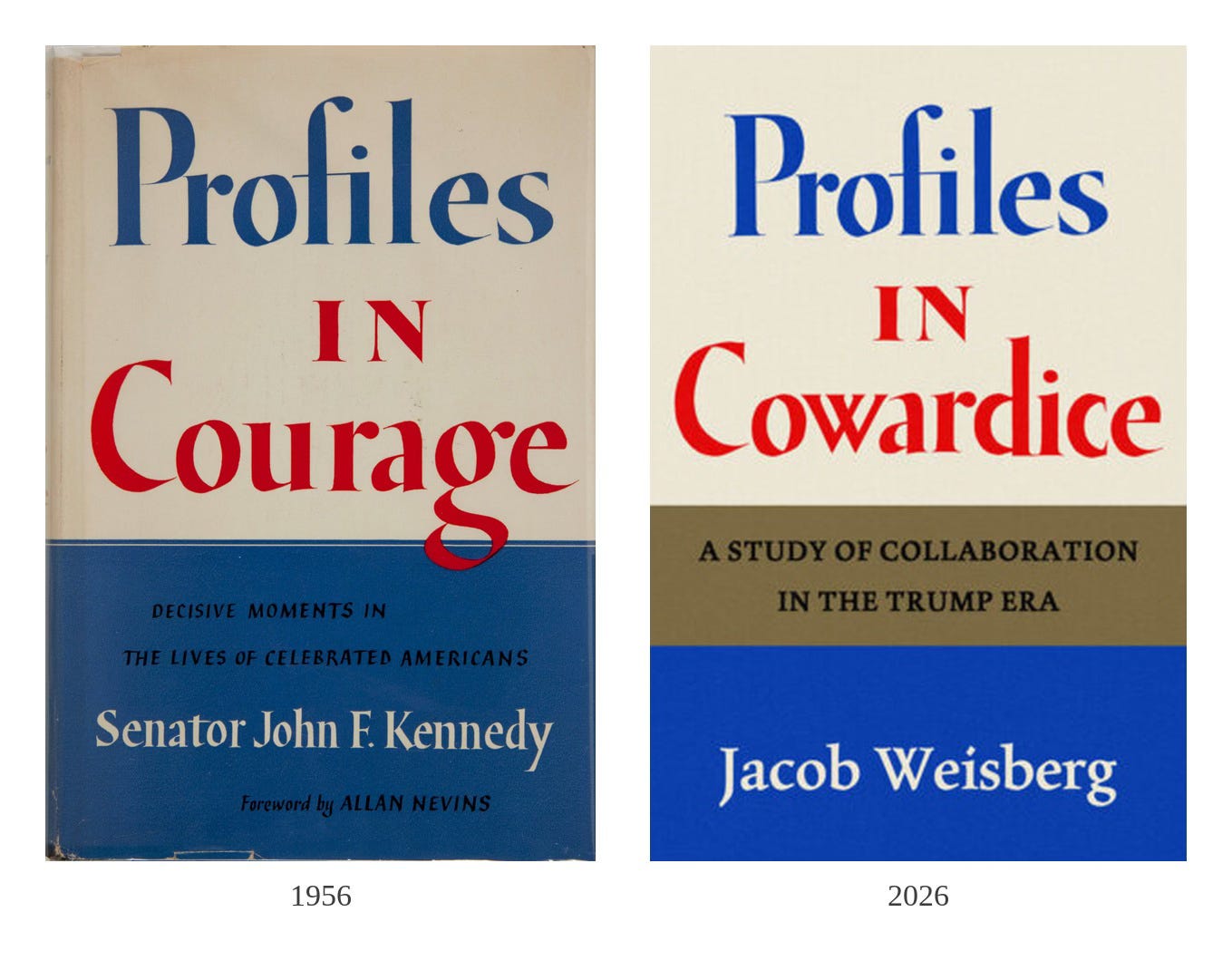
The book, published in 1956, was Profiles in Courage, an account of eight U.S. senators who took principled stances, often at great risk to their careers.
The Kennedy family reacted furiously to Pearson’s claim, as Mike Wallace later recalled. Sen. John F. Kennedy sought the help of Washington power broker Clark Clifford, who recounted the episode in his memoir. The senator put his father on the phone with Clifford. “This is Ambassador Kennedy,” the older Kennedy told Clifford. “Sue the bastards for fifty million dollars.”
As it turned out, there was no need for a lawsuit. Clifford met with the president of ABC Television, Oliver Treyz, who agreed to read an on-air apology to Kennedy, his publisher and the Pulitzer Prize board, including these words: “We deeply regret this error and feel that it does a grave injustice to a distinguished public servant and author.”
The apology outraged Wallace. History would show that Pearson was essentially right about the book. In 2008, JFK’s speechwriter, Theodore Sorensen, finally admitted in his own memoir that he wrote “a first draft of most chapters” and “helped choose the words of many of its sentences.”
At Sorensen’s behest, John Kennedy thanked his aide for providing assistance in the book’s preface, but didn’t acknowledge that he was by rights at least a co-author. Of course, politicians routinely rely on ghostwriters, but such books don’t normally win Pulitzers.
ABC’s apology wasn’t the first or last time that a network would cave to political power. But it also wasn’t as flagrant as what happened after Donald Trump won the 2024 presidential election. ABC agreed to a $16 million settlement of Trump’s defamation lawsuit over a broadcast by George Stephanopoulos rather than fight it in court.
In July 2025, Paramount, the owner of CBS, also agreed to pay $16 million to settle a flimsier Trump lawsuit — this time over the editing of an appearance by then-Vice President Kamala Harris on “60 Minutes.”
Both of the recent settlements are mentioned in a new book by journalist Jacob Weisberg. His Profiles in Cowardice riffs on Profiles in Courage with its title and cover design. But Weisberg mostly sidesteps the revealing history of JFK’s book and its Pulitzer Prize.
The new book is a well-timed and powerfully argued account of the many American leaders who shamelessly submitted to Trump upon his return to the White House. These leaders — in law firms, universities, corporations and Congress — are looking particularly forlorn now that American voters have dealt Trump a historic repudiation in the midterm elections that could restore limits on his power.
Profiles in Cowardice is a better-constructed book than Profiles in Courage, which in places seems to read more like the first drafts Sorensen said he submitted than a fully thought-through project.
The JFK book shows flashes of inspiration in its description of central figures in the Senate’s history, but often meanders around the point as it struggles to group a wide variety of disparate events under the category of courage.
Still, there is a natural human tendency to admire people who stand up for what they believe no matter the consequences. Kennedy’s book struck a nerve with readers, landing on the New York Times bestseller list for 88 weeks, as historian Craig Fehrman noted.
Sadly, Profiles was published again as a “memorial edition” after President Kennedy’s assassination on Nov. 22, 1963 and it was again a best-seller. This edition bore a foreword by JFK’s brother, Robert F. Kennedy. “If there is a lesson from the lives of the men John Kennedy depicts in this book,” RFK wrote, “if there is a lesson from his life and from his death, it is that in this world of ours none of us can afford to be lookers-on, the critics standing on the sidelines.”
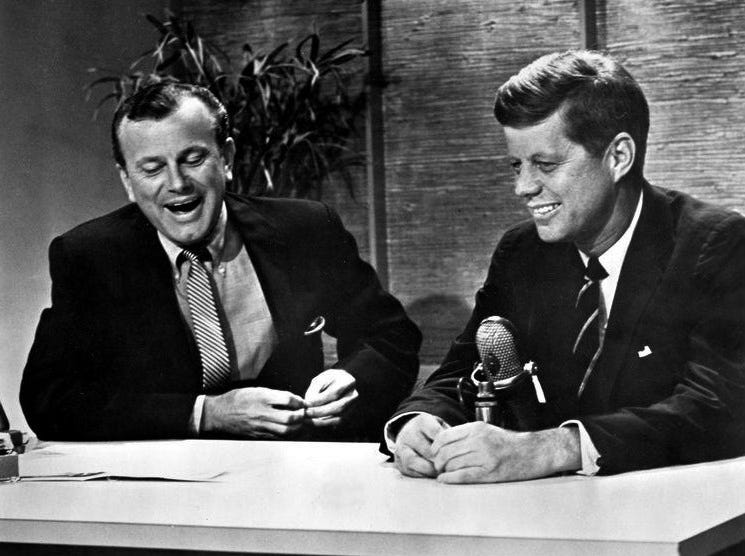
Brad Karp
In writing narrowly about the period from Trump’s second election victory through his first year in office, Weisberg has a more unified terrain to cover than the nearly 140 years of history traversed by Kennedy’s book.
One of the major figures in Weisberg’s book is Brad Karp, the former chair of Paul, Weiss, Rifkind, Wharton & Garrison, a New York law firm with a long tradition of championing social justice. With Karp and his other subjects, Weisberg makes his characters come alive, grounding their thoughts and actions in their youth and early adulthood to better explain their behavior in the Trump era.
Karp grew up on Long Island, the son of two lawyers. He wanted to be Perry Mason and scored top grades at Harvard Law School. Hired by Paul, Weiss, Karp got to meet a celebrated partner, Ted Sorensen, the same man who had ghostwritten for JFK.
Weisberg wrote:
What was supposed to be a ten-minute meeting stretched to an hour and a half. Sorensen talked about Paul, Weiss’s history of public engagement and pro bono civil rights work. “Ted and I talked about Brown v. Board of Education, and Paul, Weiss’s role representing Oliver Brown and working with Thurgood Marshall,” Karp later recalled in a podcast interview. Paul, Weiss was the type of place where an idealistic liberal lawyer could do well and do good.
As a Paul, Weiss associate and eventually partner, Karp represented major corporations, but he said he “always rooted for the underdog, always helped the vulnerable.” During Trump’s first administration, Karp “assigned seventy-five attorneys,” Weisberg noted, “to a massive pro bono project of fighting the administration’s family-separation policy, ‘reuniting families destroyed by the administration,’ as he told The New York Times.”
In 2024, Karp raised funds for then-Vice President Kamala Harris’ presidential campaign.
After Trump took the oath of office in January 2025, he began his promised campaign of retribution against a large swath of American society that had been horrified by his first term — and particularly the effort to overturn the 2020 election. On March 14, 2025, Trump signed an executive order suspending Paul, Weiss lawyers’ security clearances, restricting their access to government buildings and threatening the government contracts of the firm’s clients.
Paul, Weiss considered challenging Trump’s order in court, but Karp felt pressure to negotiate a deal to avoid what he feared would be a devastating exodus of clients and partners from the firm. He reached out to New England Patriots owner Robert Kraft, who helped set up a meeting with the president.
The language of the deal the firm reached with the White House is disputed. But Paul, Weiss agreed to do $40 million in pro bono work for causes supported by Trump. The real significance, Weisberg wrote, was that it amounted to “a public promise to quit pissing off Donald Trump.”
That set off what Weisberg called a “bidding war of submission” with other top law firms agreeing to do as much as $125 million each of Trump-friendly pro bono work.
Weisberg moves on from Karp’s story to that of financier Stephen Schwarzman, who proved to be a vital Trump ally on Wall Street. A collector of trophy houses who magnified his fame with over-the-top birthday parties, Schwarzman comes across as someone more concerned about the recognition he gets from charitable gifts than the causes he supports. He backed Trump in 2024, appearing unbothered by the candidate’s efforts to overturn the 2020 election.
Trekkie
Jeff Bezos, the Amazon founder and Washington Post owner, comes in for similar treatment. As a boy obsessed with Star Trek reruns, he dreamed of a career as an astronaut. His phenomenal success with Amazon enabled him to invest heavily in his passion project, the space company Blue Origin.
That business, far more than the Post, is close to Bezos’ heart, and competing for government space contracts is likely one of the reasons that prompted him to submit to Trump, beginning in 2024. He killed the Washington Post’s endorsement of Kamala Harris and went on to overhaul the paper’s left-leaning opinion department. Amazon paid $40 million for Melania Trump’s documentary, a deal that Weisberg notes gave the first lady a 70%-plus share.
Trump “invited Bezos to his inauguration, requiring only a $1 million contribution. Bezos, in a blue suit, and [then-fiancée Lauren] Sánchez, in a white pantsuit with a plunging neckline and bustier, stood prominently among the billionaire donors behind Trump at the ceremony.”
Bezos’ space rival, Elon Musk, also ingratiated himself with Trump — in his case, through enormous contributions to the Republican campaign in 2024. (This year, Musk’s investment of nearly half a billion dollars in the GOP midterm campaigns failed spectacularly.)
Weisberg also tells the stories of Trump skeptics who knuckled under to him, including Megyn Kelly and Sen. Mitch McConnell, who overcame childhood bullying only to become victims of the biggest bully of them all. Former President George W. Bush, Chief Justice John Roberts and Dartmouth College President Sian Beilock also are discussed in the book.
Courage and cowardice
If there’s a fault in Weisberg’s approach, it’s one it shares with JFK’s book: the limits of applying the concept of courage and cowardice so loosely. Some of the compromises made by the eight leaders fit better under the heading of capitulation. If Brad Karp bowed to Trump to save his own job and salary, we’re likely to see him as a coward. If it was to preserve the jobs of thousands of others, as a steward of the law firm, it may still be despicable, but the vice is not exactly cowardice.
As the New York Times’ astute columnist Carlos Lozada wrote, the submissions to Trump in Weisberg’s book “were self-interested trade-offs, not flags of surrender. There is a difference between cowardice and opportunism.”
Kennedy’s Profiles in Courage similarly relies too much on the central theme of courage. It’s not clear, for example, that Sen. Edmund Ross, who cast the key vote against removing President Andrew Johnson from office, acted for reasons of principle or whether he profited financially from the vote. Was Sen. Robert Taft’s condemnation of the Nuremberg war crimes trials as a violation of American standards of justice courageous or just foolhardy? Establishing a worldwide duty to refrain from committing war crimes is arguably worth the affront to the Constitution’s ban against ex post facto laws.
As the book itself notes, “The Toledo Blade told its readers that ‘on this issue, as on so many others, Senator Taft shows that he has a wonderful mind which knows practically everything and understands practically nothing...’”
But there are others deservedly covered in the book, including John Quincy Adams, who was effectively forced to surrender his Senate seat from Massachusetts because he favored a trade embargo that harmed the merchants in his home state.
Kennedy was a young senator when he wrote Profiles. He had shown bravery in World War II as commander of PT-109, sunk by a Japanese destroyer on August 2, 1943 in the Solomon Islands. Kennedy led his men on a three-and-a-half-mile swim to safety, towing an injured sailor with a life jacket strap clamped in his teeth. After a weeklong ordeal involving more heroic swims and Kennedy sending a message carved on a coconut shell to U.S. forces, the crew was rescued. Kennedy earned a Purple Heart and other decorations, but had aggravated a back injury that would plague him for years.
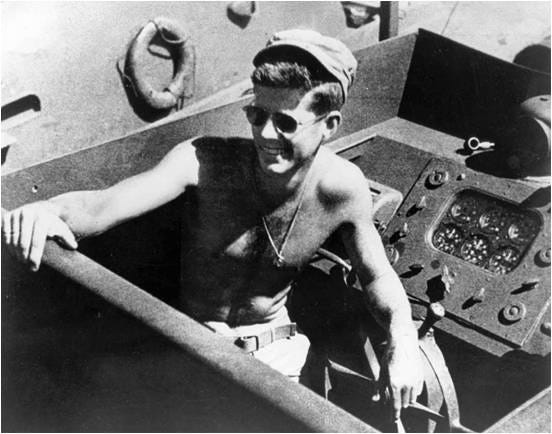
As Weisberg notes, Kennedy showed no courage in his early years in the Senate, when Senator Joseph McCarthy’s red-baiting crusade ruined the lives of thousands of Americans.
“When the Senate censured McCarthy on December 2, 1954, Kennedy was in the hospital for back surgery and did not vote — nor did he say how he would have voted,” wrote Weisberg. Every Democrat present in the Senate that day voted against the Wisconsin senator.
In fact, years earlier, on June 1, 1950, a freshman senator from Maine had displayed a real profile in courage by standing up to denounce McCarthy’s tactics when he was riding high. Margaret Chase Smith said then, “The United States Senate has long enjoyed worldwide respect as the greatest deliberative body.... But recently that deliberative character has...been debased to...a forum of hate and character assassination.”
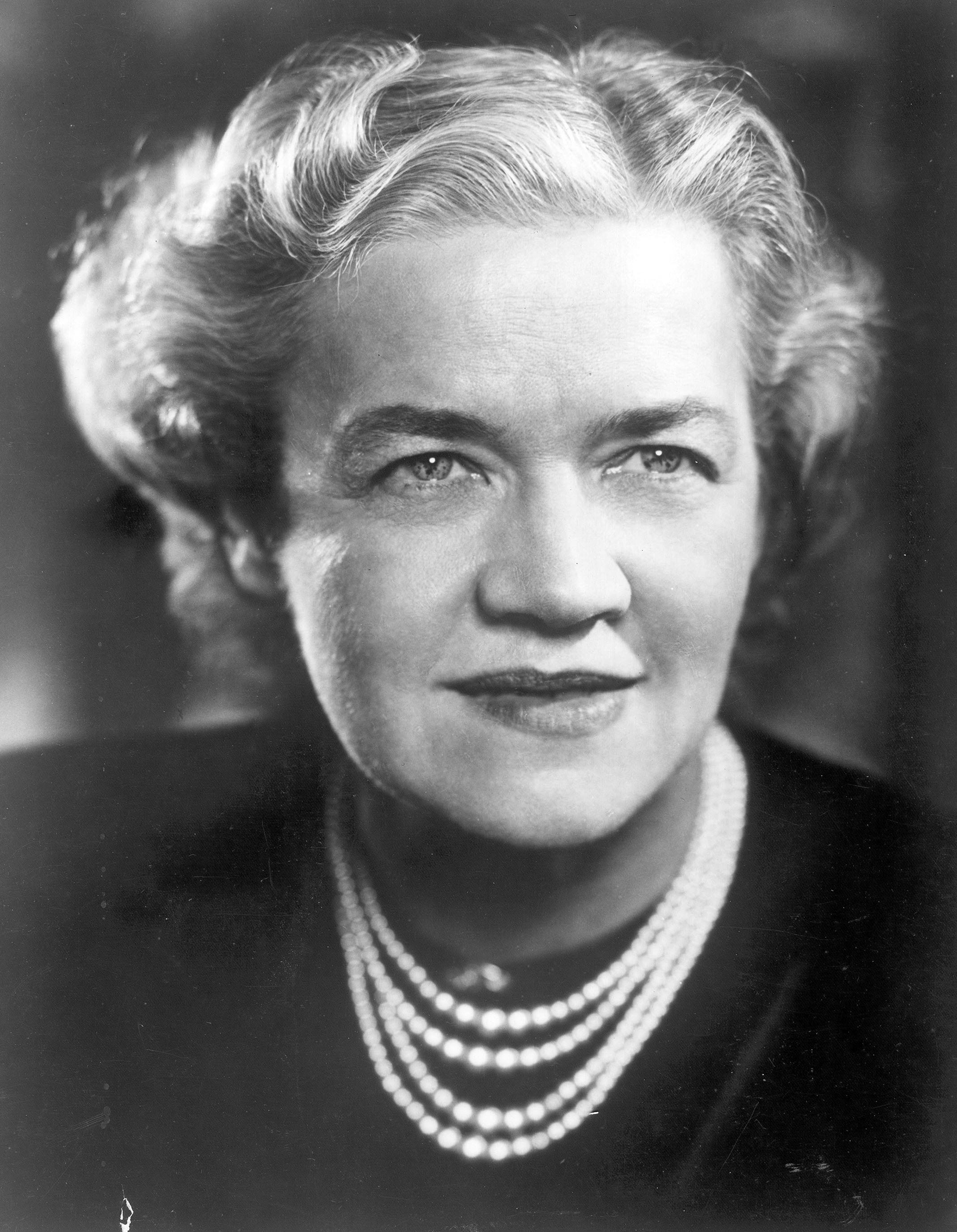
Margaret Chase Smith is not mentioned in Profiles in Courage.
Weisberg suggests that Kennedy’s work on the book helped steel his character:
Kennedy’s failure of nerve at a dangerous moment for American democracy seems to have left him curious about the virtue he had not shown, political courage in a moment of moral vulnerability. That may have been why he wanted to write the book (or have it written for him). Studying aspirational examples might help an ambitious politician do better, to stiffen his spine and hold himself accountable. And to a meaningful degree, it worked. The Kennedy who spurned the advice of his generals and defused the Cuban Missile Crisis in 1962 was no longer the Kennedy who failed to challenge McCarthy in 1954. He gave himself moral courage by studying morally courageous predecessors.
Krock and the Kennedys
Profiles in Courage came together during Kennedy’s convalescence. It was not Kennedy’s first book. That was Why England Slept, a version of JFK’s college thesis.
How did a young Harvard graduate get his thesis published as a book? Credit Arthur Krock, the Washington bureau chief for the New York Times, along with JFK’s father, Joseph.
David Nasaw, the biographer of the elder Kennedy, called the relationship between Krock and Kennedy “one of the stranger partnerships in the history of American politics and journalism.”
Joseph P. Kennedy, appointed head of the Securities and Exchange Commission in President Franklin D. Roosevelt’s administration, got to know Krock in 1934. “Within a year,” Nasaw wrote in his book The Patriarch, “Krock was ‘an intimate of the family.’ For the next quarter century, while working as Washington bureau chief and as columnist, [he] would serve as Kennedy’s unofficial, clandestine press agent, speechwriter, political adviser, informant, and all-purpose consultant. Whenever Kennedy had something to say, Krock helped him say it and gave him space in his column or in those of the reporters in his bureau.”
It was a breach of journalistic ethics.
Even worse, as Nasaw added:
On the whole, the correspondence reveals something quite disturbing, if not corrupt, about Krock’s willingness to do Kennedy’s bidding, to advise him or write a speech for him, then praise it in his column, to take money for ghostwriting Kennedy’s I’m for Roosevelt campaign book in 1936, to assist Jack in turning his college thesis into a book, Why England Slept, to allow Kennedy to pay for vacations in Palm Beach and travel to London, all without any acknowledgment to his superiors at the Times or his readers.
John F. Kennedy initially paid Ted Sorensen a $6,000 bonus for his work on Profiles in Courage. The book’s success, according to Fehrman, helped elevate the senator’s own profile, making him the keynote speaker at the 1956 National Book Awards. The next year, Profiles would be a finalist in the National Book Awards nonfiction category.
A Pulitzer Prize would be a bigger honor, one he had coveted for years. Fehrman wrote for Politico that Pulitzer Prize winner Margaret Coit, author of a biography of John Calhoun, had resisted JFK’s physical advances when she was interviewing Kennedy in 1953. In an oral history for the John F. Kennedy Presidential Library and Museum, she quoted Kennedy as saying, “You know, I would rather win a Pulitzer Prize than be president.”
JFK enlisted his father’s help in trying to secure the 1957 Pulitzer for biography. Soon Arthur Krock, a former member of the Pulitzer board, was on the case. He had spent 15 years on the board and corresponded with at least one of the board members about JFK’s book.
Is there a ghost in the house?
Pulitzer Prizes are awarded through a two-step process. A jury reads the entries and recommends winners to the Pulitzer Board, which can endorse or ignore the jury’s choices. The biography jury in 1957, consisting of two scholars, chose Alpheus T. Mason’s 914-page biography of U.S. Supreme Court Justice Harlan Fiske Stone. Its second choice was Roosevelt: The Lion and the Fox, by James MacGregor Burns. Its third choice was Profiles in Courage, according to longtime Pulitzer administrator John Hohenberg.
When the Pulitzer board met to choose the winners, J.D. Ferguson, the Milwaukee Journal’s editor, “raised his hand somewhat hesitantly.” Hohenberg said he “sighed deeply, then murmured of the Kennedy book, ‘I read it aloud to my 12-year-old grandson and the boy was absolutely fascinated.’” Other board members chimed in, agreeing Profiles deserved the prize.
“Arthur Krock,” Hohenberg noted, “not then a member of the board, had been recommending it widely and it also had been at the top of most best seller lists.”
“When the board voted on the biography prize, Don Ferguson and his 12-year-old grandson carried the day for Kennedy.”
Hohenberg also noted that James MacGregor Burns, the author of the jury’s second-place recommendation, observed that Kennedy gained four points in the Gallup Poll over Senator Estes Kefauver in the race for the Democratic nomination after winning the Pulitzer. JFK was a war hero and a youthful senator, but the added fillip of a Pulitzer Prize-winning book made him much more than just another politician seeking the White House.
In May 1957, a little more than a week after the prize was awarded, critic Gilbert Seldes blasted the choice in the Village Voice: The book “shows no research,” expounds the obvious theme that “courage is a Good Thing” and was the “most innocuous book published in a generation.”
Noting a report that Kennedy had a “collaborator” who worked with him on the book, Seldes said there was nothing wrong with that, but the subheads in his column read: “Is there…a ghost…in the house?” That month, the Kennedys arranged to pay Sorensen an estimated $100,000 bonus over several years.
In December, seven days after Drew Pearson’s explosive accusation, Sorensen signed a two-page affidavit saying, in part:
Inasmuch as Mr. Pearson has referred to me, and further in view of my own intimate knowledge as to the conception and creation of Profiles in Courage, I wish to state under oath that these charges are wholly untrue. I am not the author of Profiles in Courage. I did not write the book for Senator Kennedy, and I have not at any time to any person declared myself to be the author. I have never written any book of any kind… The author of Profiles in Courage is Senator Kennedy, who originally conceived its theme, selected its characters, determined its contents, and wrote and rewrote each of its chapters…
Sorensen maintained that he only supplied research and materials for the book and made suggestions — sticking to that story until his 2008 admission to writing the first drafts and choosing the words of much of the book.
In the aftermath of the controversy over his appearance on Mike Wallace’s show, Drew Pearson hedged his claim that Sorensen wrote Profiles in Courage. On February 16, 1958, his Washington Merry-Go-Round column ended with a coy note:
“Said Norman Thomas preaching at All Souls Church the other day: ‘It’s easy to write profiles in courage about men who are dead. What we need is profiles in courage among men who are living.’ Author of ‘Profiles in Courage’ is Sen. Jack Kennedy of Massachusetts.”
According to letters on file at the John F. Kennedy Presidential Library and Museum, JFK took Pearson’s note and the ABC apology as vindication. He was so pleased at the outcome that he sent his lawyer Clark Clifford a watch.
As for Norman Thomas’ remark about the need for living profiles in courage, Margaret Chase Smith had already been one.
Jacob Weisberg’s book applauds one for our own time, a member of Congress who, like John Quincy Adams, lost her seat because she stayed true to her principles: Liz Cheney. Three months before Wyoming voters ousted her in 2022, the Kennedy Library Foundation gave Cheney its Profile in Courage Award.