
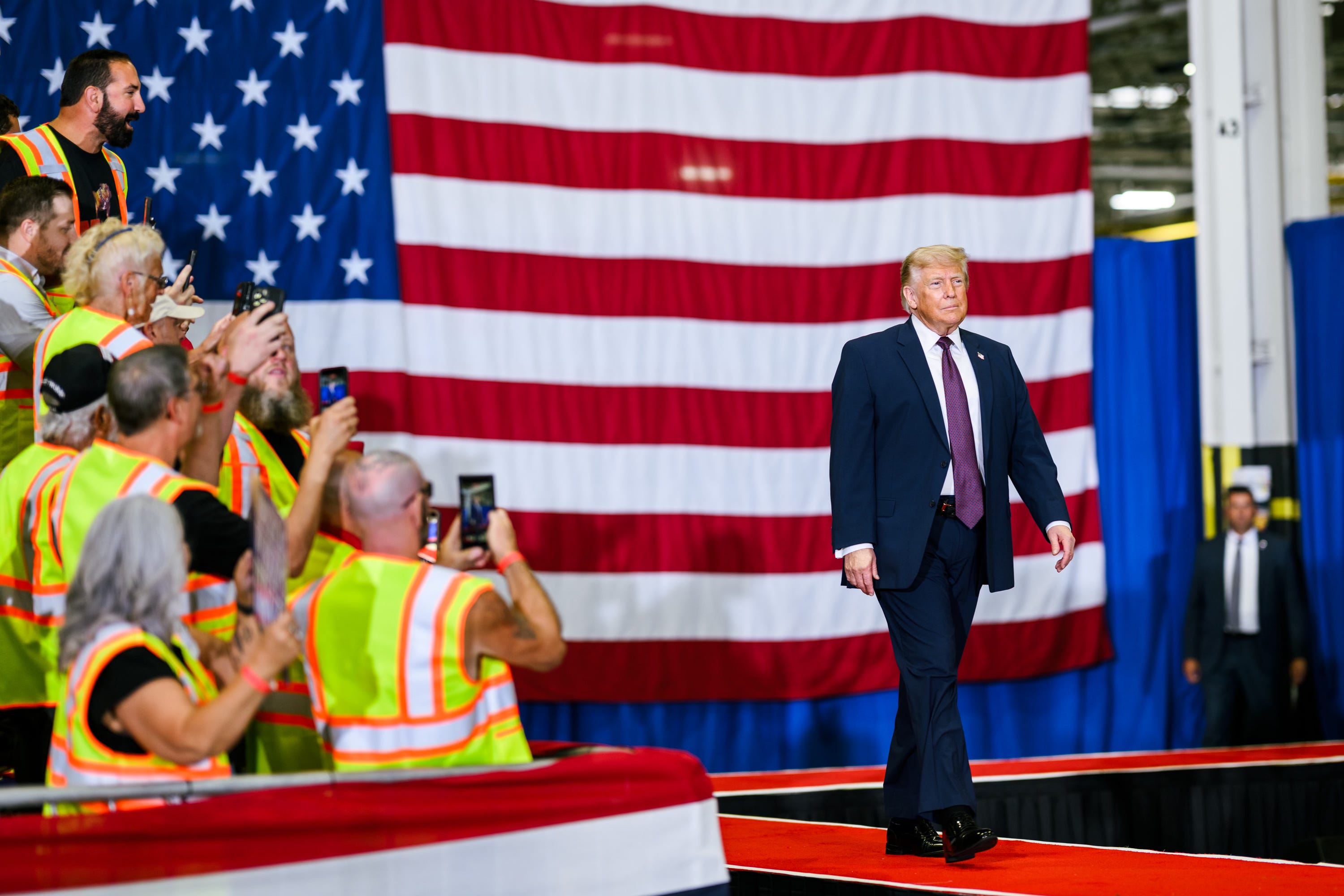
Summing up Trump in a word
What the birthright citizenship ruling and the scoops in 'Regime Change' tell us
Lawless. If you had to sum up the second Trump presidency in a word, that would be it.
The Supreme Court implicitly confirmed that view on June 30 with its 6-3 ruling quashing Trump’s executive order, signed on his first day in office in 2025, that severely limited birthright citizenship.
Rejecting the racial test for citizenship imposed by what today’s court called the “odious” Dred Scott decision, the court’s majority relied on its 1898 landmark decision in United States v. Wong Kim Ark. That ruling established for all time that children born in the U.S. are citizens. Birthright citizenship has firm roots in English common law, the opinion by Chief Justice John Roberts pointed out.
Citizenship entails “the right to have rights — to freely participate in our political community,” the court found. “The Framers of the Fourteenth Amendment extended that promise to ‘every free-born person in this land’ … We keep that promise today.”
As the new best-selling book Regime Change by Maggie Haberman and Jonathan Swan makes clear, Trump’s push to redefine citizenship despite the 14th amendment to the Constitution is only one of dozens of his affronts to the basic ground rules of American government. But the truth is that you don’t have to read this briskly-told narrative to find that out.
The book, which covers the first 13 months of the president’s second term, is full of revelations. In the long tradition of Washington insider narratives, going back to Bob Woodward’s 1987 book Veil: The Secret Wars of the CIA, Haberman and Swan conducted a huge number of interviews — more than 1,000 — while allowing their sources to speak on “deep background.” That means that “we could use the information but not identify who gave it to us.”
Many of those sources clearly felt free to dish on Trump’s often bizarre approach to governing — and to life. So there are scoops, but there aren’t a lot of surprises.
Through the eras of Reagan, Clinton, George W. Bush, Obama and Biden, reporters were able to unearth behind-the-scenes anecdotes and dialogue that revealed a hidden side of the power elite, showing how their private strivings often clashed with the image they sought to project to the public.
With Trump, there is no distinction between backstage and the space in front of the curtain; what you see is what there is.
After decades of knowing Trump as a tabloid celebrity, a TV character and now a president twice over, Americans can no longer be shocked by what he does, though they can still be outraged by it. He doesn’t hide his enormous ego, his greed, his lack of empathy, his pettiness, his neediness and his list of self-aggrandizing projects, including the arch, the ballroom, the Trump-Kennedy Center, the Trump passport….and on and on.
Paging through Haberman and Swan, an informed reader will be reminded of DOGE, the attacks on big media outlets, law firms and universities, the prosecutions of former FBI director James Comey and New York Attorney-General Letitia James, the bullying of Republicans in Congress, the campaign to unseat and unnerve Fed governors, the “Liberation Day” tariffs, the summary executions of alleged drug traffickers on the high seas, the two attacks on Iran and the abduction of Venezuela’s Nicolás Maduro.
It’s too soon for a deep historical examination of these events’ consequences. Reading about them when the wounds are still fresh seems like voluntarily exposing yourself to unnecessary pain.
We find out that Trump munches on crabmeat snacks and candy, washing them down with Diet Coke, as he riffs on ways to expand his power and punish his perceived enemies. The book tells us who was sitting where in the Situation Room as administration officials discussed crises ranging from Iran to the Jeffrey Epstein files.
Among the most compelling parts of the book is the section focusing on the riches that have flowed to the Trump family since the president became “crypto-friendly” and allowed his sons to take stakes in companies that either rely on favorable regulation or sell products to the government.
(For those who want to keep score, there’s a helpful tracker from the Center for American Progress that as of 10 a.m. EDT on June 30, put “Trump’s Take” at $2,664,058,340 and counting, reflecting “Cash and gifts received by Trump over the past 602 days.”)
Trump’s power to pardon anyone, combined with the Supreme Court’s ruling granting presidents immunity in their official duties and his absolute control of the Justice Department has created freedom of action that no other recent president has enjoyed.
12 hours of Watergate
When Vice President J.D. Vance suggested on June 25 that “if Watergate happened tomorrow, it would be like a 12-hour news story,” he presented it as a joke. But he wasn’t that far wrong. The furious norm-breaking of the Trump presidency has assailed Americans with so many potential scandals that any individual one doesn’t get the attention it deserves.
At the end of Regime Change, Haberman and Swan recount their March, 2025 interview in the Oval Office. They recall wanting to ask Trump if he thought there had ever been a president as powerful as he was now.
Rather than respond to that specific question, Trump pivoted to a story involving famed golfer Gary Player. Trump said he recently played golf with Player, who shot an impressive 71 at the age of 90.
Through Player, Trump met a man he described as a historian who recently wrote a piece comparing the 45th U.S president to Genghis Khan, Attila the Hun, Alexander the Great, the Caesars and William the Conqueror. The piece began by saying that Trump is “without question the most powerful man that the planet has ever known.”
Trump liked the argument, noting that those other leaders “didn’t have airplanes” and could only project their power locally. Then, referring to Hitler, Mao and Stalin, Trump said, “these leaders maintained power through fear. Who would ever do a thing like that?”
It turned out that the writer of the document Trump cited was not a historian, but Gary Player’s former caddy and a business executive, who later said he had been a lifelong student of history.
Haberman and Swan acutely assessed the significance of Trump’s comments.
“What was revealing was not really that Trump agreed with the thesis,” the authors wrote, “but the way he inhabited it, the evident pleasure he took in the company of Mao, Hitler and Stalin, masters of state control through murder, torture and detention … and the untroubled ease with which he accepted a place among men who had reshaped the world through conquest and fear. He drew no distinction between those who built and those who destroyed, between those who liberated and those who enslaved. What mattered was that they had had huge power and that he had more.”


Attempts to understand the Trump phenomenon, and Trump, himself, will go on for years. Known already is that the country was vulnerable in ways unimagined and voters surprisingly open to the appeal of a person driven by power, grievance and individual advantage. If given the chance to better protect ourselves, let's hope we do. Thanks, as always, Rich for an insightful piece.
“Voluntarily exposing yourself to unnecessary pain” is about right. And the pain shall continue until the regime is tossed into the trash heap of history. Nicely done.