

Ted Turner, a captain who could only have come from America
Winning was the only thing
In 1899, the British grocery magnate Sir Thomas Lipton tried to win back the most coveted trophy in sports for his country. His yacht Shamrock faced off against Columbia, which was defending the America’s Cup on behalf of the New York Yacht Club. Lipton lost all three races.
In 1901, Lipton’s Shamrock II challenged Columbia again and lost all three races.
In 1903, his Shamrock III lost all three races against a new American yacht.
In 1920, Lipton’s Shamrock IV won twice before losing the final three races.
In 1930, Lipton’s Shamrock V lost every race against the U.S. contender.
Despite five successive defeats, the self-made multimillionaire from Glasgow was contemplating a sixth shortly before he died in 1931. Lipton, whose tea brand survives to this day, handled his defeats with grace, earning the admiration and sympathy of Americans — so much so that they raised a fund which gifted him a spectacular gold trophy by way of consolation.
Lipton never gave in to the temptation to bad-mouth his opponents. As Michael D’Antonio writes in A Full Cup, a biography of the entrepreneur, “One sympathetic woman told Lipton she had heard that the American side had ‘put something in the water’ to prevent him from winning.”
“Lipton said she was correct. They had ‘put the Columbia in the water for just that very purpose.’” Even when he was losing, D’Antonio pointed out, Lipton gained publicity that brought customers to his businesses. Yet Lipton was only playing the part of a prosperous yachtsman — he looked jaunty in his cap, but never learned how to captain a boat himself.
A very different kind of entrepreneur, Ted Turner, successfully defended the America’s Cup in 1977, prolonging the streak that kept the trophy in the U.S. from 1851 until Australia II defeated a team led by Dennis Conner in 1983.
Along with a boat made in America to win the America’s Cup came a captain who could only have come from America.
Turner lived out the indelible quote attributed to Vince Lombardi, but which was first said by college football coach Henry 'Red’ Sanders: “Winning isn’t everything; it’s the only thing.” Turner would never have been content being only a gracious loser.
His hyper-competitive spirit and hands-on expertise in sailing made him a ferocious competitor. His drive and intuitive grasp of human nature enabled him to overcome the odds and grow his quirky UHF tv station in Atlanta into a massive cable news, entertainment and sports empire. Turner, who willed into being the category of 24-hour-cable news with the launch of CNN in 1980, died May 6, at the age of 87 of Lewy body dementia.
His sailing career offers insights into his business success. Turner decided not to rest on his laurels after winning the America’s Cup aboard Courageous. He entered his personal yacht Tenacious in Britain’s Fastnet Race in August, 1979, as his company was preparing to launch CNN.
“Winning the America’s Cup and Fastnet would be comparable to taking the Olympic gold medal in both the marathon and the 100 meters, and I was eager to win it,” Turner wrote in his memoir Call Me Ted.
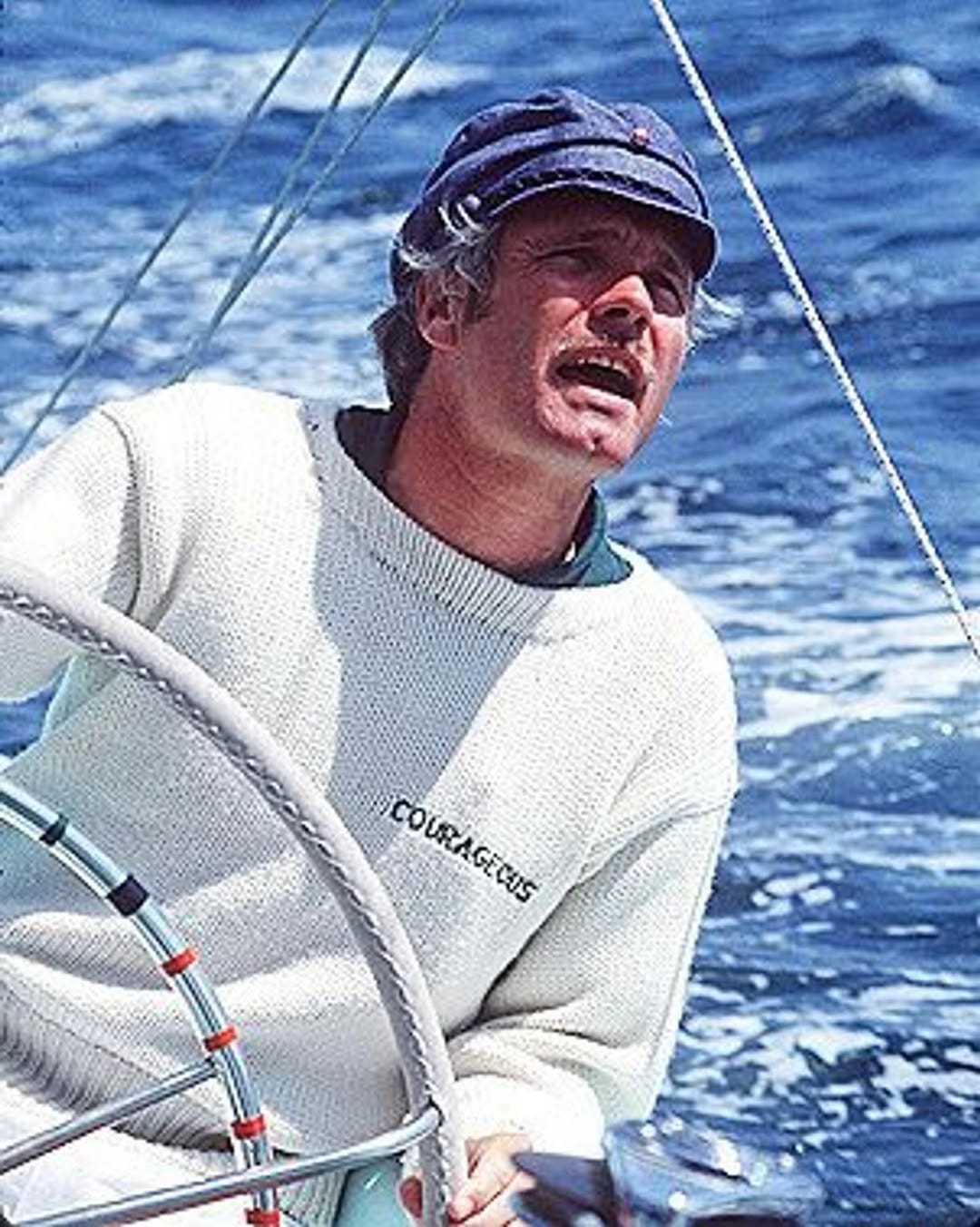
The Fastnet was a vastly bigger event than the America’s Cup; the field of yachts exceeded 300 and the course was 605-miles long. It began at Cowes in southern England, proceeded west into the Irish Sea, wound around Fastnet Rock on Ireland’s southern tip and back to Cowes.
The 1979 race began in good weather. But by the time Tenacious was halfway through the race, the forecast turned ominous. A major storm with hurricane-strength winds was heading their way. Turner was on watch during the worst of it, from midnight to 4 a.m. The winds reached 60 knots and the waves 35 feet, according to Gary Jobson, Turner’s tactician.
“It was really scary that night,” Turner observed, adding that he had confidence in his 61-foot boat. “Even at the height of the storm, I was more concerned about winning than I was about dying.”
There were many casualties, all on boats less than 39 feet long. Fifteen people died in the race. Five boats sank and 24 boats were abandoned. Only 85 of the 303 boats that started the race crossed the finish line.
Some early reports erroneously listed Turner’s yacht among the missing, alarming his company’s executives who were then working feverishly to get CNN ready to launch the following year. According to Citizen Turner, a 1995 book by Robert Goldberg and Gerald Jay Goldberg, some doubted whether the CNN venture could survive the loss of Ted.
So the executives were relieved to see him pop up on a news report from England, where his crew all survived and his yacht had been pronounced the winner of the tragic race.
As the Goldbergs wrote:
There was Ted alive and talking a blue streak. “Sailing in rough weather is what the sport is all about,” he boasted to reporters, praising his strong boat, his good crew and their experience. “The people who didn’t have those,” he added, in an offhand fashion, “went to the big regatta in the sky.” Asked about the tragic loss of life, he replied “it’s no use crying. The king is dead. Long live the king. It had to happen sooner or later. You ought to be thankful there are storms like that or you’d all be speaking Spanish.” His wise guy answers and his flip reference to the fate of the Spanish Armada which in 1588 also encountered fatal storms angered the British press.
For Turner, simply competing was not enough: he had to win. As TIME reported when it named him Man of the Year in 1991, “For all his days on the sailing circuit, Turner had struck some of those who know him as a joyless monomaniac who pursued achievement not out of passion for the undertaking but out of a tortured focus on the finish line. ‘He told me 20 times that he never liked sailing,’ says [former CNN executive Robert] Wussler. ‘He said, ‘You know, Bob, I got cold and I got wet.’ He was more in love with just winning.”
The CNN project began after Turner won the America’s Cup at the age of 38. Turner wrote in his memoir, “my thoughts turned to what would come next.”
Turner’s willingness to take risks had become clear when he bought the listless Atlanta Braves, whose games he had already been airing on his station. His flair for showmanship led him to inventive ways to fill seats in the stadium:
According to Citizen Turner:
Soon there were ostrich races and home plate weddings, Easter egg hunts and dollar bill scrambles, mattress stacking and motorized bathtub competitions, free halter-top giveaways and aerialist Karl Wallenda in a Braves hat doing a skywalk 200 feet above the infield. All this plus fireworks, wrestling matches, ball girls in hot pants and belly dancers! Turner said he’d do anything to bring people into the stadium, and he clearly meant it but most interesting and characteristic of the near middle-aged Turner was his eagerness to participate in these events and his willingness to look like a damn fool in the process.
Unlike the airing of Braves games, news had never been a priority for Turner’s “superstation” in Atlanta. It would be presented in the very early morning hours by anchor Bill Tush, who, as Turner recalled, “could read the news with a German shepherd sitting next to him, or he’d put a shopping bag over his head and call himself the ‘Unknown Newsman.’”
But Turner knew that radio stations had succeeded in launching 24-hour news channels and believed that the time was ripe to challenge the triopoly of broadcast networks that profited from half-hour evening newscasts. He did no research before greenlighting the idea of CNN, but wisely hired an experienced journalist, Reese Schonfeld, to get the new venture off the ground.
Schonfeld recruited some TV news veterans including Daniel Schorr and Mary Alice Williams. He had trouble luring others to risk their careers on a news venture based in Atlanta, rather than New York or Washington.
CNN nearly died before it was launched due to the loss of a vital communications satellite and Turner’s financial difficulties. In April 1980, Turner was trying to raise financing for his new venture after having invested $34 million in the CNN project.
According to Citizen Turner, a frazzled Turner told his lawyers on April 8:
This is about it. The whole deal is crumbling and when it goes it’ll take everything I’ve got with it. I’m just about flat broke... the banks are calling in their notes on me, and the insurance company already has. I’ve got three hundred people on the Cable News payroll, and no money coming in to pay them. I just had to borrow twenty million to tide me over. The interest rate is twenty-five percent. Twenty-five percent of twenty million is five million a year, and there’s twelve months in a year and that’s $400,000 a month in interest alone. I can’t pay it.
Turner wasn’t the only one with doubts about whether CNN could get off the ground. J. Christopher Burns, the vice president for planning of the Washington Post Company, said, “the reason Ted Turner decided to go ahead with it in the form that he’s doing may be that he doesn’t understand the problem. He’s not paying attention. The cable industry doubts that Ted Turner knows his ass from a hole in the ground about news.”
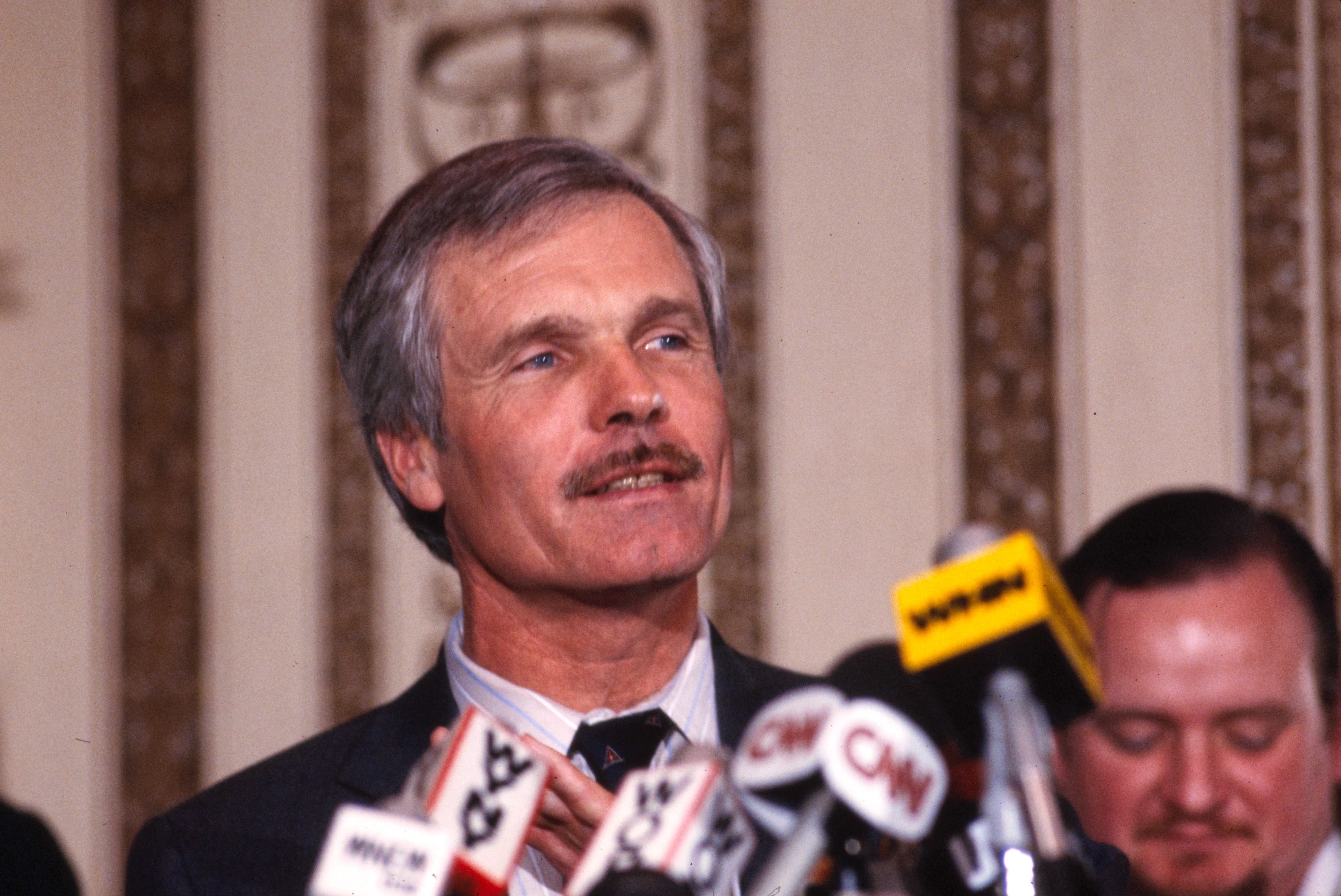
But on Sunday, June 1, 1980, CNN actually did launch — with a ceremony at its headquarters, a former country club in Atlanta. There was a military band and a color guard and 300 guests had been invited. “I’m going to do news like the world has never seen news before,” said Turner. “This will be the most significant achievement in the annals of journalism.”
The hype aside, this was a big moment. There were very few people in business who would have had the courage to take the risk Turner assumed in launching CNN.
It was a rocky start. “Within its first hour on the air,” the Goldbergs noted, “CNN lost its feed from New York and went black, came back on the air only to cut out in the middle of a presidential speech, started to go live to the Middle East only to find out that the Jerusalem feed wasn’t ready” and cut to a reporter who was picking his nose.
“Over the following months there were enough blunders, flubs and goof-ups for a dozen blooper reels.”
A light bulb exploded, setting Daniel Schorr’s clothes on fire. A cleaning woman emptied the wastebasket at Bernard Shaw’s desk as he delivered the news. The weatherman got smacked by the weather map’s revolving panels. More seriously, the network was losing millions of dollars a month.
But for all the early mishaps and the long shake-out period that is natural for any major startup, CNN emerged in the 1990s and early 2000s as one of the world’s strongest journalism organizations, with a staff whose enterprise and intelligence proved equal to the challenge of covering war, political upheaval and social change.
As a business, it stopped bleeding money in the mid-1980s and began earning hundreds of millions — and eventually more than a billion dollars a year.
By all accounts, Turner led a tumultuous personal life and at times treated people, including members of his own family, shabbily. He was haunted by his father’s suicide. But Turner was eventually diagnosed with — and treated for — bipolar disorder and made amends. He became a leading conservationist and a supporter of the United Nations and of world understanding and peace.
When I joined CNN in 2008, Turner had long left the company, a victim, like many others, of the disastrous AOL Time Warner merger. The plummeting stock shrank Turner’s net worth from nearly $10 billion to less than $3 billion. His imprint on CNN was very much evident even after he left. It was a place where people took risks to uncover the news, set high standards and tried to work together collaboratively, like the crew of a sailboat.
The launch of the Fox News Channel in 1996 aped CNN in a deceptive way. While proclaiming that it was “fair and balanced,” the channel’s main engine was in reality a conservative ideological project devised by longtime Republican operative Roger Ailes and backed by Rupert Murdoch.
Viewers would tune into CNN in times of crisis, or just for a five-minute update on the news, but they were more likely to stay tuned to a channel whose anchors and guests revved up their political tribe and railed against the opposing side. In the ratings, partisan opinion proved a stronger draw than straight news.
But there is still a need for the kind of impartial, truth-seeking news organization Ted Turner created, even as cable television is being superseded by streaming. As the network faces the likelihood of new ownership in a politically treacherous climate, it’s more important than ever that CNN remain true to the principles laid down by its founder.
Without Turner’s vision, his passion for winning and his willingness to put everything on the line, CNN would never have gotten off the ground.
Was Turner’s CNN a precursor for Fox News? And was Turner himself more carnival barker than committed patron of professional journalism? These are only innocent questions from a not so innocent bystander.