
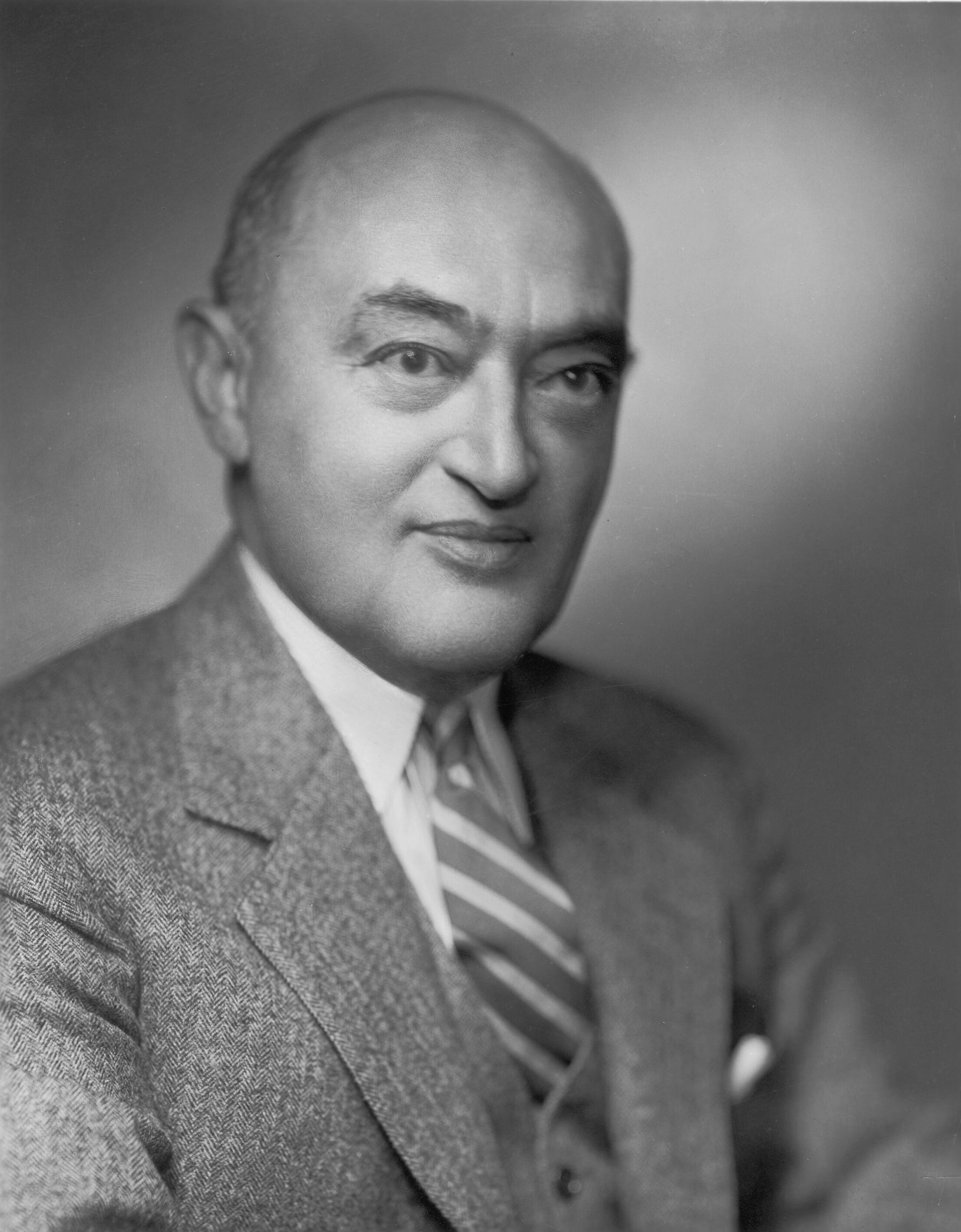
The gentleman who discovered the beating heart of capitalism
He called it 'creative destruction.' AI could prove him right
Joseph Schumpeter’s mother had an overriding ambition for her only child: to turn him into an English gentleman.
Born in what is now Czechoslovakia, Schumpeter began living like a gentleman in his 20s, when he left Vienna for a grand tour of European capitals. Visiting London, the future economist rented an apartment and rode his own horse in Hyde Park. He met and married the daughter of a Church of England official.
As biographer Thomas K. McCraw noted, Schumpeter never learned to cook, do laundry, drive a car or type his own manuscripts. But he did know how to wear a hand-tailored suit, seduce a woman and live beyond his means.
Schumpeter came from a German-speaking Catholic family that had operated a textile business in a small Czech town for generations. When his father died, apparently in a hunting accident, Joseph was four years old.
His mother Johanna took him to Graz, Austria’s second-largest city, where she enrolled young Jozsi in a good school. Later, after marrying a much-older Czech aristocrat, Johanna traded up to an apartment in Vienna, the Habsburg capital.
The city was a perfect breeding ground for a budding intellectual — a crossroads for people from all over Eastern Europe and a hothouse of ideas. Joseph attended one of the world’s finest institutions of higher learning, the University of Vienna.
Here was a young man who not only appreciated tradition but followed it in his daily life. Yet there was something surprisingly radical about Joseph Schumpeter.
He would soon unveil a complete re-thinking of the dynamics of capitalism. His vision, first described 115 years ago, is startlingly relevant to our own times. Other economists saw capitalism in static terms, like a still photo. Schumpeter understood it as a rapidly moving picture.
The impact of AI
Today, all appears in flux. The rapid advance of artificial intelligence is seen as a threat to the future of enterprises as big as Microsoft and as small as a lawyer’s office on Main Street. Companies are avoiding hiring as they try to figure out where this is all headed.
The economic upheaval is coinciding with a turbulent political climate, driven by an uninhibited White House making new demands on the private sector. Netflix, a company that used to mail out movie DVDs, is trying to take over the century-old Warner Bros., Hollywood’s premier studio. The Washington Post is gutting its newsroom after its publisher failed to devise a strategy to reduce losses.
Expect far more disruption. Last month, Anthropic CEO Dario Amodei wrote, “We are now at the point where AI models are beginning to make progress in solving unsolved mathematical problems, and are good enough at coding that some of the strongest engineers I’ve ever met are now handing over almost all their coding to AI.” His company’s products include Claude and Claude Code. If the trend continues, Amodei predicted, “then it cannot possibly be more than a few years before AI is better than humans at essentially everything.”
In an essay posted this week that’s been viewed 74 million times, Matt Shumer wrote, “The experience that tech workers have had over the past year, of watching AI go from ‘helpful tool’ to ‘does my job better than I do’, is the experience everyone else is about to have. Law, finance, medicine, accounting, consulting, writing, design, analysis, customer service. Not in ten years. The people building these systems say one to five years. Some say less. And given what I've seen in just the last couple of months, I think ‘less’ is more likely.”
Joseph Schumpeter wouldn’t have been surprised. “The opening up of new markets” and technological change within industries, Schumpeter wrote in 1942, elaborating on ideas he first expressed in 1911, “revolutionizes the economic structure from within, incessantly destroying the old one, incessantly creating a new one. This process of Creative Destruction is the essential fact about capitalism.”
He gave a vivid example: Assume there are a number of retailers who compete by the services they provide for customers without undercutting each other’s prices. If new retailers move in to the neighborhood, the existing ones may cut a deal among themselves: to raise their prices in unison, even if it means they lose some sales. Schumpeter calls this process “pyramiding.”
But he argued, that is not a viable long-term strategy: “The competition that matters arises not from additional shops of the same type, but from the department store, the chain store, the mail-order house and the supermarket which are bound to destroy those pyramids sooner or later.”
The Amazon effect
Take Amazon, founded in July, 1994 by Jeff Bezos, who is now also the owner of the Washington Post. It was an online bookstore, initially called Cadabra and run out of his garage in Bellevue, Washington.
In 1999, Amazon expanded to selling music and videos; the next year it allowed third parties to sell on its website. In 2005, it rolled out Amazon Prime. In 2006, it created Amazon Web Services, which provides cloud-computing resources to other companies. It unveiled the Kindle e-book reader in 2007. It became a giant seller of digital advertising, as did Google and Facebook.
How many book and music outlets, hardware stores, newspapers, radio stations, magazines, mail-order firms and providers of back-office services have been wiped out by Amazon’s expanding presence? The toll is in the tens of thousands.
Last week, Amazon reported fourth-quarter revenues of $213 billion, with net income of $21.2 billion. For the full year, its net income was $77.7 billion. Yet its stock fell 8% after the company revealed that it would raise its 2026 capital spending plan to $200 billion.
Why is Amazon, like the other tech giants, plowing huge sums into capital spending? To build data centers that would allow it to compete aggressively in the AI space. In other words, the companies that a quarter-century ago were up-ending established corporate empires, using technology to threaten their business models, are now themselves at risk of seeing AI companies make them economically irrelevant.
It’s hard to think of a better example of Schumpeter’s view that, “Economic progress, in capitalist society, means turmoil.” There are always new opportunities, either to produce new products or make old ones more cheaply.
He wrote:
These new products and new methods compete with the old products and old methods not on equal terms but at a decisive advantage that may mean death to the latter. This is how “progress” comes about in capitalist society.
As Thomas McCraw, a Harvard Business School professor and Pulitzer Prize winner, said in a 2007 interview, “Schumpeter wrote that all firms must try, all the time, ‘to keep on their feet, on ground that is slipping away from under them.’ So, no serious businessperson can ever completely relax. Someone, somewhere, is always trying to think of a way to do the job better, at every point along the value chain. Whatever has been built is going to be destroyed by a better product or a better method or a better organization or a better strategy.”
Is the disruption AI is causing an example of Schumpeter’s thesis or something fundamentally different?
The duel
At 26, Joseph Schumpeter landed a job as an associate professor at the University of Czernowitz, which is now part of Ukraine. There “he liked to disrupt faculty meetings by showing up late, still clad in jodhpurs and helmet from his daily horseback rides,” McCraw wrote.
Schumpeter assigned his students a lot of reading. They complained about a librarian who wouldn’t let them check out the books. This angered the young professor, who went to the library to express his outrage.
In what may have been a first for a librarian, he declared the dispute a matter of personal honor — and challenged Schumpeter to a duel. Neither excelled at sword play. Their seconds stopped the duel after the librarian sustained a cut on his shoulder. From then on, students were allowed to check out the books, and Schumpeter and the librarian became friends.
The more serious business for Schumpeter at Czernowitz was the writing of The Theory of Economic Development, published in 1911. At the center of his conception of capitalism was the entrepreneur — “the modern type of captain of industry.”
“The entrepreneur,” McCraw wrote, “in contrast to the ordinary manufacturer or merchant, is not merely overseeing the daily flow of production and consumption but is actually crafting the future.”
It is new companies that drive this process. They “do not arise out of the old ones but start producing beside them,” wrote Schumpeter. “It is not the owner of stage-coaches who builds railways.”
Entrepreneurs can’t do this on their own, however. They need capital to finance their innovations; so the credit markets and particularly, investment bankers, are crucial.
Schumpeter’s book received rave reviews from economists; he had already moved on to the University of Graz when his rising profile led to the offer of a visiting professorship at Columbia University.
He sailed to New York on the Lusitania in 1913, two years before that ship’s sinking by a German U-boat would help draw the U.S. into World War I.
But when Schumpeter arrived in the U.S., the world was still at peace. He made the most of his stay in the country, traveling widely and speaking at 17 universities. America was a congenial environment. The nation’s rapid industrial progress vindicated the economist’s belief in the vital role of entrepreneurs.
Gladys Schumpeter chose not to come to the U.S. and instead returned to England. Their marriage was in decline, though they didn’t legally end it.
When war broke out in Europe in 1914, the vision of “entrepreneurial, future-oriented capitalism” described by Schumpeter was shoved aside by the two alliances of nations that fought for power, McCraw observed.
The Habsburg empire would be one of the war’s casualties. The peace treaties negotiated in 1919 whittled Austria down to a remnant nation without the power to dictate its own fate.
But the chaos let loose by the war provided opportunities for Schumpeter. The first was to join Austria’s government as finance minister, where his brief stint ended in failure. A second chance enabled him to gain a stake in a bank and amass enough money to invest. He built and lost a small fortune. Deeply in debt that would take him years to pay off, he returned to the academic world as a professor at the University of Bonn.
‘All light has gone out’
On November 5, 1925, Schumpeter married for the second time. It’s hard to understand why someone of his brilliance didn’t fully clear up the legal status of his first marriage before exchanging vows again. A new law in Vienna allowed unhappy partners to terminate their marriage, and Joseph received that approval, but it must have been invalid since Gladys wasn’t informed.
In any event, Joseph and Anna Reisinger, who was 20 years his junior, were married in a Lutheran church, in light of the Catholic prohibition on divorce. Schumpeter had known Anna a long time. Her father was the concierge of the Vienna apartment building where his mother Johanna lived.
Schumpeter had many affairs, but Anna appeared to be his deepest love. They moved together to Bonn, where Joseph attended social events accompanied by his new wife, who he presented as a fellow aristocrat, according to McCraw.
Then within a six-week period, his world collapsed. On June 18, 1926, a telegram arrived from Vienna: Schumpeter’s 65-year-old mother had suffered a life-threatening cardiac event. She died four days later.
Meanwhile, Anna was struggling with a difficult pregnancy. On August 3, she died in childbirth. Their son survived for only four hours.
These were blows from which Schumpeter could scarcely recover.
As McCraw wrote:
Every morning for the rest of his time in Bonn, he walked a half-mile to the cemetery and laid a single rose on Annie’s grave. He kept death masks of her and their child in a prominent place, preserving the rest of the house just as it was. For years he could not bring himself to remove her clothes from the closet.
He wrote to a friend four weeks after Anna’s death, “of course, my days are falling slowly into their new order but… all light has gone out of them.” (That last phrase was almost exactly what Theodore Roosevelt wrote in his diary in 1884, when his mother and wife died in his home on the same day. His infant daughter Alice survived.)
Schumpeter tried to lose himself in his work, delving more deeply into the history and dynamics of capitalism, but he remained scarred by grief. For decades, he wrote diary entries addressing his wife and mother.
A star at Harvard
He traveled to the U.S. again, this time for a visiting professorship at Harvard University, which sought to hire him permanently. After several years of splitting his time between the U.S. university and Bonn, Schumpeter moved to Cambridge for a full-time role at Harvard.
There he met, and eventually married, an accomplished 35-year-old grad student in economics, Romaine Elizabeth Boody Firuski. She had earned the first summa cum laude degree in economics from Radcliffe College and would go on to partner with Schumpeter in researching his longest book, the 1,260-page History of Economic Analysis.
At Harvard, Schumpeter was a supportive mentor and faculty colleague — and a star in the classroom. His student, the future Nobel Prize-winner Paul Samuelson, recalled that Schumpeter '“wore a variety of well-tailored tweeds with carefully matched shirt, tie, hose and handkerchief.”
Attending one of his lectures was an experience, McCraw observed:
At precisely the appointed. hour, he would make his entrance into the filled classroom, then remove his trademark topcoat, fedora, and gloves — “slowly, finger by finger, as everyone watched,” a student recalled. “It was all very dramatic.” Next, Schumpeter would write something on the blackboard, then whirl around and begin his lecture. Speaking in an aristocratic Viennese accent, he gave the impression of complete spontaneity, even though he prepared every class with meticulous care. Using no notes, he dazzled students with his erudition. “He never told jokes,” Samuelson remembered, “but somehow made the class itself seem witty.”
Why capitalism?
Schumpeter’s analysis raises a central question: If the economy is in perpetual turmoil, if no one in business can ever ever sleep soundly, if destruction of companies and jobs never ends, why is the capitalist system worth preserving?
The simple answer: it brings millions out of poverty, continually raising the average person’s standard of living and contributing to unprecedented increases in life expectancy.
“Capitalism — in the form of enterprise and trade — has been the driving force behind the most remarkable decline in global poverty ever witnessed in human history,” wrote Eugenie Joseph, an analyst at the Centre for Independent Studies. “In the past 200 years, extreme poverty has collapsed from a whopping 94% of the entire world population to less than 10% today.” No other economic system has had this profound effect.
In the developed world, people today live better than the kings and queens of old. “Queen Elizabeth owned silk stockings,” wrote Schumpeter, referring to the first Elizabeth, the English queen who reigned in the 16th and early 17th century. “The capitalist achievement does not typically consist in providing more silk stockings for queens but in bringing them within the reach of factory girls in return for steadily decreasing amounts of effort.”
The railroad revolution
Schumpeter wrote extensively about the rise of railroads in America. In the 1840s, they were introduced to move goods from factories to ports. Over the next 50 years, entrepreneurs built a web of railroad lines connecting all parts of the United States.
That drastically lowered the cost of transporting goods and revolutionized industries including coal, oil and steel. Immigrants poured into the U.S. to live on “free or cheap land along the new rail lines,” as McCraw noted. Thousands of new communities sprang up across the country. The railroad industry itself got disrupted and transformed through price wars and mergers.
“The consolidation of the railroad system foreshadowed hundreds of other mergers in manufacturing, distribution and retailing,” McCraw observed. “From 1897 through 1904, 4,227 American companies merged into 257 large entities.” Among them: PepsiCo, Kellogg, Gillette, Monsanto, 3M and Texaco.
The disruption that AI is expected to cause could be an epochal cycle like that of the railroads. Or it could be a far more relentless process, since it relies on a technology that is becoming more divorced from human control and potentially resistant to attempts to regulate it.
Capitalism vs. socialism
When Schumpeter wrote what became his masterwork, Capitalism, Socialism and Democracy, capitalism and democracy appeared to be in retreat around the world. Many American intellectuals spoke glowingly of life in the Soviet Union, which became a U.S. ally after Hitler invaded Russia. Socialism seemed poised to spread after the war’s end.
Wisely judging his audience, Schumpeter didn’t come in with guns blazing to declare his support for capitalism. Instead he began the book with praise, and subtle criticism, of Karl Marx. He credited Marx as a genius for his work in history and economics, while pointing out all the ways Marx’s system failed to grasp the true nature of capitalism.
While Marxism is built on the concept of class struggle between the proletariat and the bourgeoisie, in fact, Schumpeter noted, workers and their bosses are essentially partners who jointly benefit when their companies do well. Schumpeter wrote that Marxist predictions of the “growing misery of the masses” were contradicted by their improving standard of living.
The book makes what many believe is a tongue-in-cheek argument that socialism can succeed, and Schumpeter even writes that he believes capitalism will ultimately fail. He clearly was aware of capitalism’s downsides. It “creates a critical frame of mind which, after having destroyed the moral authority of so many other institutions, in the end turns against its own.” It “creates, educates and subsidizes a vested interest in social unrest,” he wrote, pointing to intellectuals who, though supported by the wealth of the system, fail to understand how it works.
Writing in the midst of the deadliest war in the human history, he at times appeared pessimistic about the future. But there was no mistaking the warning he gave about socialism.
Just as it proved in the history of the Soviet Union, a socialist system would not be tranquil.
“Effective management of the socialist economy means dictatorship not of but over the proletariat in the factory….As a matter of practical necessity, socialist democracy may eventually turn out to be more of a sham than capitalist democracy ever was.”
Answers
On December 21, 1943, Schumpeter wrote in his diary: “Two kinds of people I distrust: architects who profess to build cheaply and economists who profess to give simple answers.” He never fell into that trap. Schumpeter’s work was layered, subtle and designed to provoke discussion, rather than close it off.
If he were asked about the upheaval that AI could cause, he probably would have had a nuanced answer — a mixture of admiration for the AI entrepreneurs’s innovations and an appreciation of the real harm that could be done to many careers.
As Schumpeter aged, he brooded about his health and mortality. At the same time, his work was beginning to receive more attention and praise. In the years following World War II, Capitalism, Socialism and Democracy became a must-read book not only for students of economics, but also for those of history and politics. He became the first foreign-born thinker elected president of the American Economic Association.
He balanced worries about his own health with caring for his wife Elizabeth as she survived surgery following a diagnosis of breast cancer.
On January 8, 1950, Schumpeter died suddenly of a cerebral hemorrhage at their country home in Taconic, Connecticut. Elizabeth died three years later, having shepherded the History of Economic Analysis into print.
The shadow of Keynes
As McCraw notes in his biography, Prophet of Innovation, Schumpeter spent much of his career in the shadow of a true English gentleman, the world-famous economist John Maynard Keynes.
Educated at Eton and Cambridge and elevated to the House of Lords, Keynes developed the playbook that many governments used to counter economic downturns. His work focused more on policies for running the overall economy than on the dynamics of how things actually work on the ground, the area Schumpeter specialized in.
In 1984, a German professor wrote in the American Economic Review that “the age of Schumpeter was replacing the Age of Keynes,” and in December, 2000, Business Week ran an article headlined, “America’s Hottest Economist Died 50 Years Ago.”
The Age of Schumpeter endures today. You can update that Business Week headline to “76 years ago.”


Fascinating reflection on the underrated Schumpeter. I first read Schumpeter (or tried to) years ago as a graduate student studying the interplay between culture and economics in Japan's emergence as a global economic power. The AI debate takes Schumpeter's idea of creative destruction to a whole new level for sure. If one assumes (not necessarily correctly) that AI will do literally any kind of work better, more efficiently, and more effectively than any mere human beings can, that raises an interesting question about the utility of humans. Or what we are for. And this is without taking into consideration the so-called alignment problem. Could it be that, without any problems to solve, the problem-creating animal has no purpose? Somehow I have a hard time imagining a wildcatter in Wyoming or a frenetic shouting trader on Wall Street donning Monk's robes and walking the globe contemplating the clouds or their navels or the meaning of life. But there may be hope. Nicely done.
Rich -- A little skeptical on capitalism, seriously unconvinced about AI. Just heard today a second Jimmy Breslin biography is in the works. When AI can write the way Breslin did about Clifton Pollard, the man summoned to dig JFKs grave at Arlington, I'll reconsider. Thanks for another heroic piece of work. https://ccnyintroductiontojournalism.com/2025/03/13/jimmy-breslins-grave-digger-story/