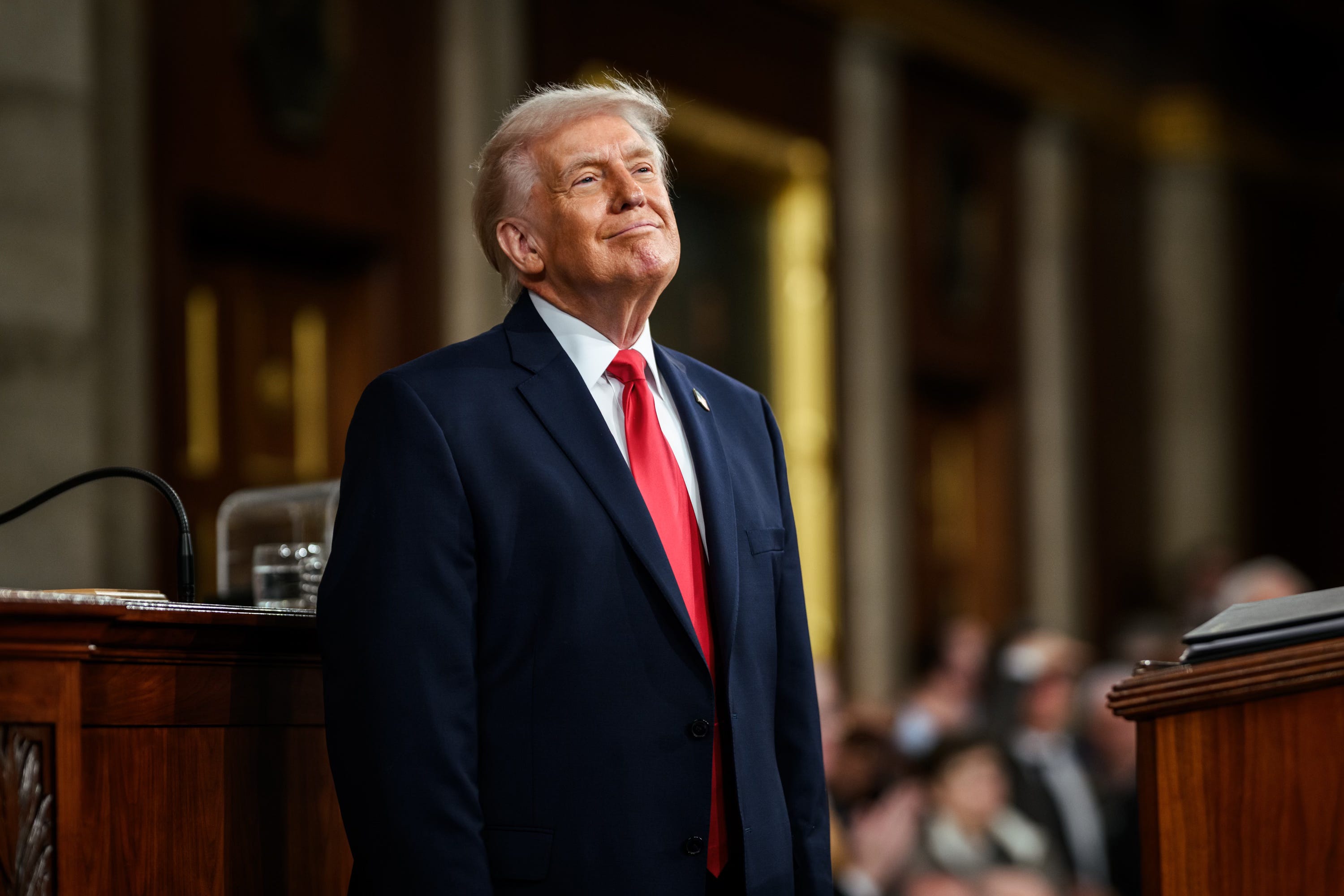
The medal that Trump can't give himself
'The bride at every wedding' effect

On October 12, 1945, President Harry S. Truman presented the Congressional Medal of Honor on the South Lawn of the White House to 15 members of the U.S. military who showed valor on the European and Pacific battlefields in the world war that had just ended.
“I would much rather have that Medal around my neck than to be President of the United States,” Truman said. “It is the greatest honor that can come to a man. It is an honor that all of us strive for, but very few of us ever achieve.”
They were just “doing their duty. They didn’t think they were being heroes.”
“Now these young men will go back and become citizens of this great country, and they will make good citizens; and you won’t find any of them bragging about what they have done or what they propose to do.”
That expression of humility was about as far as it is possible to go from the braggadocio of President Donald Trump’s 108-minute State of the Union address on Tuesday.
Channeling Regis Philbin as a game show host and Roger Ailes as an executive producer, the president dispensed balm to heroes, gold medal winners, survivors of crimes and ordinary citizens in the House gallery. He gave out a Purple Heart and two Congressional Medals of Honor — one to a helicopter pilot wounded in the January 3 raid that captured Venezuelan President Nicolás Maduro and the other to a 100-year-old veteran of World War II, the Korean War and the Vietnam War for his actions in an air battle over Korea in 1952.
Thanking the two recipients, Trump said, in a joking manner, “I’ve always wanted the Congressional Medal of Honor, but I was informed I’m not allowed to give it to myself, and I wouldn’t know why I’d be taking it. But if they ever opened up that law I will be there with you someday. But you know, that’s our highest honor, the Congressional Medal of Honor. And that’s a big thing. And it’s an honor to be in the same room with you. Thank you both very much. Thank you.”
It was pure Trump, an offhand remark subject to interpretation. A joke, except that it came from the man who put his name on the John F. Kennedy Center in Washington and appointed himself chairman for life of the “Board of Peace,” a wannabe United Nations he created.
How could they “open up that law” to enable Trump to qualify? The Congressional medal was created during the Civil War. Sen. James W. Grimes of Iowa introduced a bill to allow the Navy to grant medals of honor to “such petty officers, seamen, landsmen and marines as shall distinguish themselves by their gallantry in action and other seamanlike qualities during the present war.” President Abraham Lincoln signed that bill and a later one to provide medals for members of the Army.
Trump, a graduate of a military high school, avoided serving during the Vietnam War, thanks to student deferments and a doctor’s letter attesting to his suffering from heel spurs.
Perhaps Trump’s musing about the Medal of Honor is just another instance of his insistence on making himself the center of everything. He’s not the first president to feel that way. Theodore Roosevelt’s daughter Alice Roosevelt Longworth famously remarked of her father, “He wanted to be the corpse at every funeral, the bride at every wedding, and the baby at every christening.”
Trump basked in the reflected glory of the U.S. Men’s Hockey Team’s gold medal overtime victory over Canada. He spoke about meeting with the team in the Oval Office. In a confiding tone, he added that he had asked the team to vote on giving Connor Hellebuyck the Presidential Medal of Freedom for fending off 41 out of 42 shots on goal in the deciding game.
“The members of this great hockey squad will be very happy to hear based on their vote and my vote — and in this case, my vote was more important — that I will soon be presenting Connor with our highest civilian honor…” It came across a bit better than FBI director Kash Patel’s jumping up and down and spraying beer in the team’s locker room celebration after the victory in Milan.
One-man rule
Trump’s speech served as a reminder of the perils of a government based on the personal appeal of one person. He gained energy from the enthusiasm of Republicans and attempted to shame the Democrats for not standing up when he said:
If you agree with this statement, then stand up and show your support. The first duty of the American government is to protect American citizens. Not illegal aliens
Trump paused for one minute and 50 seconds while Republicans applauded, whistled and cheered. The president smirked and waved his hand to emphasize the refusal of Democrats to stand up. For many, it seemed like an excruciating moment. Members of the opposition party stared grimly as Rep. Ilhan Omar shouted a reminder that ICE had “killed Americans” in Minneapolis.
It was no surprise that Trump seemed most at home when he was trafficking in “wedge issues” — immigration, sanctuary cities, DEI, Obamacare, transgender treatment — where there is a divide that can energize the GOP base and provoke Democrats.
He was less adept at dealing with “affordability,” the issue that Democrats hope to ride to victory in the November midterm elections. There is no pro- and anti- position on affordability, a concern that unites Americans across party lines.
He tried to tie the sharp rise in inflation during the Covid-19 pandemic to President Joe Biden’s policies. “Now the same people in this chamber who voted for those disasters suddenly use the word ‘affordability,’” Trump said. “A word, they just used it. Somebody gave it to them, knowing full well that they caused and created the increased prices that all of our citizens had to endure. You caused that problem.”
What is the plan for the Republican Party post-Trump? The president had praise for Vice President J.D. Vance and Secretary of State Marco Rubio Tuesday night, but is keeping his options open. The side-lining of Congress in the past year means that few Republican legislators have been able to gain public recognition, a potential prelude to running for president in 2028.
In the closing section of the speech, Trump marveled at the fact that we are just two centenarian lifespans away from the death of Thomas Jefferson on July 4, 1826, the 50th anniversary of the Declaration of Independence. (John Adams also died on that day, of course.) But for the nation observing its 250th birthday this year, another timespan is also very noticeable.
Stunningly, Donald Trump has dominated American politics over a 10-year span, from his 2016 victory, to his denial of defeat in 2020, to his second term. And he has nearly three more years in office. His message of closed borders, lower crime rates and economic prosperity still has political appeal, but do Americans consider him a credible messenger? Only 36% of Americans approve of Trump’s performance in office, according to a CNN pre-speech poll. His approval rating among independents has fallen to a new low of 26%.
In a businesslike response, recently elected Virginia Gov. Abigail Spanberger summed up Trump’s vulnerability:
In his speech tonight, the President did what he always does: he lied, he scapegoated, and he distracted. He also offered no real solutions to our nation’s pressing challenges — so many of which he is actively making worse.
He tries to enrage us, to divide us, to pit us against one another. Neighbor against neighbor. And sometimes, he succeeds.
Desmond Doss
One of the men honored by President Truman on the South Lawn 80 years ago was Desmond T. Doss, of Lynchburg, Va.
As a Seventh Day Adventist, Doss was opposed to bearing arms in war. He could have gotten a deferment for that reason, but he enlisted as a medic. Members of his unit bullied him and even threw boots at him as he prayed.
“Several attempts were made to remove the man they felt was a coward and a detriment to the unit,” according to an article posted by the National WWII Museum. “His commanding officers attempted to have him discharged for mental illness, but he refused to accept, stating he could not agree to a discharge due to his religion.”
In 1944, Doss showed bravery in treating wounded soldiers in Guam and Leyte; he was awarded two Bronze Stars.
But he earned his Medal of Honor in Okinawa. His company climbed cargo nets to the top of a 400-foot-high cliff. They were seeking to root out Japanese soldiers entrenched on what became known as “Hacksaw Ridge.” Doss treated wounded soldiers and refused an order to retreat.
The museum’s account added:
An estimated 75 men remained behind, too wounded to retreat under their own power. He would not leave them behind. Doss successfully rescued 75 men trapped at the top of the escarpment by lowering them with a special knot he knew. He had miraculously not been wounded and stayed in the fight with B Company.
On May 21, Doss was wounded several times by grenade fragments and a sniper’s bullet through his arm. He continued to put others first, refusing treatment before those more seriously wounded. Due to his extensive wounds, Doss was evacuated in late May.
Doss spent more than five years in hospitals recovering from his wounds and tuberculosis, which he contracted on Leyte. “He devoted himself to his religion and worked with young people in church-sponsored programs, living for many years in Rising Fawn, Ga., before moving to Alabama,” a New York Times obituary said.
Doss died in 2006 at the age of 87. His courage stands out, in part because he was the only conscientious objector to gain the Medal of Honor in World War II — and because of his humility. His citation says he saved 75 lives, but Doss set the record straight: it was closer to 50.


This is just wonderful Richard.....without doubt both those men deserved this honor...but it seems so like Trump that one of them would be pinned for action during what was effectively little more than a legalized kidnapping !
