The most powerful weapon Trump has to open the Strait of Hormuz is the one he least wants to use
Hugo Grotius figured it out in 1609

At the age of 15, Hugo Grotius so impressed Henry IV, king of France, with his intelligence that the monarch declared him “the miracle of Holland.”
At 17, the budding Dutch legal scholar argued his first case. Soon he would be named Attorney-General of the provinces of Holland, Zealand and West Friesland. But Grotius chose the losing side in a 17th Century theological dispute that had explosive political ramifications.
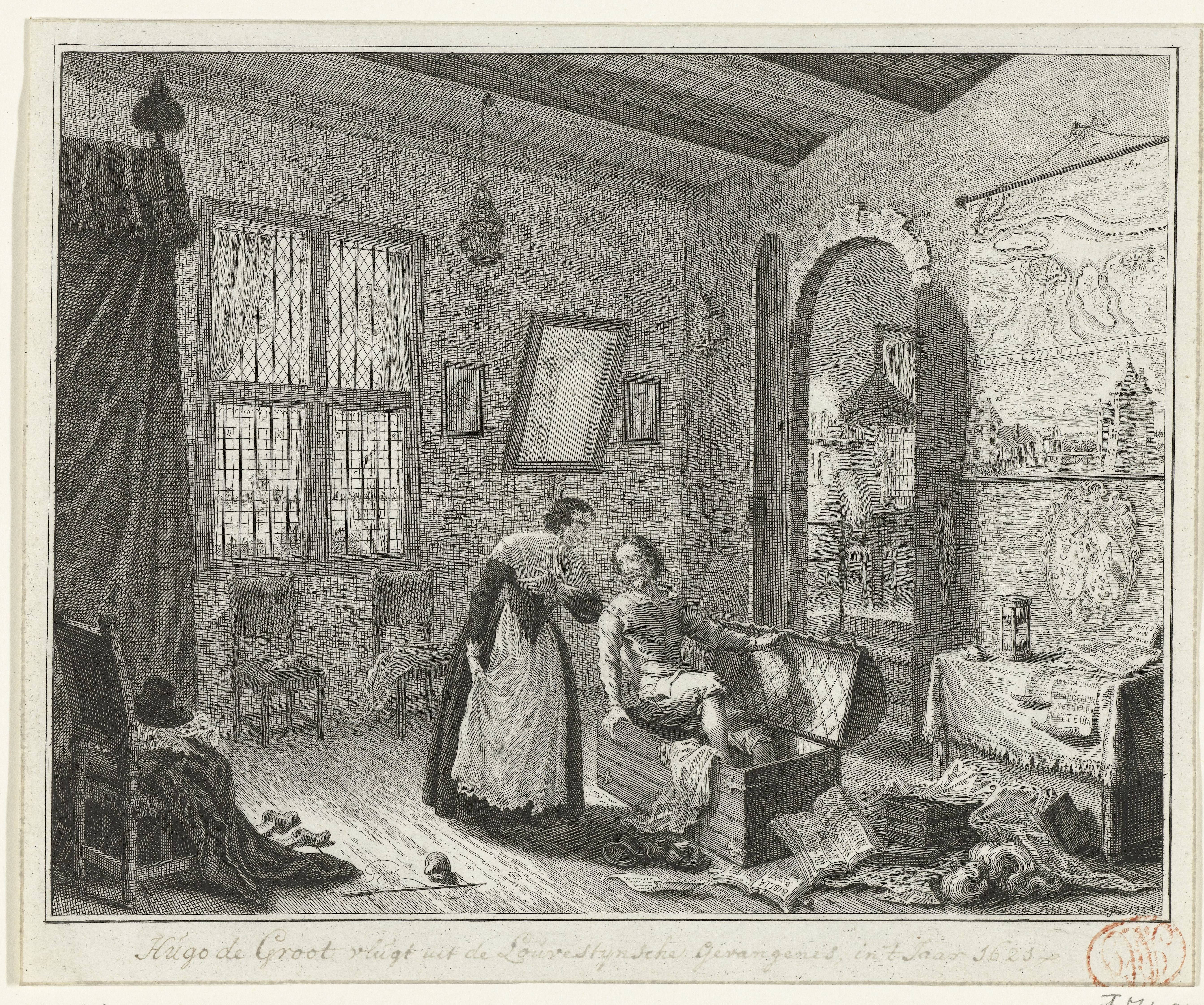
That was why Prince Maurice of Nassau imprisoned Grotius, then in his mid-30s, for life at Loevestein castle. The inmate’s clever wife Maria gained permission to move into the castle. As the vigilance of the guards gradually waned, Maria saw an opportunity. She told the wife of the warden that Hugo was sick from overwork and vowed to get rid of his borrowed books.
Maria had air holes drilled into a wooden book chest. She persuaded Hugo to curl up inside the container, which biographer Samuel Butler says was no more than three and a half feet long. Soldiers carried it to a boat, thinking they bore a particularly heavy load of books and accompanied by a maid who may have inhibited them from opening it. At a nearby town, the chest was taken to the home of a friend of Grotius, who set him on the road to freedom.
The escape, on March 22, 1621, has its historical resonances: a scholar literally finding his salvation in books, an imprisoned philosopher of freedom achieving his own liberty. Yet in our own time, the Dutch thinker commands attention because of his eloquent defense of the freedom of the seas.
“Every nation is free to travel to every other nation, and to trade with it,” Grotius wrote, in 1609’s Mare Liberum (The Free Sea). “For do not the ocean, navigable in every direction with which God has encompassed all the earth, and the regular and the occasional winds which blow now from one quarter and now from another, offer sufficient proof that Nature has given to all peoples a right of access to all other peoples?”
This is the principle at stake when any nation attempts to seize control of a narrow waterway and asserts a right to decide who shall pass. Iran’s effort to rule over (and profit from) traffic in the Strait of Hormuz, through which 20% of the world’s oil normally transits, is a clear violation of the freedom of navigation Grotius advocated more than 400 years ago.
For more than two centuries, American presidents and the U.S. Navy have led the charge to open such chokeholds. Most nations would support that principle and stand with the U.S. Indeed the Navy sent two destroyers into the strait Friday to try to demonstrate a commitment to freedom of navigation.
But President Donald Trump is particularly ill suited for the role of free-sea advocate. He recently scoffed at legal principles for the planet. “I don’t need international law,” he told the New York Times in January. “I’m not looking to hurt people.” He said then the only constraint on his power was “My own morality. My own mind. It’s the only thing that can stop me.”
Moreover, he repeatedly trashes America’s allies and has denied that they and the U.S. have a common interest in opening the strait. He told NATO allies to find a way to solve the problem on their own.
“The United States imports almost no oil through the Hormuz Strait and won’t be taking any in the future,” he said in his primetime speech to Americans. “We don’t need it.” That of course ignores the importance of traffic through the strait in restraining the prices Americans pay at the gas pump and the impact of blocked deliveries of fertilizer on the world’s food supply.
Last week Trump floated the idea of a “joint venture” with Iran to control the strait; that’s not freeing up the sea but rather proposing to share in the ill-gotten billions Iran may reap by charging tolls.
The president seemed to change course Sunday, when he declared the U.S. Navy would blockade the strait to prevent ships that pay a toll to Iran to travel out of it.
Other American leaders have understood that if one nation can illegally dominate a vital chokepoint, the principle that the seas can be used as an open highway — a rule that benefits all of us — will be threatened.
Hormuz isn’t an isolated case; there are “more than 100 straits used for international navigation of critical importance for global commerce and military transit,” said John Norton Moore, in a 2017 speech at the U.S. Naval War College. Moore is a University of Virginia Law School professor emeritus who served as chair of the U.S. National Security Council Interagency Task Force on the Law of the Sea and ambassador and deputy special representative of the president to the law of the sea conference.
As the Financial Times pointed out, there are some limited examples of tolls charged for waterways: “Experts suggest the Bosphorus, a Turkish territorial waterway, is the nearest comparison to Hormuz. It is governed by the Montreux Convention, which allows Ankara to charge ships not for transit but for lighthouse, health inspection and rescue services, calculated based on net tonnage. The revenues amount to about $250 million from ships that do not dock.”
The stakes in the overall cause of free seas are enormous: more than 80% of the world’s goods are traded by sea, and the oceans — making up 71% of the earth’s surface — are the prime arena for projecting military power.
Grotius
In advocating a free sea, Grotius wasn’t writing in a vacuum. He was avidly promoting his own national and financial interest in allowing ships of the Dutch East India Company to trade in Asia. He condemned the Treaty of Tordesillas, which sought to divide the seas into areas controlled either by Spain or Portugal.
As Martine Julia van Ittersum wrote in a 2010 article in the journal History of European Ideas, “Grotius cooperated closely with the directors of the Dutch East India Company in the years 1604-1615….Right up to his arrest for high treason in August 1618, he contributed towards Dutch government discussions about the establishment of a West India Company (WIC). Three years of imprisonment at Loevestein Castle and, following his escape, long years of exile could not weaken his dedication to the cause.”
“In his view, the Dutch had gone to the Indies as merchants, not conquerors, and should regulate themselves according to natural law and the law of nations.”
The American belief in freedom of navigation also began as a self-interested move. The infant nation created in 1776 could not seriously challenge the British navy or the land forces of France; it sought to be a neutral nation profiting from the trade carried on ships.
Britain argued that the waters nearest her home islands were a narrow sea: “the King of Great Britain is Lord of the Sea flowing about, as an inseparable and perpetual Appendant of the British Empire," wrote John Selden, in his 1635 book Mare Clausum.
Britain seized American sailors and pressed them into serving in the British Navy. It commandeered U.S. merchant ships carrying goods intended for France and its colonies, and France did likewise to ships carrying goods headed for Britain. American vessels also had to contend with the Barbary pirates, who threatened maritime commerce for three centuries.
As James Kraska and Raul Pedrozo wrote in their 2018 book The Free Sea, the fate of those seized by the Barbary powers was even grimmer than those pressed into the British navy: “Chained to their oars, they sat, ate, slept, and defecated on a one-foot-wide bench; often they were not unchained for months at a time or until they collapsed from exhaustion and died — at which point they were thrown overboard.”
In 1794, Congress sought to oppose the Barbary threat by approving construction of six warships, including the Constitution, which remains a commissioned naval ship.
During the Quasi War with France in the late 1790s, Congress officially created the U.S. Navy and the Marines. From October, 1796 to June 1797,” Kraska and Pedrozo wrote, “French raiders captured 316 American ships” — six percent of the US merchant fleet. Marine insurance rates soared, from 6 to 30 percent of the cargo value. For ships bound to the West Indies, the insurance cost increased by as much as 600 percent.

U.S. warships saw repeated action, not only in the Quasi War, but in later battles against the North African powers and in the War of 1812 against the British. Naval combat would again deeply involve the U.S. as it sought to protect merchant ships from German submarines in World Wars I and II.
After those wars, the U.S. took the lead in pushing for free seas. In 1982, the United Nations Convention on the Law of the Sea was approved, with more than 160 countries participating in the process. It took effect in 1994. The U.S. Senate has not ratified the treaty, but America generally abides by its provisions.
As John Norton Moore observed:
The rule of law matters. Law serves to provide clear expectations as to jurisdictional boundaries and national rights and obligations so necessary for co-operative relations, economic life, and more broadly, human creativity. Thus, we need to know the breadth of the territorial sea, who manages coastal stocks of fish, the rules for straits transit and a myriad of other rules to function cooperatively in the oceans. If some states claim three nautical miles for the territorial sea and others two hundred nautical miles, we simply do not know the basic rules. But of even greater importance, the rule of law serves as a check on power. An oceans space driven by out-of-control national claims and a “might makes right” credo can neither serve community common interests nor restrain conflict. The Law of the Sea Convention is a remarkable achievement in the rule of law—providing both stability and a check on power.
The Law of the Sea established that nations could govern fishing, oil drilling and seabed mining within a 200-mile “exclusive economic zone” radiating outward from their coasts, but allowed other nations to send ships freely through those zones. Otherwise, more than half of all coastal nations would be effectively land-locked, Moore said.
But while there’s general agreement with the Law of the Sea, there are many clashes: for example, China asserts that its 200-mile zone is only open to foreign commercial ships; the U.S. maintains that military ships can travel freely through it.
Tanker War
In the 1980s, the Iran-Iraq war led to repeated attacks on shipping in the Persian Gulf and Strait of Hormuz, with Iran often adopting the tactics it is now trying to apply to prevent ship travel. Neutral ships, Kraska and Pedrozo noted, can be stopped and searched by nations that are at war, but they cannot be legally captured or destroyed. Both Iran and Iraq violated that rule, with nearly 500 ships attacked from 1980 to 1987.
“Iran repeatedly warned it would close the Strait of Hormuz to international shipping if Iraq succeeded in interdicting its oil exports,” wrote Kraska and Pedrozo. The U.S. caught Iran in the act of laying mines in the gulf, a violation of international law. The U.S. frigate Stark was attacked, perhaps accidentally, by an Iraqi fighter, killing 37 American sailors.
President Ronald Reagan said he wouldn’t let Iran control the strait. “Freedom of navigation is not an empty cliché of international law. It is essential to the health and safety of America and the strength of our alliance…”
The U.S., U.K. and Soviet Union sought to protect shipping by allowing foreign-flagged ships to be reflagged as their own. Following a UN Security Council resolution calling for an end to the Iran-Iraq war, the U.S. Navy provided a convoy for U.S.-flagged tankers in Operation Earnest Will. Five European nations also provided protection for ships.
The U.S. attacked an Iranian ship laying mines, as well as offshore oil drilling platforms that were being used by Iran’s Revolutionary Guards, as part of Operation Praying Mantis. Those counter-measures eventually ended the Tanker War.
“Three Iranian command-and-control platforms were destroyed. Six Iranian vessels were sunk and the [Iranian frigate] Sabalan heavily damaged,” Kraska and Pedrozo wrote. “The United States lost one AH-1 attack helicopter…and its two-man crew.”
Tragically, a U.S. Navy ship, the Vincennes, wrongly assessed a civilian airliner as an incoming missile, and shot it down, killing 290 people. The U.S. expressed regret and paid $131.8 million in compensation.
Summing up the lesson of the Tanker War, Kraska and Pedrozo noted, “Iran’s decision to forego further challenges to U.S. naval power in the Persian Gulf and halt attacks on U.S.-flagged shipping illustrates the country’s typical characteristic of de-escalation when confronted with a determined, superior force.”
The Law of Reason
The history of conflict over the free seas demonstrates the need for calm, determined leadership. Will we get that from Donald Trump?
This is another area in which Hugo Grotius can be a helpful guide. The Dutch philosopher believed in the importance of reason, even when it threatened to diminish the claims of religion.
"Now the Law of Nature is so unalterable, that it cannot be changed even by God himself,” he wrote in The Law of War and Peace. “For although the power of God is infinite, yet there are some things, to which it does not extend.” Even God, he wrote, can’t deny that two plus two equals four, nor make something that is evil not evil.
Moreover, he argued, a person can only lead others if he is in control of his own inclinations and can submit to reason.
“A man cannot govern a nation if he cannot govern a city; he cannot govern a city if he cannot govern a family; he cannot govern a family unless he can govern himself; and he cannot govern himself unless his passions are subject to reason.”


