The other thing that happened on July 4, 1776
Three legendary Founding Fathers fumbled. Then a forgotten one got it done

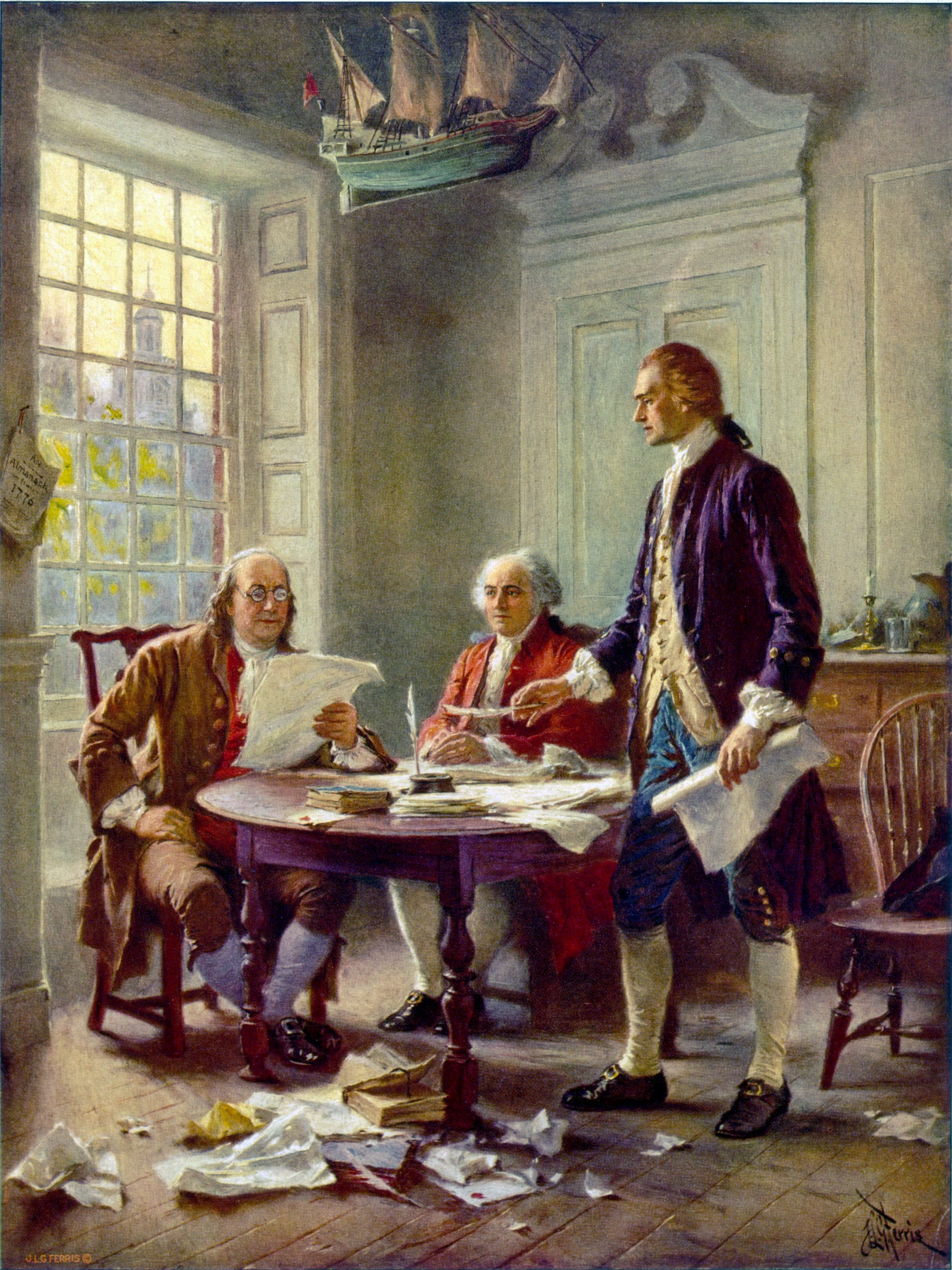
A few hours after the Continental Congress adopted the Declaration of Independence on July 4, 1776, it agreed on another resolution. The Congress appointed a committee of three men to create a seal for the United States of America.
The three were among the ablest members of the body that had committed to rebellion against Britain: John Adams, Benjamin Franklin and Thomas Jefferson. Adams, a bright and courageous Massachusetts lawyer, advocated persuasively for independence. Franklin, a Philadelphia printer, had gained fame for his writing, inventions and wisdom. Jefferson, a Virginia planter, thinker and politician, had drafted the Declaration of Independence.
For all their eminence, they were “peculiarly unqualified to suggest or compose a suitable design” for the seal, according to Richard S. Patterson and Richardson Dougall, the authors of The Eagle and the Shield: A History of the Great Seal of the United States.
Although the three consulted experienced Philadelphia artist and designer Pierre Eugene Du Simitière, they had about as much success in achieving their aim as President Donald Trump has had in turning Washington’s Reflecting Pool blue.
Perhaps it was the breadth of their learning that doomed the process. Franklin proposed that the seal show Moses preparing to part the sea and drown Pharaoh. Adams wanted it to depict the “Judgement of Hercules” as the mythical hero chose a life of virtue over vice.
Jefferson vacillated, at first proposing a seal showing the Israelites in the desert on one side and Anglo-Saxon chieftains on the other, before endorsing a Moses-Pharaoh theme.

The designer Du Simitière suggested a heraldic motif referencing the home countries of the American settlers and the names of the 13 colonies. He also recommended using the motto E Pluribus Unum (Out of many, one), apparently taken from the title page of a London publication Gentleman’s Magazine.
According to Patterson and Dougall, the three-member committee gave its report to Congress on August 20, 1776. They proposed using Du Simitière’s conception for one side of the seal and a version of Franklin’s Moses-Pharaoh scene on the other side.
This proposal was a dud; Congress tabled it. And there would soon be far more important things to worry about than the design of a seal for the infant nation. In the Battle of Long Island on August 27, General George Washington’s Continental Army was routed by a superior British force and forced into the first of many retreats.
Worth a cask of wine?
In March, 1780, Congress appointed three lesser-known names to a new three-member committee to take up the matter of the seal: James Lovell, John Morin Scott and William Churchill Houston.
They recruited a former member of Congress, Francis Hopkinson, who took charge of the project. He claimed credit for designing the U.S. flag and seals for New Jersey, the University of Pennsylvania and for government departments. In return for his proposed design — which included a sword-wielding warrior, an olive-branch-armed woman and Lady Liberty — and for other design projects including the national flag,
Hopkinson at first asked for a quarter-cask of wine in compensation. The next month, he changed his request, billing the government £2,700, including £600 for the design of the Great Seal. Congress didn’t pay him, possibly because he had been a government official at the time he did the work.
In 1782, Congress appointed yet a third committee of three on a “Device for a Seal of the U.S.” but the prime mover in finally achieving the goal was Charles Thomson, secretary to Congress. Thomson, together with congressional members Arthur Lee and Elias Boudinot, consulted William Barton on the design.
Barton’s proposal introduced the figure of an eagle which he described as the “symbol of supreme Power & Authority and signifies the Congress.” The report of the third committee went to Congress on May 9, 1782 and that body left the matter in the capable hands of Charles Thomson, Patterson and Dougall wrote.
Thomson’s life
“The name Charles Thomson is not widely known among the Founding Fathers of the United States of America.” So goes the undeniable opening of Lawrence Knorr’s introduction to Lewis Harley’s 1900 biography, The Life of Charles Thomson.
But Thomson deserves to be better known, if only for his involvement with the Declaration of Independence. “Few know that it was Thomson who helped edit the document, was the first to read it aloud, arranged for its distribution and printing, and affixed his name as the only other signer [aside from John Hancock, president of the Continental Congress] of the original document on July 4, 1776,” wrote Knorr. “Of course, the delegates signed the document the following month. Thomson signed as Secretary and not as a delegate. For that reason, he does not appear on many lists of the Signers of the Declaration of Independence.”
Born in County Derry, Ireland, Thomson and five siblings were orphaned aboard ship when their father died within sight of the Delaware shore in 1739.
An avid student, Thomson became a teacher and gained the support of an influential friend, Benjamin Franklin. When he left teaching, Thomson built a fortune from an import business, where he chafed at Parliament’s passage of the Stamp Act, and an ironworks that produced arms for the Continental Army. With a growing reputation for fairness and honesty, he had been chosen by the Lenape chief Tedyuscung to take notes of peace negotiations with the colonists.
Thomson was far-sighted. He wrote to Franklin in 1769 about Britain’s imposition of taxes on the colonies: “The people by examining have gained a fuller knowledge of their rights and are become more attentive and watchful against the encroachments of power…and as the property of land is parcelled out among the inhabitants and almost every farmer is a freeholder, the spirit of liberty will be kept awake and the love of freedom deeply rooted; and when strength and liberty combine it is easy to foresee that a people will not long submit to arbitrary sway.”
Similarly, he foresaw the threat to the nation posed by slavery. Writing to Jefferson in 1785, 76 years before the Civil War, Thomson observed, “This is a cancer that we must get rid of. It is a blot in our character that must be wiped out. If it cannot be done by religion, reason, and philosophy, confident I am that it will one day be by blood.” Jefferson, who owned about 200 slaves, wrote a denunciation of slavery into his original draft of the Declaration; his fellow members of Congress deleted it.
As a member of the Pennsylvania Assembly, Thomson was instrumental in persuading the people of the colony to join in the American Revolution, and it was in Philadelphia that the first Continental Congress convened in 1774.
Returning to that city days after his wedding, Thomson was surprised to be summoned to Congress, where he was told he had been unanimously elected secretary, a post he held until 1789. That year, he traveled to George Washington’s estate at Mount Vernon to tell the retired general that he had been elected the first president of the United States.
Getting it done
Thomson was “a man of high intelligence, self-disciplined, morally irreproachable, well read, a scholar and a learned man,” wrote Patterson and Dougall. While he knew little about heraldry, he knew how to get things done.
Once he was given responsibility for the seal project, he began sketching. “His major innovations were in promoting the eagle to a prominent position in the design, in placing a shield on the eagle’s breast (with chevrons on that shield), and in placing symbols of peace and war in the eagle’s talons,” noted Patterson and Dougall. Thomson made clear that it should be an “American eagle” and used the same Latin motto the first committee had proposed: E Pluribus Unum.
After consulting with Barton, who refined and expanded on the congressional secretary’s concept, Thomson submitted his report to Congress on June 20, 1782. Congress agreed to it that day. The six-year-long hunt for a seal was finally done.
In the final design, the eagle spreads its wings under 13 stars and behind a shield with 13 stripes. In one talon, the eagle grasps 13 arrows; in the other, an olive branch with 13 olives and 13 leaves.
As Patterson and Dougall added:
During the remainder of his period of service as secretary of Congress, Thomson enjoyed his responsibility as custodian of the seal and the designation he assumed as its “keeper.” When government under the Articles of Confederation and the Continental Congress came to an end in 1789, he tried to arrange a new position for himself under which he would retain control of it. When this failed he relinquished it reluctantly, delivering the die and press personally into the hands of President Washington.
After leaving government, Thomson embarked on an ambitious project. He spent 20 years translating the Bible from Greek to English. The book was published in 1808 by Jane Aitken, the first woman to publish the Bible in the U.S. Thomson died at the age of 94 in 1824.
Thomson’s friend Benjamin Franklin never succeeded in placing Moses on his country’s great seal. And perhaps in jest, he objected to the symbol that was chosen for his nation: the eagle.
Writing to his daughter about the eagle badge of the Society of the Cincinnati, Franklin noted that some people complained that the eagle looked too much like a turkey. He added:
For my own part I wish the Bald Eagle had not been chosen as the Representative of our Country. He is a Bird of bad moral Character. He does not get his Living honestly. You may have seen him perch’d on some dead Tree near the River, where, too lazy to fish for himself, he watches the Labour of the Fishing Hawk; and when that diligent Bird has at length taken a Fish, and is bearing it to his Nest for the Support of his Mate and young Ones, the Bald Eagle pursues him & takes it from him. With all this Injustice, he is never in good Case but like those among Men who live by Sharping & Robbing he is generally poor and often very lousy. Besides he is a rank Coward: The little King Bird not bigger than a Sparrow attacks him boldly & drives him out of the District…
The bald eagle has symbolized the American republic since 1782. But it was only in December, 2024 that it finally won designation as the national bird, thanks to legislation signed by President Joe Biden. Trivia fans, remember that for your next contest.


