
Trump faces a wrenching choice
Iwo Jima and the danger of 'boots on the ground'
On February 27, 1945, CBS Radio’s Don Pryor reported from the flying bridge of the U.S.S. Eldorado as Marines fought to take the Japanese-controlled island of Iwo Jima.
The operation’s overall commander, Navy Vice Admiral Richmond Kelly Turner, and Lt. Gen. Holland M. Smith of the Marines, put a positive spin on the bloody battle.
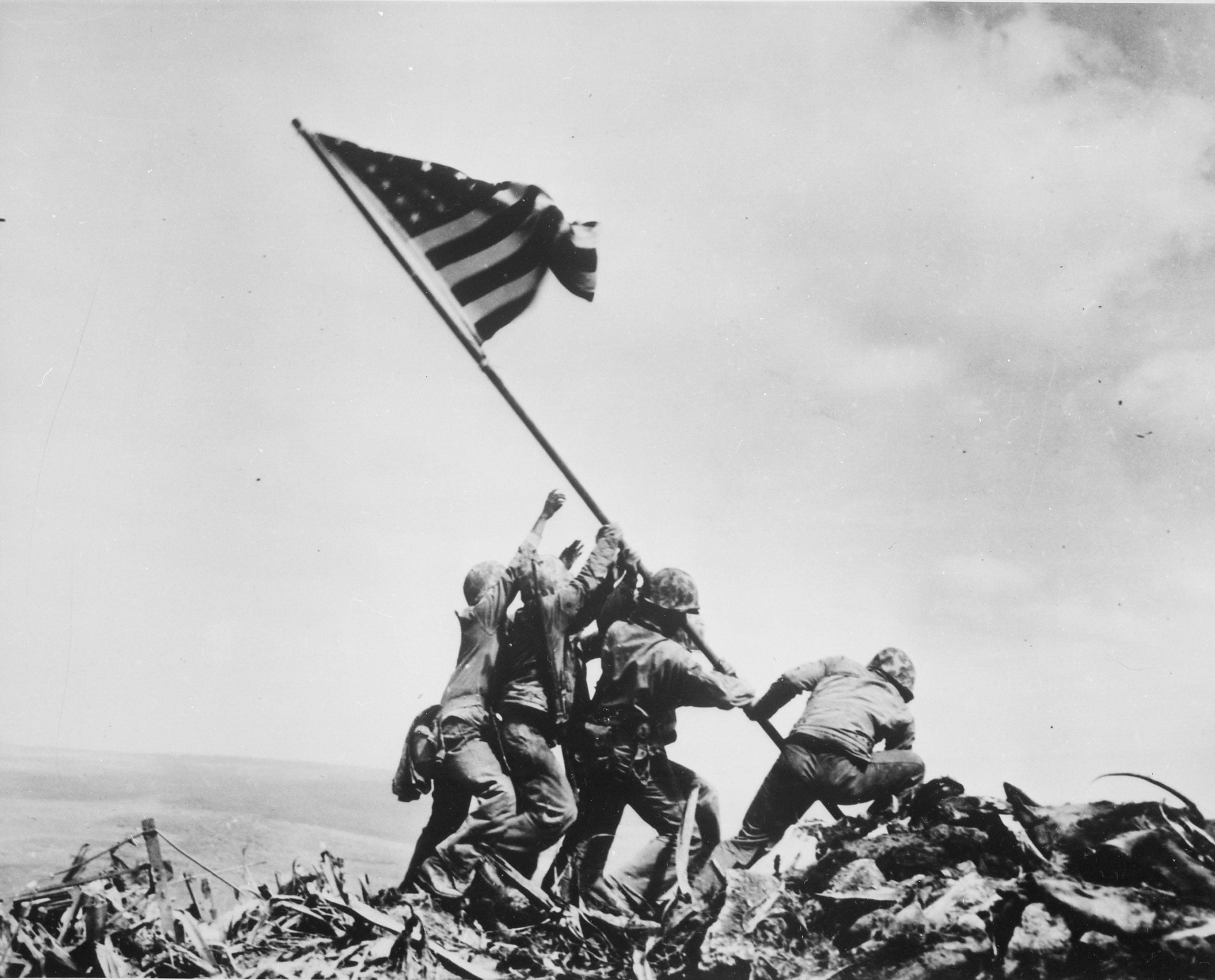
“To me,” Turner told the reporter, “the most impressive incident of the whole campaign so far as the raising of the flag on the top of Suribachi volcano Thursday morning by men of the 28th Marines. It affected me very deeply — and I’m sure that General Smith felt the same way…”
Smith then saluted the patriotism and esprit de corps of the Marines who captured “that extinct volcano rising 556 feet, with sheer cliffs around the sides.”
Turner added, “For my part, General, I hope the American flag always flies there; that it’s never allowed to come down.”
There’s no hint in the CBS Radio report of the titanic clashes between these two commanders behind the scenes. Both had suitable nicknames: It was “Terrible Turner” versus “Howling Mad Smith” and the two had “horrendous shouting matches,” according to The Pacific War Online Encyclopedia. Turner was a perfectionist who thought he knew everything, a workaholic and a heavy drinker.
He also was a lightning rod for controversy. As a Washington-based war planner, he had been criticized for failing to share enough intelligence with naval commanders about Japan’s potential to attack the U.S. base at Pearl Harbor in 1941.
But when the Navy embarked on a planned series of amphibious landings on South Pacific islands, Turner was selected as an operational leader. He was “brilliant, caustic, arrogant, and tactless. If anyone could succeed with Operation Watchtower (the code name for the eastern Solomons assault), it would be Turner,” Thomas B. Buell wrote in his biography of Admiral Ernest J. King.
Turner’s new role started out disastrously, with the Japanese sinking four U.S. cruisers at Savo Island near Guadalcanal, but he achieved a string of victories afterward.
Iwo Jima would go down in history as the bloodiest battle ever fought by the Marines — and also the source of the iconic AP photograph by Joe Rosenthal of U.S. troops raising the flag. The battle is now playing a role in the Iran war debate.
On the March 22 edition of “Fox News Sunday,” Sen. Lindsey Graham argued that the Marines should take Iran’s oil-exporting center Kharg Island. “We did Iwo Jima,” he said. “We can do this.”

‘Losses must be expected’
The Marines did take Iwo Jima. But it was far from easy.
Responding to a question from Don Pryor in the February 27,1945 radio interview, Vice Admiral Turner acknowledged that the U.S. had suffered “losses and damage to our troops, ships, and boats.”
“Losses are regrettable, of course, and we try to reduce them so far as possible. But losses must be expected if we are to go forward — and we are strong enough to accept them.”
The battle to conquer Iwo Jima, a stepping stone on the way to a potential allied invasion of Japan, lasted for five weeks — and there were indeed heavy losses before the U.S. declared victory. Of the 87,000 members of the landing force, 6,821 were killed and 19,217 wounded. The 30% casualty rate was even slightly higher than allied forces suffered in the much larger D-Day invasion of Normandy, according to a report prepared for the U.S. Navy in 2002.
The U.S. military’s experience at Iwo Jima, in Normandy, in Anzio, Okinawa and numerous other battlefields, shows the extreme risk that troops face in trying to pull off an amphibious landing against a well dug-in enemy, especially when the element of surprise is absent.
It’s worth recalling this history given the Trump administration’s commitment of ground troops to the Middle East for potential deployment against Iran. Perhaps the thousands of Marines and paratroopers sent to the region are only there to give the U.S. leverage in negotiations with Iran. But if President Donald Trump gives the signal for “boots on the ground,” the risks of the invading force taking serious casualties are substantial. (Incidentally, the phrase “boots on the ground” was coined by a U.S. general at the time of the Iran hostage crisis, more than 45 years ago.}
Haunting the U.S. war planners in World War II was the frightful history of the Gallipoli campaign, the allies’ failure to secure control of the Dardanelles Straits between the Aegean and the Black Sea.
Of the 559,000 allied troops committed to that operation, there were more than 250,000 casualties; of those, about 58,000 people died. Much of the toll resulted from disease rather than combat. The operation’s prime backer, Winston Churchill, resigned as first lord of the admiralty.
As Richard B. Frank wrote for Naval History in August, 2005,
At the start of World War II, conventional wisdom ranked horse-cavalry charges well above amphibious landings as an effective means of waging war. Military critic B.H. Liddell Hart declared in 1939: “A landing on a foreign shore in the face of hostile troops has always been one of the most difficult operations of war. It has now become almost impossible. . . .” By 1945, however, the United States had transformed not simply amphibious landings but the very nature of modern warfare.
Transforming amphibious warfare wasn’t just a puzzle to solve; it was vital for victory. There was no practical way for the allies in World War II to defeat Germany, Italy and Japan without using amphibious landings. And over time, they learned how to coordinate air, sea and land resources effectively to secure needed territory.
During the Korean War, Gen. Douglas MacArthur executed a surprise amphibious landing at Inchon, with U.N. forces suffering a casualty rate of only 4%. The operation cut off the North Korean troops that had been trying to seize all of South Korea. It could have ended the war, had MacArthur not sent troops to the far north, prompting China to deploy hundreds of thousands of soldiers across the Yalu River.

What now?
Now that Iran has essentially closed the Strait of Hormuz, through which a fifth of the world’s oil normally travels, Trump is faced with a wrenching choice.
Is he willing to allow Iran’s regime to control this chokepoint and charge a toll to any vessel seeking to transit? Will he agree to a ceasefire that fails to achieve regime change and U.S. control of Iran’s enriched uranium? Or will he put U.S. troops at extreme risk by launching an invasion of Iranian territory, with a potential outcome that even then, Iran’s regime could survive and continue to destabilize the global economy.
After the conquest of Iwo Jima, “Terrible Turner” led the amphibious attack on Okinawa, where the U.S. casualty rate was 21%. His record of victories led to the saying, “If you want something done, call on Turner.”
He retired to Monterey, California, where he died of a heart attack at the age of 75 on February 12, 1961. His obituary in the New York Times noted that he was a cultivator of prize roses. But it also mentioned his candor. Some thought he was “too ready to disagree with his superiors,” the Times said.
“A friend recounted once that a general brought a military plan for Admiral Turner to look over,” the obituary continued. “After a few minutes, the Navy man ridiculed the plan and asked whose it was. ‘It’s mine,’ the red-faced general snapped. Admiral Turner then repeated his original opinion.”
The obituary doesn’t say whether that “red-faced general” was “Howling Mad Smith.”


