
A warning from the Jimmy Carter era
Trump's slow-motion Cabinet purge
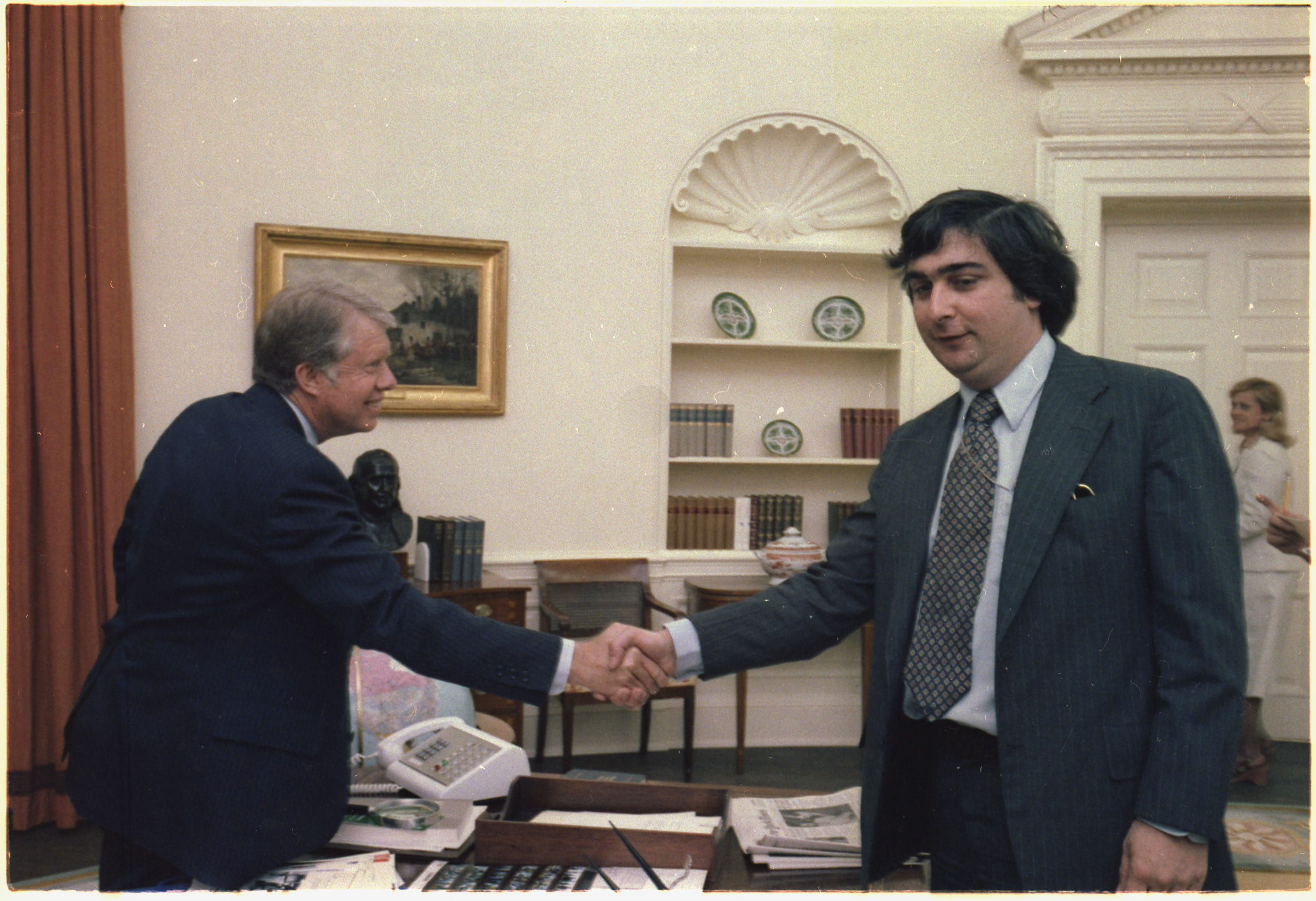
On the last Saturday in April, 1979, President Jimmy Carter and first lady Rosalynn Carter met in the Oval Office with one of the people who helped put them in the White House: pollster Patrick Caddell.
The 28-year-old former campaign aide had developed a back-channel connection to Rosalynn, who fretted about the president’s failing political fortunes. Her husband was at first reluctant to meet with Caddell, according to one of his former White House staffers, but on that day, “Jimmy Carter began to come under his spell.”
We know that because of former White House domestic adviser Stuart E. Eizenstat’s thousand-page memoir, President Carter: The White House Years. Eizenstat was not only a trusted aide to the president but also an industrious note-taker, who documented Carter’s single term in microscopic detail.
What happened after the Saturday Oval Office meeting was extraordinary.
As an oil shortage following Iran’s Islamic revolution forced Americans to wait in line for gasoline, the president’s approval rating continued to plummet.
Now that he was even below the level President Richard Nixon had registered during the Watergate scandal, Carter was willing to entertain far-reaching changes in his approach to governing. Among the steps he took: replacing a planned speech on energy policy with a soul-baring address on America’s “crisis of confidence” and demanding that his Cabinet members offer him their resignations so he could shake up the government.
Carter’s reshuffle was abrupt and politically damaging. He did in one day what President Donald Trump is doing bit by bit as he offloads Cabinet-level officials who run afoul of the White House. So far this year they have all been women: Homeland Security Secretary Kristi Noem, Attorney General Pam Bondi, Labor Secretary Lori Chavez-DeRemer.
Other changes may be in the offing, perhaps prompting Cabinet officials to lash out proactively to fend off a “you’re fired” from the former Apprentice host. FBI Director Kash Patel sued the Atlantic over devastating coverage of his leadership. Defense Secretary Pete Hegseth fired the Secretary of the Navy in the midst of that service’s blockade of Iranian ports, weeks after he axed the Army chief of staff during the war with Iran.
However richly deserved some of Trump’s Cabinet firings might be, throwing people overboard is no recipe for success in Washington. As Eizenstat wrote in his 2018 book of Carter’s upheaval, “When this ghastly period was over, the Gallup poll of September 14 showed his ratings were the lowest of any president in three decades. And Senator Ted Kennedy saw a clear path to deny the renomination of his party’s president.”
Rasputin
Detractors who learned of the Carter couple’s increasing reliance on Pat Caddell inevitably compared him to the bearded Russian monk Grigori Rasputin, who exercised inordinate influence over Russia’s Czar Nicholas II and Empress Alexandra. Even Carter’s close aide Hamilton Jordan cited the Romanov royal family’s disastrous experience with the monk.
Rasputin’s presence appeared to improve the health of their hemophiliac son. Caddell’s presence was less mystical but equally intense.
“Pat Caddell was not satisfied with providing poll numbers for the president,” Eizenstat recalled, “he saw deeper trends in American society that he impressed upon the president and first lady with ferocity. He sported a heavy black beard with a streak of white that made it appear he had been touched by lightning—and in a sense he had been. He also wore a perpetual frown under a furrowed brow, and his eyes seemed to be lit by embers of coal, so intense was his visage.”
Caddell’s polls revealed that Americans had lost their usual optimism about the future. The combination of low economic growth and high inflation — stagflation — soured people on the prospect of upward mobility. The Vietnam War and Watergate planted seeds of distrust in the basic institutions of government. Spiritually, Americans were drifting away from organized religion and questioning the nation’s values.
The polls, Caddell wrote, showed “an alarming decline in confidence in the country, both in the political system and in people’s expectations for the future, never registered before in data that goes back to the 1940s.”
Now there were “more pessimists than optimists, which is unheard of in America.” And the mood was shifting, with people “much more hostile, much more greedy, much more short-term, and much more volatile.”
A moral crisis
For Carter, the ascetic Sunday school-teacher in the White House, this sense of a moral crisis resonated. It was a battleground on which he felt comfortable operating, unlike the political horse-trading that left him cold.
Caddell brought leading academic experts to the White House to alert the president to a crisis of alienation in America. But he faced pushback from many in the administration, and not least the vice president and experienced Washington hand Walter Mondale.
“When the president gave Caddell’s memo to Mondale,” Eizenstat wrote, “he exploded in anger, telling me Caddell was selling a ‘bunch of crap’ taken from books he might have read in college, and dismissing Caddell’s analysis as ‘crazy,’ a view shared by the vice president’s top staff.”
Mondale would later tell aides he was so upset with Carter’s support for Caddell’s prescriptions that he was thinking of resigning as vice president.
Mondale and many Carter aides, including Eizenstat, thought the president’s problems were primarily economic and political, not spiritual. “Gasoline lines were spreading across the country, and rising prices of fuel and other necessities had reached deep into American pockets,” Eizenstat recalled.
But Carter read Caddell’s extensive analytical memo on July 4th, 1979 and termed it “one of the most brilliant analyses of sociological and political interrelationships I have ever seen. The more I read it along with Rosalynn, the more I became excited.”
The president had made peace between Egypt and Israel during an unprecedented 13-day ordeal at Camp David; now he used the presidential retreat in the Catoctin Mountains of Maryland for a week of discussions with leaders and experts from government, religion, business and labor, all trying to diagnose the problem facing America (and Carter).
Washington powerbroker Clark Clifford told Eizenstat that his experience at Camp David was “as unusual a weekend as I have ever spent. The president of the United States was sitting on the floor with a big pad of yellow paper, taking notes while people sat around him, five or six of us, and told him what he was doing wrong.”
The result was a dramatic speech to the nation. Carter said “too many of us now tend to worship self-indulgence and consumption [and are] no longer identified by what one does, but by what one owns.”
It became known as the “malaise” speech, but Carter never used that word. It was used by Caddell in his memo, which was leaked to a reporter.
In any event, the speech worked, Eizenstat noted:
In one night Carter’s approval rating jumped 17 points as measured by the Gallup poll, the greatest gain ever recorded by a modern president in such a short time, except for a speech seeking a declaration of war. Newsweek stayed open beyond its Saturday deadline to cover the Sunday address, then put Carter on the cover with a halo. On television CBS’s normally skeptical Roger Mudd approved of the speech wholeheartedly: “A very strong one, very upbeat.”
Carter connected with his audience, partly because he admitted his own shortcomings. “Also, the American people still liked Jimmy Carter and wanted him to succeed,” wrote Eizenstat.
Cabinet shake-up
Hamilton Jordan, who Carter then elevated to White House chief of staff, was among several voices urging the president to follow up his speech by taking action, including firing several members of his Cabinet. But rather than do that surgically, Carter made every Cabinet member submit a resignation letter.
In the end, five cabinet secretaries departed, although at least a couple of those were voluntary.
“All the goodwill built up by the retreat to Camp David and the president’s speech seemed to be thrown away in a sophomoric effort to look tough,” wrote Eizenstat.
In his book, the former White House aide makes a good case that Carter was a consequential president, in a good way. He protected vast stretches of public land (including more than 100 million acres in Alaska), deregulated industries such as airlines and telecommunications, started increasing defense spending that contributed to the collapse of the Soviet Union and put America on a course toward energy self-sufficiency.
Carter placed Paul Volcker at the head of the Federal Reserve, where the banker eventually broke the double-digit inflation that bedeviled the American economy. Perhaps the president’s greatest accomplishment was the treaty that has kept the peace between Egypt and Israel for nearly 50 years.
But Eizenstat is also honest about Carter’s failures, including a refusal to compromise and a baffling lack of commitment to the basic block-and-tackling that is needed to get things done in Washington.
The stereotype of Carter as a “weak and hapless president” wasn’t fair, Eizenstat wrote. At many points in his term, he showed great fortitude and took risks to achieve his aims. Many of his accomplishments though were buried under the wreckage of his failed mission to rescue the American hostages seized by Iran.
Trump’s trouble
As President Donald Trump watches his own approval ratings fall to new lows in 2026, he too is unable to solve the problem posed by the enmity between the U.S. and Iran. He is also grappling with inflation made worse by conflict with the Islamic regime.
Trump, who was 34 when Carter left office, once said of him, “He’s a nice man. He was a terrible President.”
Does Trump ever reflect on the contrast between his second term and Carter’s four years in the White House? And does he wonder if history will treat him the way it has Jimmy Carter, as a failed president?
In 2002, the Nobel Peace Prize was awarded to Jimmy Carter for his post-presidency — "for his decades of untiring effort to find peaceful solutions to international conflicts, to advance democracy and human rights, and to promote economic and social development." Of course, it is the Nobel Peace Prize that Trump has lusted after, as he claims to have ended 10 wars. The decision to attack Iran, with its devastation and worldwide economic consequences, likely killed his Nobel chances for good.
There was one holdover from the Carter era that stretched into Trump’s first term: Pat Caddell. The pollster never gave up his central analytical point: that Americans had fundamentally lost faith in their country.
“By 2016,” Eizenstat wrote, “Caddell had moved into the orbit of Donald Trump and served as pollster and sometime adviser to the candidate and his billionaire backers. Steve Bannon, Trump’s political guru, likened Caddell to an ‘Old Testament prophet’ for propounding the same message of voter alienation for a quarter of a century.”
John Fund wrote, “Few people had more to do with Donald Trump’s amazing victory in 2016,” than Caddell, who died of a stroke in 2019 at 68.
Caddell’s polls showed that “political conditions in America were increasingly ripe for an outsider candidate to take the White House,” wrote Jane Mayer.
Of course, the hope for an outsider president to drain the swamp has been a recurrent theme of American politics, from Andrew Jackson to Ronald Reagan to Bill Clinton to Barack Obama. The question now is whether Jimmy Carter’s unhappy experience in the 1970s and, even more so, the chaos of the Trump presidency, will be enough to cure us of the “outsider” impulse.


