
Was the American Revolution a grand mistake?
A provocative question on the 250th birthday of the U.S.
Was it all “a grand mistake?’
That’s the thesis of The American Revolution: A Grand Mistake, a 2010 book by Leland G. Stauber, a former associate professor of political science at Southern Illinois University-Carbondale.
The 292-page book makes a somewhat halting case that the 13 colonies’ Declaration of Independence from Britain got the United States launched on a wrong-footed basis that haunts us up to the present. Stauber wrote that America’s founding ideology was not only anti-British, but also opposed to “governmental authority in general.”
Thus the Articles of Confederation created a national government far too weak to meet the challenges the young nation faced. And the framers of the Constitution focused their energy on devising a government structure to prevent any president from exercising monarchical power rather than one that could act swiftly to solve social problems.
Stauber granted that the Declaration’s key phrase — “all men are created equal” — established a principle that “has been a great inspiration and a potent political instrument for all efforts toward greater equality of rights and opportunities in society.” He also conceded that independence set America on a path toward popular government, even though it took a long while to achieve full voting rights for those without property, those who were not white and for women. Still the U.S. reached “universal adult white male suffrage” far earlier than in Europe and Canada.
History suggests, he argued, that like the other British colonies in the New World, the colonies would eventually have achieved independence. So the real question is whether the manner in which they did was the right one. “Would there have been major advantages for American society if the United States had followed something closer to the Canadian path of peaceful and gradual evolution…” He admitted that the question is somewhat “imponderable.”
In 1775, there were desperate attempts to resolve the dispute with London peacefully. As the New York Times reported, recently discovered letters show that founding father John Dickinson wrote to a British merchant proposing a compromise between the colonies and Britain. He also drafted the “Olive Branch Petition” sent by the Continental Congress on July 8, 1775. His peace efforts arrived too late, and the king refused to even read the petition. On August 23, 1775, George III had commanded his civil and military officers to “suppress such Rebellion.”
That rebellion had lasting consequences, Stauber argued. “Americans are more reluctant to use government for societal purposes than are Canadians, for Canada attained its independence from Britain by a gradual process that did not discredit governmental authority per se. Government was not mentally associated with ‘tyranny.’”
Slavery: What Britain did
Then there’s the question of slavery. Did the political dynamics of the confederation of the colonies — and the adoption of the Constitution — involve compromises that froze the issue in place for decades, ensuring that the U.S. ended slavery 32 years after the British Empire adopted the Slavery Abolition Act of 1833 — and only then at the price of a bloody civil war. If the colonies had stayed under British rule, would slavery have been abolished sooner?
Slavery was very much on the table at America’s founding. In one draft of the Declaration of Independence, Thomas Jefferson charged King George III with waging a
cruel war against human nature itself, violating it’s most sacred rights of life & liberty in the persons of a distant people who never offended him, captivating & carrying them into slavery in another hemisphere, or to incur miserable death in their transportation thither. this piratical warfare, the opprobrium of infidel powers, is the warfare of the CHRISTIAN king of Great Britain. determined to keep open a market where MEN should be bought & sold, he has prostituted his negative for suppressing every legislative attempt to prohibit or to restrain this execrable commerce: and that this assemblage of horrors might want no fact of distinguished die, he is now exciting those very people to rise in arms among us, and to purchase that liberty of which he has deprived them, & murdering the people upon whom he also obtruded them; thus paying off former crimes committed against the liberties of one people, with crimes which he urges them to commit against the lives of another.
As Timothy Sandefur wrote for Reason, Jefferson watched as the Continental Congress deleted this attack on slavery in the days leading up to July 4, 1776.
“No records remain of who said what during these debates,” Sandefur noted, “although Jefferson recalled that Adams tirelessly defended every word in the draft, while Jefferson remained silent, as always. The ‘cruel war on human nature’ passage was eliminated ‘in complaisance [sic] to South Carolina and Georgia, who had never attempted to restrain the importation of slaves, and who, on the contrary, still wished to continue it,’ he wrote, as well as some Northerners, who, although holding ‘few slaves themselves,’ were ‘pretty considerable carriers of them to others.’”
Jefferson’s hypocrisy, of course, was stunning. He owned hundreds of enslaved people and freed only a few.
The British law that abolished slavery took effect on August 1, 1834, though it only applied to children under the age of six. Others had to serve their former owners as apprentices for up to four years. According to the government of Canada, Britain’s abolition of slavery “laid a pathway to freeing over 800,000 enslaved Africans and their descendants in parts of the Caribbean, Africa, South America as well as Canada.”
For the next three decades, Canada would become a refuge for people fleeing slavery in the United States.
Counter Facts
Stauber treads carefully in making his case that the break with Britain was a mistake, often choosing to use questions rather than affirmative statements. For example: “Could a slower approach to complete independence have widened the options and opportunities for a more socially balanced development of the United States?”
He is right that these matters are worth discussing: “These are fundamental questions that are obscured by an enormous volume of pronouncements that appeal to patriotic emotions and cite sacred scriptures — as substitutes for thought.”
But where his argument begins to break down is in the dynamics of counter-factual history. The eminent historian David Hackett Fischer tackled that topic in his book, Historians’ Fallacies. He wrote about a 1931 book, If, or History Rewritten, that looked at such questions as what would have happened if John Wilkes Booth’s bullet had missed hitting Abraham Lincoln, or if Robert E. Lee had won at Gettysburg.
There’s nothing wrong with asking such fictional questions, Fischer wrote, “but they prove nothing…All historical ‘evidence’ for what might have happened if Booth had missed his mark is necessarily taken from the world in which he hit it. There is no way to escape this fundamental fact.”
Consequently, when Stauber looks at the history that followed the American Revolution, he is dealing with events, especially in the evolution of the British empire, that were partly shaped by the Declaration of Independence and the colonists’ successful war and might not have happened otherwise. The British empire after American independence was not the same as the empire would have been had it subdued or compromised with the colonists.
History isn’t a controlled experiment in which you can change one variable and run events a second time to see the difference it made. There’s no way to isolate the evolution of Canada, the independence of other British colonies and Britain’s abolition of slavery from whatever impact the American Revolution had on them.
Stephen King’s fascinating novel 11/22/63 tells the story of a man traveling back in time to prevent the assassination of President John F. Kennedy. This is a spoiler: he succeeds, only to discover that the world turns out to be a far worse place as historical events develop very differently from the way they actually played out.
What still works
As for the American skepticism about governmental authority tracing back to the Declaration’s condemnation of King George III, we’re living through an era in which the checks and balances on a would-be authoritarian leader, too weak as they may be, are proving their worth.
In a smart post this week, Gabe Fleisher pointed out how different America would be today if the Supreme Court hadn’t issued some key rulings against positions taken by President Donald Trump. He argued that if Trump had appointed more pliant judges in his first term, he would now be free to tariff any country at any rate, send National Guard troops to major cities, deport migrants with no due process, force the Federal Reserve to cut interest rates at his whim and redefine “the meaning of American citizenship.”
For all its limitations and wrong turns, the Supreme Court actually can stand in the way of unchecked executive power.
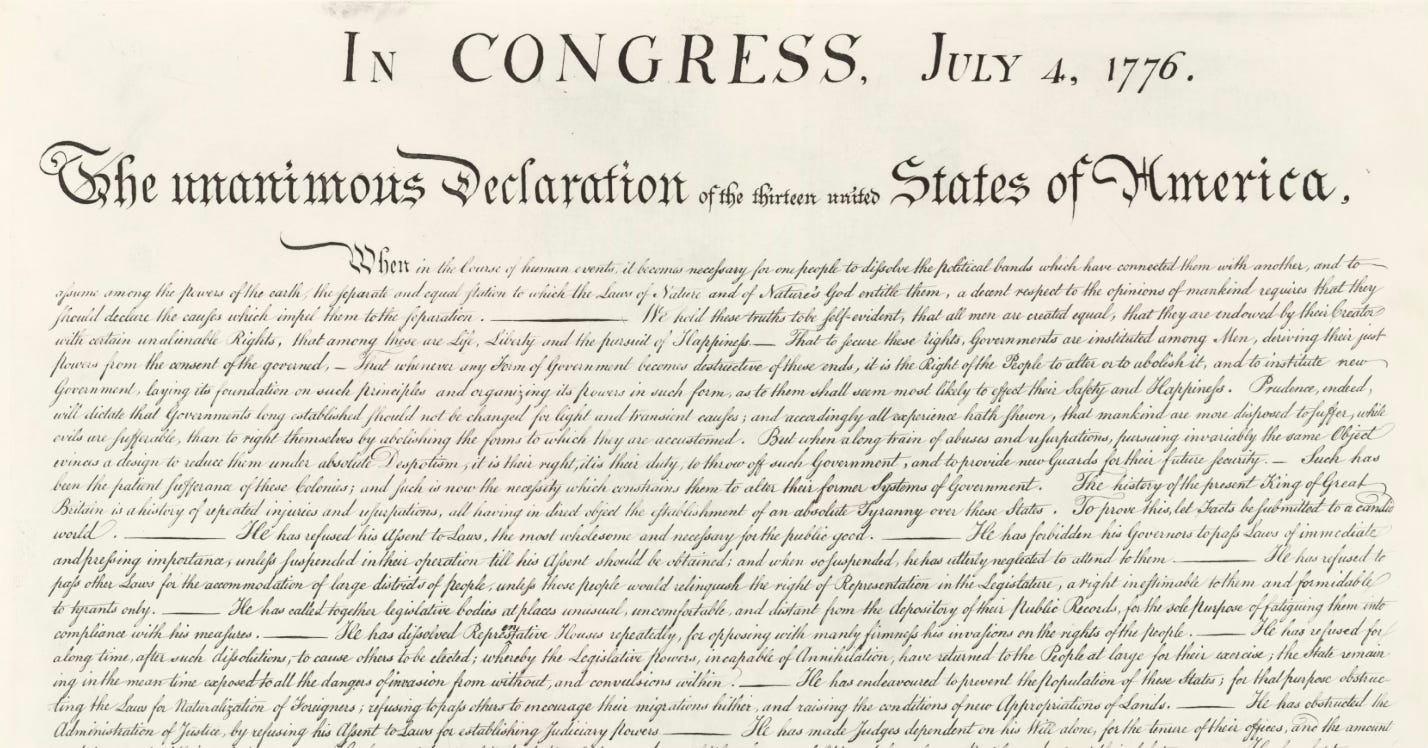
The United States developed a vibrant, and far from perfect, democracy after its break with Britain. It built the world’s biggest and most dynamic economy. It issued a founding credo that still commands our attention and should guide our action: “We hold these truths to be self-evident, that all men are created equal, that they are endowed by their Creator with certain unalienable Rights, that among these are Life, Liberty and the pursuit of Happiness.”
So on July 4, 2026, let’s celebrate America’s 250th.
(Thanks to Bob Keeler for calling my attention to Leland Stauber’s book.)


And thanks to you for writing about it. I loved the title of the book, but I have only read a few pages. You’ve done all the work, as usual. As a pacifist, I look at all wars as being wrong, including the one we are currently glorifying. I just finished listening to a book based on interviews with Howard Zinn. He points out that Washington had problems getting recruits from the southern states. Also, Zinn talks about mutiny in the ranks of Washington’s army. My bottom line is that we fought a war to get rid of a king, but now we have one, and the actual king of England is a far more admirable person than the faux king of America. King Charles has been a leader on environmental issues, while Trump has simply been mental. I had considered writing about the revolution, but you’ve made that unnecessary.