

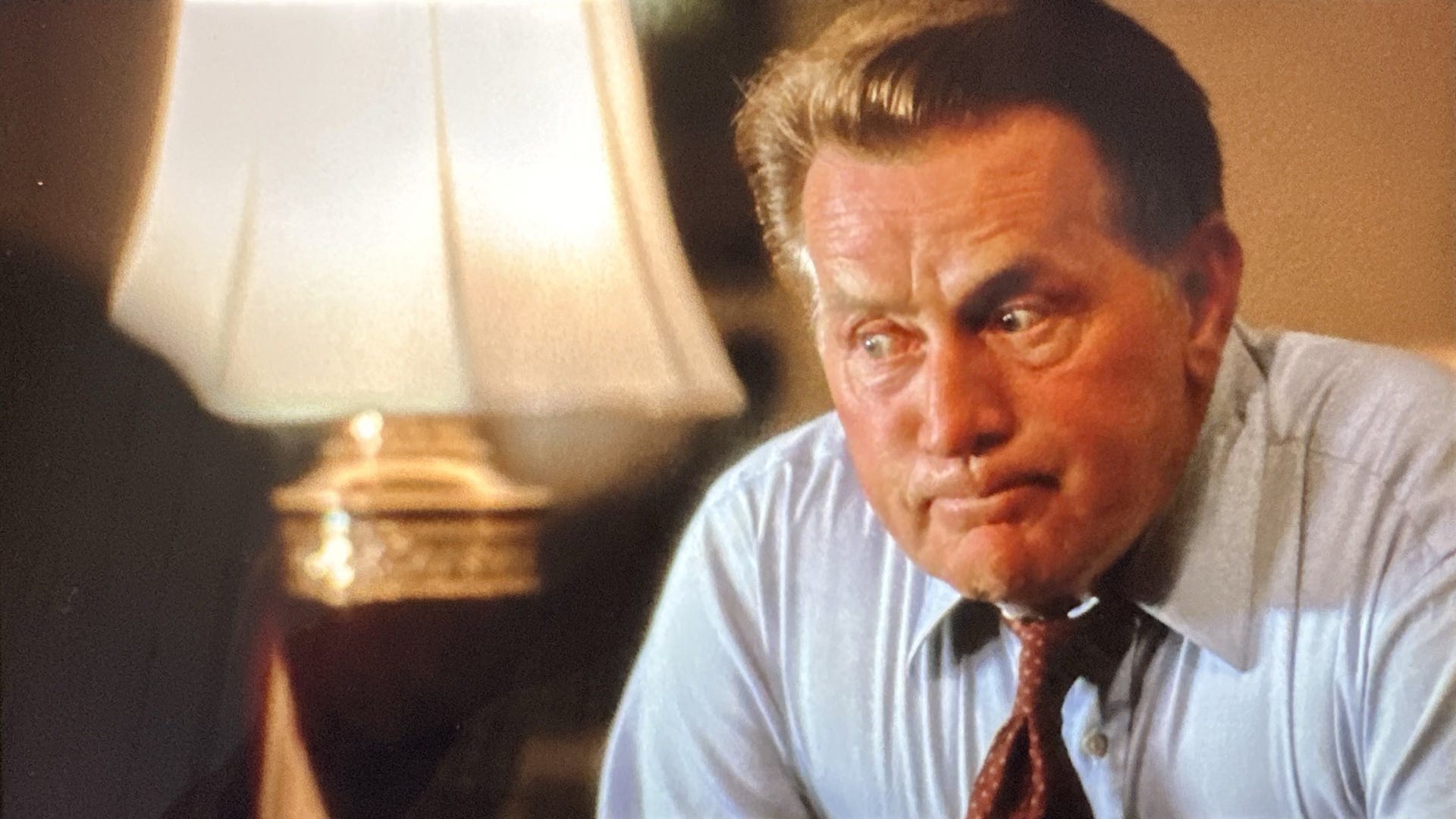
“I was wrong.”
“I was.”
“I was just — I was wrong. Come on, we know that. Lots of times we don’t know what right or wrong is, but lots of times, we do, and come on, this is one.”
President Josiah Bartlet is sitting in the Oval Office, telling his closest confidante Leo McGarry why he agreed to a congressional censure for hiding the truth about his health. It is Season 3, Episode 11 of The West Wing, the NBC drama that ran for seven seasons. As a candidate, the show’s fictional president had concealed his diagnosis of multiple sclerosis from the American people — and even from his own inner circle.
Bartlet, played by Martin Sheen, continues to explain why he deserves the punishment of a censure resolution: “I may not have had sinister intent at the outset, but there were plenty of opportunities for me to make it right. No one in government takes responsibility for anything anymore. We foster, we obfuscate, we rationalize. ‘Everybody does it.’ That’s what we say. So we come to occupy a moral safe house where everyone’s to blame, so no one’s guilty.”
Bartlet, his face slick with sweat, adds, “I’m to blame.”
“I was wrong.”
Those three words make for an unsparing confession of guilt and acceptance of responsibility. To hear it from the mouth of a president is stunning in the abstract. It’s especially so for viewers today, in the midst of the second Trump presidency, where there is zero possibility of any confession of error, let alone of taking responsibility for what goes wrong.
Bingeing The West Wing now, two decades after its final season, is comforting, almost too comforting. At times, it’s like plunging into an overly warm swimming pool, retreating into what even back then was an unreal world, a fantasy land for policy wonks and political junkies. So much of what happens makes for compelling television. That doesn’t mean it always, or even often, rings true.
The West Wing debuted in September 1999 at a time of heightened political combat. President Bill Clinton had been impeached and acquitted by the Senate. He was nearing the end of his second term in the White House with a more than respectable approval rating of 60%.
The early reviews of the show were mixed. It “swings wildly from the impressive to the insufferable,” James Poniewozik wrote in TIME magazine. He panned the casting of “serial over-emoter” Martin Sheen as President Bartlet. “There will be no curtains left in this Oval Office once Sheen has finished chewing the scenery.”
In 2014, Poniewozik updated his view: “When the show was at top form (‘Two Cathedrals,’ e.g.) it could be red-white-and-blue magic. (And all right—I was a little rough on Martin Sheen, who turned out to have a wry touch as Jed Bartlet.)”
In the first four seasons, show creator Aaron Sorkin indulged his liberal views by enacting some do-overs of the Clinton presidency. Bartlet allows himself to get talked out of proclaiming those famous words Bill Clinton actually said in 1996: “The era of big government is over.” (Big government outlasted the president’s saying.)
President Bartlet also commits U.S. troops to try to stop a genocide in Africa (Clinton, to his eventual regret, didn’t intervene in the actual Rwandan genocide in which 800,000 died.)
At times, improbable plotlines roll out in clumsy fashion. Confronted with the terrorist kidnapping of his youngest daughter Zoey (Elisabeth Moss), The West Wing’s Democratic president invokes the 25th Amendment, thereby inviting Republican Speaker of the House Glen Allen Walken, played by John Goodman, to temporarily take over the White House and put the administration’s accomplishments at risk. (The vice presidency was vacant, making the speaker the first in the line of presidential succession.)
The Zoey kidnapping subplot was launched in the fourth season when Aaron Sorkin was still running the show. In the next season, filmed after Sorkin’s departure, Zoey was found and safely brought home, with almost everything about her kidnapping and rescue left unexplained.
Sorkin and actor Bradley Whitford, who played political adviser Josh Lyman, have mused about bringing back The West Wing as an updated limited series. That may be unlikely. Still, the original episodes on HBO Max reward watchers.
We learn a lot about Bartlet over the course of the series. He is the former governor of New Hampshire. His friend McGarry (John Spencer) talked him into running for president, guided his candidacy and served in his administration as chief of staff. Leo was the voice of realpolitik, the one adviser Bartlet could count on to recommend the most prudent (and centrist) course of action — often to the dismay of the liberal idealists on the president’s staff.
All of the advisers, and Bartlet himself, exemplify the famous saying of Immanuel Kant: “Out of the crooked timber of humanity, no straight thing was ever made.” Every one of them is broken. Leo’s no-limits dedication to his job destroyed his marriage. Other aides — the equally committed Josh, Toby and C.J. — also are unhappily living mostly alone.
Bartlet’s marriage to Abbey Bartlet (Stockard Channing), a doctor, is troubled, with the first lady furious that he repudiated his pledge to her of serving only a single term because of his potentially debilitating MS. The father of three daughters, he is too often pulled away from the family by his political career.
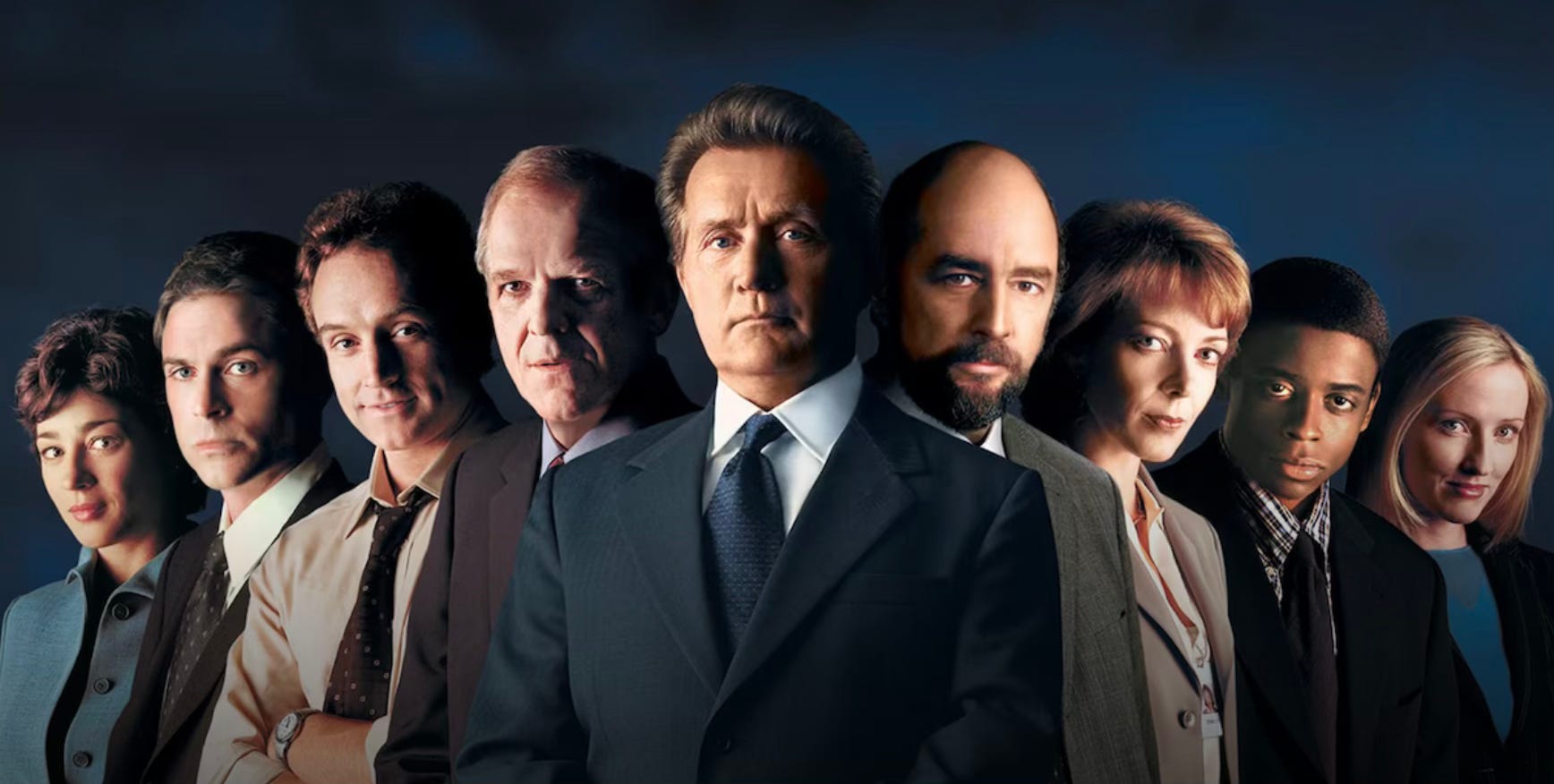
The back story is that Bartlet is an intellectual. He won a Nobel Prize in Economics and shows off his erudition, in ways that drive his family and his staff crazy. Sometimes we laugh as he seems to be making fun of himself; at other times, his self-indulgent grandiosity wears thin. Bartlet schools the staff on a logical fallacy expressed in Latin: post hoc ergo propter hoc (after this, therefore because of this).
In Season 3’s episode “Hartsfield’s Landing,” he brings home exquisite chess sets from a state visit to India. He gives them to deputy communications director Sam Seaborn (Rob Lowe) and communications director Toby Ziegler (Richard Schiff) and immediately challenges them to games.
Playing against Sam, Bartlet munches popcorn and riffs: “The Spanish brought chess to the court of Charlemagne. Charlemagne in French is Charles the Great. The Charles is a river in Boston. The Hudson River is actually not a river at all.”
Bartlet’s core
Still, there is a fundamental decency to Martin Sheen’s portrayal of Bartlet. He loves his family, he’s immensely grateful to his advisers and protectors, he cares about the people affected by his decisions. It’s impossible to imagine him conducting an affair with a White House intern, as Clinton did.
Here is a president who reads books, who debates ideas, who challenges himself and his team to live up to their standards and values, who recognizes when he fails to do so, who understands that presidents are not only political actors, but moral leaders whose example sets a tone for society as well as government.
His greatest weakness, reflecting the real-life experience of American presidents, is an openness to foreign adventures, including the secret assassination of a terrorist-linked minister of a Middle Eastern state. When reporter Danny Concannon digs into the true story, press secretary C.J. Cregg (Allison Janney) agonizes over the betrayal of the administration’s ideals.
Then, in a bid for a lasting Middle East peace, the president commits 20,000 American troops to the no-win role of buffers between the Israelis and Palestinians.
Bartlet and the two candidates to succeed him at the end of his second term — Matthew Santos, played by Jimmy Smits, and Arnold Vinick, played by Alan Alda — are gifted political strategists, serious thinkers and essentially decent people, who mostly won’t cross ethical lines for the sake of convenience and political success. Santos, whose character was partly modeled on then-rising Illinois politician Barack Obama, prefigures Obama’s barrier-breaking run for president with the eloquence and authenticity of his speeches. Spoiler alert: Santos becomes the first Hispanic president. Vinick is a moderate Republican, a John McCain kind of figure.
Most improbably, Bartlet, in his final year in office, deploys 130,000 American troops to Central Asia to try to disrupt Russia’s and China’s impending clash in Kazakhstan. As Santos notes, there’s no exit strategy for this risky venture. There’s no compelling reason to enter this quagmire in the first place. After all, there’s a reason for the saying, famously uttered in The Princess Bride, to “never get involved in a land war in Asia.”
There is some dialogue that seems preternaturally relevant in 2026: when Toby talks to Bartlet about the prospect of saving Social Security and the president jokes that a solution will come “right after we colonize Ontario.” Or Bartlet jokes on a midterm election day: “I wish I could spend more than a few minutes with you, but the polls in the East don’t close for another hour, and there are plenty of election results still left to falsify.”
Sorkin and his co-writers had the rhythm of a successful presidential speech down pat, as shown by Bartlet’s rousing appeal to pass a foreign aid bill. Here is a president unashamed of asserting America’s leadership in the world, making the case for the nation to support its ideals rather than simply relying on its might.
You only have to watch the speech — in “Guns, Not Butter,” Season 4, Episode 12 — to lament how much of a vacuum the U.S. has created by retreating from global responsibility and substituting naked self-interest for it.
Channeling the global outlook of President John F. Kennedy’s Inaugural Address, Bartlet says, “We live in an interdependent world and we should act like it. We live in a global community and we should sustain it. We should cross borders. We should cross borders to build sustainable democracies that can banish privation and fear. And we should cross borders to bring food, and medicine, and roads, and schools, and teachers to parts of the world forgotten by all but the warlords...”
“This should be a century of hope and prosperity everywhere. And America is going to lead the world and not just bully it.”
Or maybe we are going to just bully it.
Your excellent reflection on what The West Wing teaches us in the Trump era got me thinking about how differently the series feels today. What once seemed like an idealized vision of Washington now feels almost like a reminder of what we stand to lose.
Sorkin’s characters were far from perfect, but they believed that public service was a moral undertaking. They respected the truth, understood the limits of their power, and recognized that the presidency was bigger than the person occupying it.
What the Trump era has made painfully clear is that institutions alone cannot protect democracy. They depend on the character of those who lead them and their willingness to put country above personal loyalty.
Perhaps the most sobering lesson is that integrity, reason, and good intentions don’t necessarily prevail in politics. And yet, I wouldn’t dismiss The West Wing as naïve. Its idealism may be more important now than ever -- not because it reflects the world as it is, but because it reminds us of what leadership ought to be, and how much we lose when it falls short.
Thanks for the reminder.