

Who declares war? Article I, Section 8 of the U.S. Constitution says Congress “shall have the power…To declare war, grant letters of Marque and Reprisal, and make Rules concerning Captures on Land and Water.”
Congress first used that power in going to war with Britain in 1812. Since then, it has declared war 10 more times, but the most recent case was 83 years ago — on June 4, 1942, when it voted to go to war against Bulgaria, Hungary and Rumania in the midst of World War II. Congress had declared war against Japan, Germany and Italy immediately after the Japanese attack on Pearl Harbor on Dec. 7, 1941.
President Harry S. Truman set the template for modern war powers in 1950 when he called the Korean War a “police action.” More than 36,500 Americans died in that war, which lasted for three years and ended without an official peace treaty. Presidents from Lyndon B. Johnson onward have exercised war powers without a congressional declaration in countries including Vietnam, Grenada, Libya and Iraq. But what has been the reaction in Congress?
Now that President Donald Trump has launched a war against Iran, the issue is newly relevant. I am resharing a post from last June that sheds light on the issue.
The war over war powers
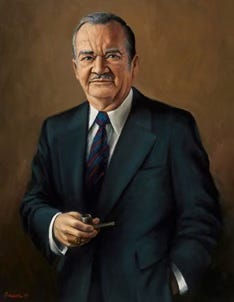
“A conciliator, not a firebrand.” That was how the New York Times’ Steven V. Roberts described Rep. Clement J. Zablocki in his obituary December 4, 1983. The Democrat from Milwaukee “preferred consensus to confrontation” and was known for “a bushy mustache he kept carefully clipped, and a tiny, leather-bound pipe he kept clasped in his hand.”
He also played a key role in the long history of disputes between presidents and Congress over who controls the power to go to war. Zablocki sponsored the War Powers Act, a 1973 law that surfaces whenever a president orders military action.
His career vividly demonstrates the potential for — and the limits of — congressional control of war powers.
U.S. bombers struck three targets in Iran on June 21, 2025, the Senate Democratic leader Chuck Schumer said, “We must enforce the War Powers Act.” He insisted, “No president should be allowed to unilaterally march this nation into something as consequential as war with erratic threats and no strategy.”
Sen. Mike Rounds, a Republican from South Dakota, said on NewsNation that the Trump administration had complied with the law by notifying congressional leaders within 48 hours of the U.S. strike on three targets in Iran.
In practical terms, members of Congress had little need for that notification. All they had to do was read the news alerts or check their social feeds to find out that Trump had ordered the air strikes. The 48-hour notification requirement is not nearly as significant as other parts of the War Powers Act.
The law seeks to “fulfill the intent of the framers of the Constitution” and “insure that the collective judgment of both the Congress and the President” will govern the use of military force. It says presidents have the power to deploy the military in three circumstances: when Congress declares war, when it passes a law authorizing the use of force or when the nation is attacked.
Whenever possible, the president should consult Congress in advance, the law states; and should submit a report within 48 hours giving the reasons for the military action and estimating its scope and duration. That report starts a 60-day clock, giving the president a deadline to end the military mission unless Congress authorizes it to continue.
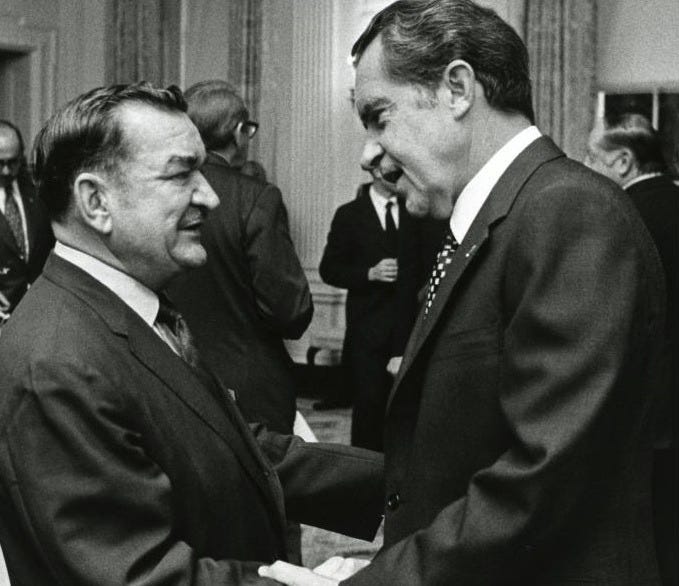
President Richard Nixon vetoed the War Powers legislation in November, 1973, but the House overrode him with a vote of 284-135, as did the Senate, voting 75-18 to make it the law of the land.
Since Nixon, many presidents have chafed at the restrictions of the law, questioning its constitutionality. That helps explain why the law ensnared Clement Zablocki in a tense confrontation with the Ronald Reagan administration just a few months before the congressman’s death at the age of 71.
The organist
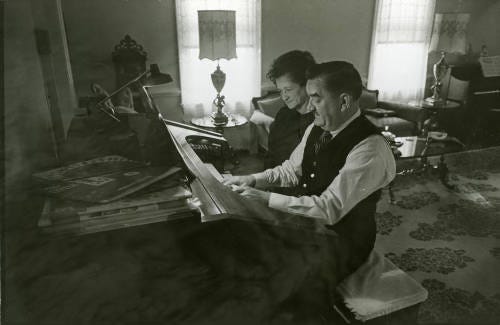
Zablocki’s parents came to the U.S. from Poland. He grew up in a working-class Milwaukee neighborhood, putting himself through Marquette University by working as a choir director and church organist. He went on to teach high school civics and then put his classroom lessons into practice by winning a seat in the Wisconsin legislature. In 1948, he moved up to a seat in Congress.
“Clem,” as his colleagues knew him, was elected to the House a total of 18 times. He gained an appreciation for the conservative politics of most of his constituents. “They’re supportive of a strong national defense, and are fiercely anti-Communist, and in that respect I reflect their views to a T,” Zablocki said in an interview quoted by Steven Roberts.
In August, 1964, President Lyndon Johnson asked for the support of Congress after he ordered a military response to apparent attacks on U.S. destroyers in the Gulf of Tonkin, near the Communist nation of North Vietnam.
Zablocki cast his vote in the House for the “Gulf of Tonkin Resolution”; it was unanimous. In the Senate, only two senators dissented. Congress little suspected that this resolution would be used by Johnson and Nixon to justify nearly a decade of war in Southeast Asia, resulting in more than 58,000 deaths of U.S. service members.
Constitutional conflict
The Constitution gives Congress the sole power to “declare war” but it also names the president “commander in chief of the Army and Navy of the United States.”
Therein lies the clash that has set Congress against the White House over war powers for generations.
While Congress was pivotal in authorizing America’s involvement in World War II, with its declarations of war against Japan, Germany and the rest of the Axis powers, the Korean War unfolded without an official declaration of war.
In an article for the Loyola of Los Angeles Law Review written shortly before his death, Zablocki makes his interpretation of the Constitution clear: “While some of the Founding Fathers were concerned about this issue, James Madison commented that the executive has no right, in any case, to decide whether there is cause for declaring war. Madison added that the power of judging the causes of war rests exclusively with the legislative branch. In short, there is nothing vague or amorphous about who receives the vast bulk of war powers under the Constitution. It is Congress.”
Revelations about the Vietnam War and the secret bombing of Cambodia helped fuel the passage of the War Powers Act. Nixon’s ability to fend off the legislation was greatly weakened by the Watergate scandal.
Once the bill became law, presidents paid it little heed. Zablocki was dissatisfied with the Gerald Ford administration’s view of the War Powers Act as it applied to Ford’s bid to rescue Americans on the cargo ship SS Mayaguez in 1975.
The congressman also objected that President Jimmy Carter’s administration didn’t comply with the War Powers Act when it staged an unsuccessful effort in 1980 to rescue the American hostages held by Iran.
Zablocki wrote that under Ford and Carter, “executive branch compliance was half-hearted at best and deliberately evasive at worst.” But he conceded that these rescue missions weren’t on nearly the same scale as wars such as Vietnam.
Lebanon
So in his view, the “first real test” of the War Powers Act came under President Ronald Reagan. In 1982, the Reagan administration provided U.S. troops for a peacekeeping force to oversee the evacuation of the Palestine Liberation Organization and Syrian troops from Beirut, Lebanon. Some members of Congress were “highly skeptical” of using the U.S. military in Lebanon, and Zablocki wrote to Reagan complaining that the White House wasn’t following the rules embodied in the War Powers Act.
In March, 1983, five Marines were wounded in a terrorist attack. In August, two Marines died from a mortar attack and two more were killed in early September. Finally, in August, one year after the Marines were deployed to Lebanon, Reagan instructed his chief of staff James Baker to meet with congressional leaders to gain their approval for the mission.
