
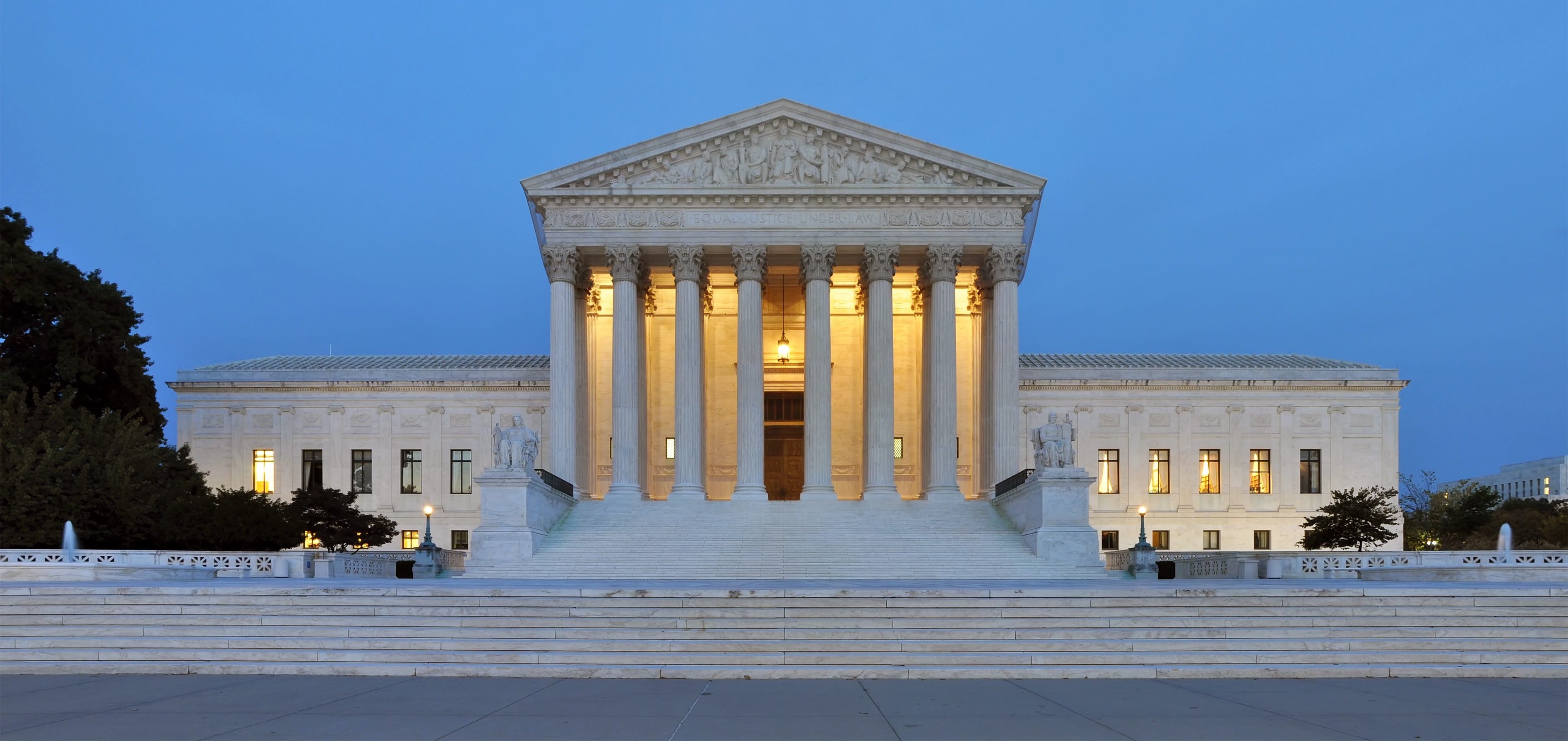
When the dragon of the Senate tried to tame the Supreme Court
Is court-packing the way to go?
On June 19, 1924, a foursome of U.S. senators delayed their golf game on the fairway of the Chevy Chase Club outside Washington while one searched for a lost ball. The next group of players, led by Dr. James F. Mitchell, asked the senators if they could play through.
Senate minority leader Joseph T. Robinson objected. As an argument brewed, he punched the doctor in the “eye, knocking him backward over a bench,” the New York Times reported.
Robinson wasn’t hurt physically but the incident was something of a political black eye. The senator from Arkansas was angling for the Democratic presidential nomination that summer.
In July, the country club’s governors voted unanimously to expel Robinson, after he refused to apologize. Robinson had to wait four years to get onto his party’s national ticket: he ran as Al Smith’s running mate in 1928, another year of defeat for the Democrats.
The golf course confrontation enhanced Robinson’s reputation as a brawler and probably didn’t impair his effectiveness in the Senate. There, the senator from Arkansas could also lose control of his temper.
“It took little imagination to see fire and smoke rolling out of his mouth like some fierce dragon,” recalled an attendant in the Senate press gallery, Richard L. Riedel. “Robinson could make senators and everyone in his presence quake by the burning fire in his eyes, the baring of his teeth as he ground out his words, and the clenching of his mighty fists as he beat on the desk before him.”
When Democrats won control of Congress in the 1932 election that put Franklin D. Roosevelt in the White House, Robinson became majority leader. He played a vital role in passing New Deal legislation.
Roosevelt cruised to victory by offering voters hope that he could wield the powers of government to rescue Americans from the misery of the Great Depression. The new president’s activism stood in contrast to President Herbert Hoover’s largely ineffectual effort to fight the economic disaster that began with the Wall Street crash of 1929.
FDR’s New Deal was a grand improvisation unlike anything in U.S. history. The president proposed sweeping initiatives including Social Security and FDIC insurance for small bank deposits. He also presided over the creation of an alphabet soup of government agencies to intervene in the economy, put people to work and aid farmers.
With big Democratic majorities in Congress and Joseph Robinson as his loyal lieutenant, Roosevelt won the legislation he needed and was able to sign bills carrying out the ideas of his “brain trust.”
What he couldn’t do was overcome the third branch of government, the judiciary in the form of the U.S. Supreme Court. The measures that most Americans saw as humane responses to widespread suffering appeared to conservative judges and wealthy Republicans as socialistic and even dictatorial infringements on free enterprise.
The court struck down key parts of the president’s program, including the National Recovery Administration (NRA) which aimed to set prices and wages for every sector of the economy. The Constitution allows the federal government to legislate on matters involving “interstate commerce” but the justices interpreted that phrase so narrowly as to rule out virtually any government action to bolster the economy. The court went even further when it overturned an intrastate policy by New York, which had passed legislation to set a minimum wage for women and children.
Roosevelt seethed as the court invalidated his programs one by one, but waited until February of 1937 to fire back. He surprised even his own party’s leaders in Congress by proposing a bill to add one justice to the court for each member over the age of 70. It would have increased the court’s size from 9 to as many as 15 justices.
FDR’s initial proposal was widely condemned — many of his fellow Democrats criticized it as a dangerous power grab — and quickly scrapped. But as historian William E. Leuchtenburg pointed out in a 1985 Duke Law Journal article, a modified plan was soon introduced, and it came closer to passing than most people realize.
The job of gaining Senate passage for that controversial bill fell to Sen. Joseph Robinson. It would be the biggest fight of his life.

Politicians in black robes?
Today, talk of restructuring the court is widespread on the left. Jamelle Bouie wrote for the New York Times on May 6 that “If the Supreme Court is going to act as a partisan institution — as a super-legislature whose judgments override the decisions of voters on the thin basis of ideology — then the only path worth taking is to discipline and transform the court with all the tools Congress has at its disposal under the Constitution.”
Fury at recent Supreme Court rulings prompted President Joe Biden to appoint a commission to review possible changes to the Supreme Court. That panel did not propose enlarging the court. But the court’s new Voting Rights Act decision (Louisiana vs. Callais), followed by the spectacle of Republican-controlled legislatures redistricting majority black districts out of existence is likely to fuel more talk of packing the court.
“The pressures on presidential candidates to make commitments of one kind or another about the Court and its reform will be intense,” observed Bob Bauer, former White House counsel to President Barack Obama. “Most candidates critical of the Court will pledge to ‘do something about it,’ just as presidents are expected to do something about everything.”
Bauer added:
What this means for reform like Court “packing” or “expansion” is that a president whose party controls the Senate can take no chances with the nominees they select for the new spots. They are not promising the voters independence and its correlate, fine judging qualities. They are pledging results. They will be under pressure to put forward either reliable ideologues or (in what might otherwise be a welcome change), lawyers drawn from service other than on the bench. The race will be on for activists, loyalists, and true believers. Each president will be striving to make the Court his or her own.
Democrats are indeed angry at the current court. But some Republicans are too. Even though the court has handed President Donald Trump major victories, he lashed out angrily at the judges’ ruling against his worldwide tariffs. With issues such as Trump’s dubious assault on birthright citizenship on the court’s agenda for the remainder of its term, we could see further eruptions of presidential outrage at the justices.
In a new book, Sarah Isgur argues that the court is the “Last Branch Standing,” in contrast to Congress, which has largely abdicated its role as a check on the president’s power. She takes on the argument that the court is merely a political body, with justices hiding their Republican and Democratic allegiances behind black robes. Instead, she claims many justices leaven their political ideology with institutionalist concerns about the proper role and image of the court.
Public distrust of the court has indeed risen, she acknowledges, but that is partly because people don’t understand how it really works. In her view Chief Justice John Roberts and Associate Justice Brett Kavanaugh aren’t Republican spear-carriers, but independent agents with a wise determination to preserve the court’s legitimacy.
Isgur runs the numbers to show that much of what the court decides is done by unanimous rulings, or by majorities that don’t break down along party lines. Instead of the commonly perceived 6-3 conservative majority, she describes the court as 3-3-3, with the middle bloc being primarily driven by institutionalist concerns rather than right/left politics.
The book makes a credible case for a more nuanced understanding of the court. It is also packed with trivia: the “highest court in the land” is actually a basketball court located above the courtroom in the Supremes’ grand marble temple at One First Street. Justice Amy Coney Barrett likes tulips and the comic spy series Slow Horses. Justice Elena Kagan enjoys a local restaurant’s version of chicken tikka masala. And anyone who argues a case before the court gets a souvenir: a white goose-feather quill.
A former president of the Harvard Federalist Society, Isgur is well-positioned to understand the dynamics of the conservative majority. She is an ABC News legal analyst, the editor of SCOTUSblog, co-host of a popular podcast and a former Justice Department official in the first Trump administration.
But ultimately, the book fails to strip the court of its political valence. Isgur can’t wipe away the damage the court has done to democracy in its landmark rulings to stop the recount of the votes in 2000, awarding the presidency to George W. Bush; to allow corporations to spend unlimited billions on swaying elections; to overturn Roe v. Wade; to grant presidents “absolute immunity” from prosecution if they are carrying out their constitutional role and to nullify common-sense gun safety regulations out of an absolutist reading of the Second Amendment.
Yes, the court has been unpredictable and at times makes decisions that run counter to the prevailing trend, such as the 2012 decision preserving Obamacare, with Chief Justice John Roberts casting the key vote, and this year’s overturning of Trump’s tariffs.
Isgur points out that “Trump in his first term had the lowest success rate at the Supreme Court of any president in at least a century.”
But that may be more of a statement about the recklessness of Trump’s policies — his willingness to test limits — than about the court’s overall impact on American society and politics. In his confirmation hearing, John Roberts said his role as chief justice would be that of an umpire — to call balls and strikes. Much of America no longer sees him as impartial.
Perhaps the book’s strongest point is its argument that Senate Majority Leader Harry Reid made a crucial mistake in 2013 when he eliminated the filibuster for judicial appointments below the Supreme Court. That opened the door for Senator Mitch McConnell, to ax the filibuster for the highest court once his party was in the majority.
Judges can now be confirmed by a simple majority in the 100-member Senate. “With the filibuster in place—requiring sixty senators to agree to take a vote—that meant a nominee would need as many as ten votes from the other side,” Isgur noted.
“Not only did this rule mean that more moderate judges were nominated; it also affected who tried to become a judge in the first place…Future judges are no longer competing against their peers for who can get the most votes from the other side of the aisle. They are competing for who can be the most pure form of their own side.”
Dramatic ending
Franklin D. Roosevelt’s first court-packing plan got a withering thumbs down from the Senate Judiciary Committee. Seven of the 10 senators who signed the committee report were Democrats, but they didn’t hold back, accusing the White House of proposing “an invasion of judicial power such as has never before been attempted in this country.” The bill they said, was “a needless, futile and utterly dangerous abandonment of constitutional principle.”
Relations between the president and his party were so strained that Roosevelt would later unsuccessfully try to purge some of his fiercest critics in the party in the midterm elections.
But Majority Leader Joseph Robinson saw a potential way out of the conflict. He suggested to FDR that the president meet with all of the Democrats in Congress over a weekend at “the Jefferson Islands Club in Chesapeake Bay, a former bootleggers’ hideout that was now a Democratic fish and game club,” noted Leuchtenburg.
On Friday, June 25, Navy patrol boats started ferrying Congressional Democrats to the retreat.
Leuchtenburg wrote:
When the Congressmen arrived at the island, not knowing what to expect, they discovered that a whiz-bang entertainment had been arranged. They swam in the nude, shot clay pigeons, fished, swapped stories, played pinochle, knocked a softball around, and enjoyed the amenities of the julep room. They sang such sentimental ballads as “The Old GOP, She Ain’t What She Used to Be” and “My Sweetheart’s a Mule in the Mines.” There was even a hog-calling contest…At long tables on the lawn, Congressmen ate a shore lunch of crabs, potato salad, cold cuts, apple pie, and iced tea. In the afternoon they sought the shade of the clubhouse or drank cold beer under the trees.
The Congressmen found the President in a jovial mood and altogether accessible. For six hours each day he sat in a big chair under a mulberry tree near the water’s edge and greeted scores of guests by first name, even those he had never met before. Dressed in old white linen trousers, coatless and tieless, his soft shirt opened at the neck, he seemed completely at ease, and reporters on press boats circling the island could hear his laugh booming across the water.
The weekend shifted the mood of the Democrats. Robinson began lining up support for a compromise bill that would allow FDR to expand the court, but a bit more slowly than the original version. FDR aide Tommy Corcoran told a senator, “Wait until the heat is turned on.” Asked to elaborate, Corcoran said he was referring to “the heat of reason.”
But it wasn’t the heat of reason, but the heat of Washington that Robinson was counting on as he assembled votes for FDR’s bill, Leuchtenburg wrote. One columnist noted that the White House was air-conditioned and the homes of the legislators were not.
“In truth, the prospect of being trapped in the capital through all of July and August and even beyond was enough to make strong men quail, and one-third of the Senate was over sixty,” Leuchtenburg noted.
Robinson could insist on all-night meetings and on convening the Senate on Saturday.
“On the opening day of the Great Debate, Robinson made an aggressive two-hour speech that carried the fight to the enemy. His face an angry purple, his voice bellowing, his arms pawing the air, both feet stamping the floor, Robinson gave the appearance of an enraged bull,” wrote Leuchtenburg.
The Senate debate droned on for a week.
Then, on July 14, 1937, as a U.S. Senate historical note recounts, “a cleaning woman entered the Methodist Building, across the street from the Capitol. When she turned the key to the apartment of her client, the Senate majority leader, a terrible sight awaited her. There sprawled on the floor, a copy of the previous day’s Congressional Record lying near his right hand, was the pajama-clad body of Arkansas senator Joseph Taylor Robinson. At the height of his powers, with hopes of a Supreme Court appointment as his reward for services to a grateful president, the grievously overworked 64-year-old Robinson had succumbed to heart disease.”
Washington was stunned; senators rose to pay tribute to Robinson’s career. So did the press.
“If it could ever be said of a good soldier in the ranks of party regularity that he died with his boots on, in the thick of battle, that epitaph belongs to Joseph T. Robinson of Arkansas,” the New York Times commented.
Robinson’s death was a turning point for the president’s court-packing plan; several senators withdrew their support, dooming the bill.
But even without packing the court, Roosevelt ended the year a winner. The court began to moderate its opposition to government regulation of the economy, allowing many key parts of the New Deal to survive.
One conservative Supreme Court justice retired, giving FDR an opening to appoint Senator Hugo Black of Alabama. Black would become a key liberal voice on the court, but before he could put on the black robe, he had to explain why he had worn a white one. His confirmation was stirred by controversy over the disclosure that he had once been a member of the Ku Klux Klan. He had resigned from the KKK 12 years earlier. (Robinson’s politics on race were also worthy of condemnation — he had consistently stood in the way of anti-lynching legislation.)
“A switch in time saved nine,” became the irresistible phrase summing up Roosevelt’s unlikely accomplishment in taming the court. But did the court-packing plan intimidate the justices into approving FDR’s program? Some legal analysts say no and argue that New Deal initiatives began faring better because the administration had improved its draftsmanship of the laws.
As for Roosevelt’s loyal, combative soldier Joe Robinson, FDR said: “A pillar of strength is gone. A soldier has fallen with face to the battle….And so death found him at the last with hope unfaltering, with vision undimmed, and with courage unafraid. Of him well may it be said: He has fought a good fight; he has finished his course; he has kept the faith.”


