
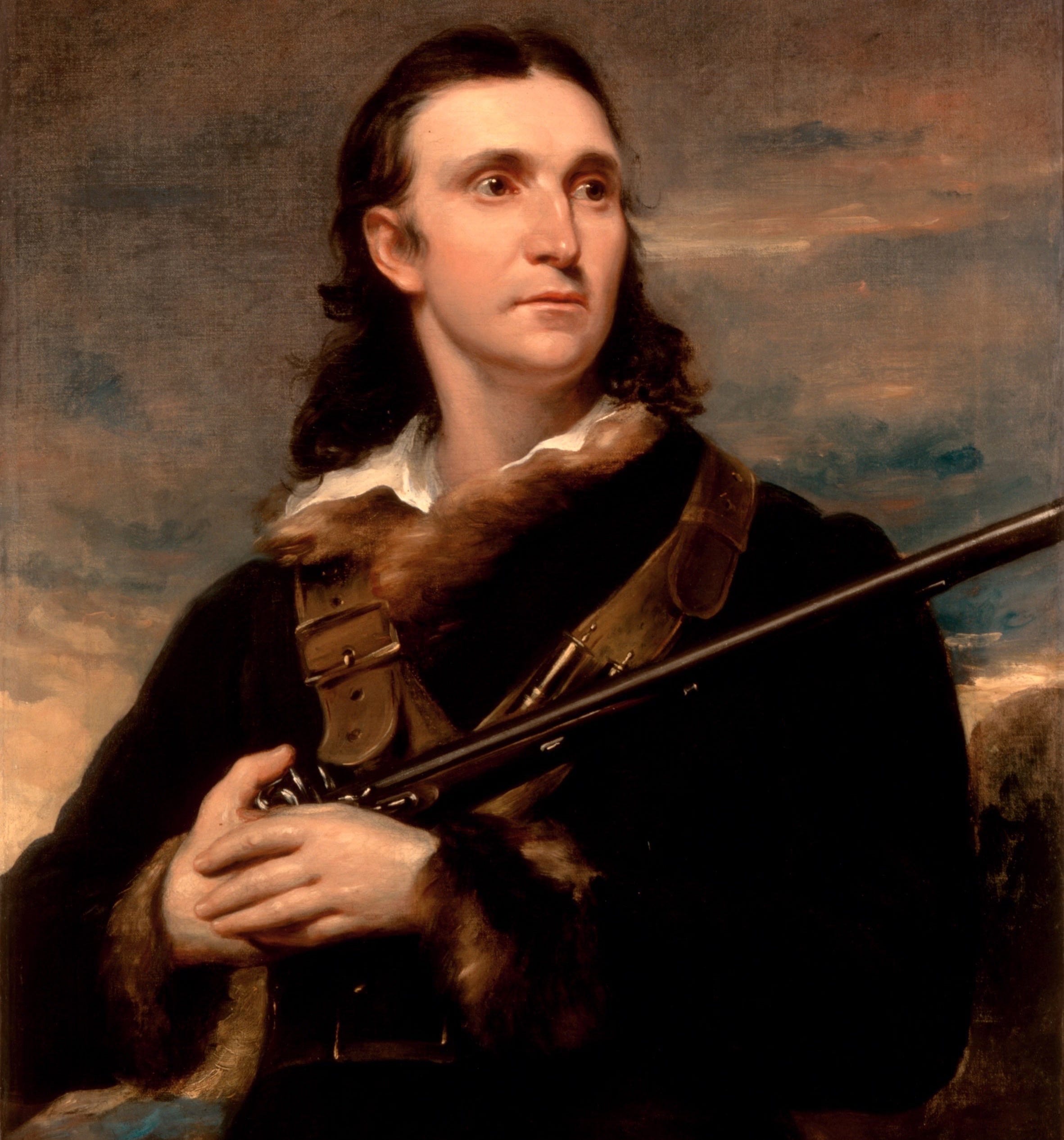
America's greatest bird lover (and killer)
The warning he left behind
John James Audubon stared at the caged bird.
“I watched his eye and observed his looks of proud disdain,” the artist wrote. The bird was more than three feet from beak to tail. Its wings could stretch as far as seven feet.
Audubon bought the golden eagle in 1833 for $14.75 from a museum owner who had gotten it from a trapper.
The bird had caught its toe in a fox trap. It carried the trap for more than a mile before the trapper caught up with it in the woods of New Hampshire.
Now what should Audubon do with it?
“At times I was half inclined to restore to him his freedom, that he might return to his native mountains,” Audubon wrote. “How pleasing it would be to see him spread out his broad wings and sail away towards the rocks of his wild haunts; but then . . . someone seemed to whisper that I ought to take the portrait of this magnificent bird, and I abandoned the more generous design of setting him at liberty.”

Following that instinct carried a grisly fate.
Audubon disdained the illustrations of the day as scientifically correct but stiff, lacking in realism. To capture birds’ shapes, motions and colors, to make art full of life, Audubon found that he had to kill them. He placed dead birds in lifelike poses on pieces of wire he set into a pine board.
The truth was that this passionate lover of birds was also a prolific slayer of birds.
Audubon knew firsthand that nature was a relentless cycle of killing —“red in tooth and claw”, as Tennyson would later write, and the artist lived at a time when hunting was a major source of food.
Since 1782, a predator — the bald eagle — had stood for the young nation as the defining symbol on its Great Seal. As Richard Rhodes noted in his 2004 biography, Audubon praised eagles as “muscular, strong and hardy, capable of bearing extreme cold without injury and of pursuing their avocations in the most tempestuous weather.” That’s not a bad description of Audubon himself; the artist braved fierce conditions in his decades-long pursuit of the “Birds of America.”
Audubon arrived from France at the age of 18 in 1803, 27 years too late to share in the founding of the nation. Yet his achievement has a foundational quality: The 435 Birds of America engravings provided an unparalleled panorama of America’s natural world in the early 19th century — a paradise he warned could not last.
Sold to a subscription audience and engraved on “double elephant” sized paper — at 26 by 38 inches, the pages are so big they take two people to turn — the images depict the birds at life size. To look at them is to encounter the endless variety, intricacy and symmetry of nature.
Even today, 175 years after his death, the name Audubon stands for the fight to preserve an imperiled environment.
That challenge has faced every succeeding American generation. Despite some spectacular successes in recent decades, the conservation movement is fighting an uphill battle.
Lesson of the eagles
A 2019 study found that North America had lost more than a quarter of its avian population — amounting to 3 billion birds — over 50 years. A report last year pointed to continuing declines, with 42 species at risk as their populations shrink to dangerously low levels.
Perversely, President Donald Trump’s first administration significantly weakened enforcement of the 1918 Migratory Bird Treaty Act. Trump’s Interior Department changed the rules to exempt companies from enforcement action for industrial hazards that kill birds unless the deaths could be shown to be intentional. The second Trump administration reinstated the rule change, despite an adverse court ruling in 2020.
The history of America’s eagles provides a pertinent lesson. By 1963, the bald eagle population had dwindled to only 417 known nesting pairs in the 48 continental states, according to the American Eagle Foundation. The birds were victims of the pesticide DDT, which they consumed from their prey, and which thinned their eggshells, making them too fragile.
Eagle hunting and loss of habitat compounded the problem. But the banning of DDT and enforcement of legal protections for the birds led to a remarkable comeback, with more than 71,000 nesting pairs and a total population of more than 316,000 eagles. Golden eagles are only one tenth as numerous as bald eagles and their population is considered stable.
Audubon not only watched birds, he “caught, caged and killed them; skinned, dissected and measured their bodies; noted their weight and diet; lingered over their peculiarities, admired their beauties,” Holland Cotter wrote in the New York Times. “His goal in all of this was to paint their portraits, to turn bird-watching into science, and science into art.”
After mulling the eagle’s fate, Audubon decided he would “take away his life with the least pain to him.” Consulting his family doctor for a method, Audubon covered the cage with blankets and put it into a closet with some burning coal.
He thought the bird would die of carbon dioxide and monoxide. Hours later, the artist raised the blankets. “There stood the eagle on his perch, with his bright unflinching eye turned towards me and as lively and vigorous as ever!”
Adding sulfur to the coal the next day did nothing but make the house smell awful. So Audubon went back to basics: “I thrust a long pointed piece of steel through his heart, when my proud prisoner instantly fell dead without even ruffling a feather.”
As Richard Rhodes recounted, the artist planned to depict the eagle capturing a fawn or a hare. In a way, the artwork would serve as a companion to his 1828 illustration of a bald eagle preying on a yellow catfish.
The original golden eagle drawing stands out among Audubon’s work for two things. Rhodes pointed out that “one of the eagle’s talons cruelly pierces the hare’s eye, releasing a drop of bright-red blood.” Also, “in the lower left corner a buckskinned, long-haired, fur-capped woodsman shinnies across a fallen log bridging a sheer chasm—Audubon himself, with a gun and the golden eagle’s mate slung on his back.” For unknown reasons, that depiction of Audubon the hunter doesn’t appear in the golden eagle engraving that was published as part of Birds of America.
The work’s composition bears a resemblance to Jacques-Louis David’s 1801 painting showing Napoleon crossing the Alps, as art scholar Theodore Stebbins noted. Audubon often claimed with little evidence that he had studied under David, who was Napoleon’s court painter.

Chaos and order
Audubon was born in the French colony of Saint-Domingue, the illegitimate son of a French planter and a chambermaid. His father sold part of his sugar plantation in the early years of the slave revolt that created Haiti and retreated to France with the six-year-old Audubon and his half-sister. The father would invest some of the proceeds in 284 acres of farmland in Pennsylvania.
France proved to be a scary place for young Audubon. As Rhodes wrote, blood flowed freely after the guillotining of King Louis XVI in 1793.
Tens of thousands of loyalist peasants rose up against the Revolutionists in the Vendée, the département that bordered Nantes below the Loire. Skeptics were criminals as far as the Committee of Public Safety was concerned. “We must rule by iron those who cannot be ruled by justice,” Saint-Just demanded in words that Robespierre endorsed. “. . . You must punish not merely traitors but the indifferent as well.”
Counterrevolution was not the worst of it; the worst was the Terror that descended on Nantes in October in the person of a nightmarish Representative, Jean-Baptiste Carrier, sent out from Paris bent on reprisal. … Deeming shooting and guillotining inefficient, he ordered victims by the hundreds tied together naked in pairs — “Republican marriage,” this indignity was called — loaded onto barges, gabarres, and the barges sunk mid-river in the Loire. “Sentence of deportation was executed vertically,” Thomas Carlyle reports Carrier writing with bloodthirsty sarcasm…. For months thereafter, says Carlyle, “clouds of ravens darken the River; wolves prowl on the shoal-places.” The putrefying flesh contaminated the river to such an extent that the health authorities were forced to ban fishing. “Kill and kill,” Carrier was heard to rage, and “butcher children without hesitation.”
It’s not hard to imagine the trauma this inflicted on Audubon — or why studying birds appealed to the young boy as an escape. Rhodes noted that his father encouraged him in this hobby and presented him with a book of bird illustrations.
“A new life ran in my veins,” Audubon wrote. “I turned over the leaves with avidity; and although what I saw was not what I longed for, it gave me a desire to copy nature. To Nature I went, and tried to imitate her.”
To keep his son safe from conscription into Napoleon’s army, Audubon’s father sent him to America. His task was to preside over the Pennsylvania estate. He began to build an American identity, carefully erasing his true origin as illegitimate, not least because it would prevent him from inheriting anything from his father.
Audubon was not a modest man. He wrote of himself, “I measured five feet, ten and one half inches, was of fair mien, and quite a handsome figure; large, dark, and rather sunken eyes, light-colored eyebrows, aquiline nose and a fine set of teeth; hair, fine texture and luxuriant, divided and passing down behind each ear in luxuriant ringlets as far as the shoulders.”
He met and eventually married Lucy Bakewell, the daughter of an English country squire who had just moved into the Pennsylvania region at the time of Audubon’s arrival. Rhodes described her as “tall, slim, graceful, poised, modest and lovely to look at, with a turned-up English nose and smoky gray eyes” and also “intelligent, loyal, well read, musical, meticulous, a good horsewoman and an athletic swimmer.”
The Audubons would have a loving but at times tense marriage as they coped with the failure of his business ventures, his frequent travel for his artistic as well as commercial efforts and the strains of building a subscription business (with the help of his two sons) to finance Birds of America.
The constant, hazardous travel and the relentless salesmanship it took to sign up enough subscribers for Audubon’s masterwork make today’s marketing efforts by Substack writers seem tame.
Of course, Audubon was charging a lot more money for a subscription: As Ashley Rose Young wrote for the Library of Congress, Audubon signed up about 300 subscribers in advance for the Birds of America plates, which were published over a period of years. “These subscribers were almost entirely wealthy individuals, as a subscription cost about $1,000—roughly $35,000 in 2025 dollars.”
Audubon’s watercolors served as a guide for his London-based engravers, Robert Havell and Son, who employed colorists to complete the prints. The vividly toned birds have a hyper-realistic quality, set in their natural habitats.
Part of what made the book so compelling was its frank treatment of nature. “Audubon’s birds sing and scream, kill and get killed, eat and defecate,” Christoph Irmscher observed. “One of his best-known compositions, of the majestic wild turkey, displays (unnoticed even by those who study his work) a pile of poop in the lower left corner.”
Audubon’s careful documentation of his travels provides a revealing portrait of the American frontier in the early 19th century. On a trip to Kentucky, he was amazed by the huge flocks of passenger pigeons traveling through the region.
“The air was literally filled with Pigeons; the light of noonday was obscured as by an eclipse; the dung fell in spots, not unlike melting flakes of snow; and the continued buzz of wings had a tendency to lull my senses to repose,” recalled Audubon.
“They were beautiful birds with gray-blue backs and wings, black-spotted wing coverts, light brown-red breasts and throats with highlights along the lower neck of gold, red and emerald green,” Rhodes wrote. “They had small heads and slender necks and their bodies were elongated compared with the familiar rock pigeons of city streets…”
Attempting to estimate their numbers, Audubon soon concluded that there were more than a billion passenger pigeons. Rhodes wrote that a modern expert has put the number at about 3 billion, or “25 to 40 percent of all the breeding birds in America.”
The depiction of the species in an 1829 Birds of America engraving shows the female passenger pigeon feeding her more richly colored mate, as each clings to a tree branch.
Naturally, hunters saw the birds as an ideal target and killed them in huge quantities, particularly during 1816, when worldwide temperatures dropped and crops failed.
Audubon didn’t know the eventual fate of the passenger pigeon, but he foresaw the inevitable effects of America’s multiplying human population.
In 1826, he wrote in his journal of the threats to America’s natural environment:
Neither this little stream, this swamp, this grand sheet of flowing water, nor these mountains will be seen in a century hence as I see them now. Nature will have been robbed of her brilliant charms. The currents will be tormented and turned astray from their primitive courses. The hills will be leveled with the swamp, and probably this very swamp have become covered with a fortress of a thousand guns. Scarce a magnolia will Louisiana possess. The timid deer will exist no more. Fishes will no longer bask on the surface, the eagle scarce ever alight, and these millions of songsters will be drove away by man.
Relentless hunting kept shrinking the passenger pigeon population through the 19th century. “Then they disappeared altogether, except for three captive breeding flocks spread across the Midwest,” wrote Barry Yeoman for Audubon magazine.
At 1 p.m. on September 1, 1914, Martha, the last known passenger pigeon, died, aged 29, at the Cincinnati Zoo.


