

Shortly before 4 a.m. on May 24, 1940, about 20 men carrying bombs, machine guns, revolvers, an iron bar and a rope ladder approached Leon Trotsky’s mansion in a Mexico City suburb.
Their leader, a noted muralist named David Alfaro Siqueiros, had revved up his team for the job with a plentiful supply of booze. He suited up in a major’s uniform, a fake Hitler mustache and a World War I-vintage pointed helmet, Josh Ireland wrote in his 2026 book The Death of Trotsky.
After the invaders tied up Trotsky’s police guards, they began firing.
“They’re shooting, they’re shooting into the room,” Trotsky’s wife Natalia told him. The couple moved from their bed onto the floor as bullets whizzed in from the room’s doors and windows. They could see a man firing a pistol into their grandson’s room. “Grandfather,” the child screamed. He too rolled onto the floor. A bullet nicked one of his toes as the boy lay on the floor.
After the attackers ran out of bullets and fled, “Mexican police counted seventy-three bullet holes in Trotsky’s bedroom wall alone; Trotsky thought that two hundred had been fired in total,” Ireland wrote.
Apart from the superficial wound suffered by Trotsky’s grandson Seva and two cuts on Trotsky’s legs, the shooters inflicted no damage to the occupants of the compound.
It was the first of two attempts on Trotsky’s life that year orchestrated by the NKVD, the Soviet secret police, acting on the orders of dictator Joseph Stalin.
On August 20, the results were different. A Spanish civil war veteran who used a false identity to ingratiate himself with Trotsky’s inner circle met with the famous revolutionary in his study. He claimed to be seeking feedback on an essay he had written. But soon after Trotsky began reading it, Ramón Mercader plunged an ice ax into his head. Trotsky died the next day. Mercader served nearly 20 years in prison and was proclaimed a Hero of the Soviet Union after his release.
It was a reversal of Karl Marx’s famous saying that history repeats itself, the first time as tragedy, the second time as farce. In this case, the farce of the Siqueiros raid came before the tragedy of Trotsky’s murder by Mercader.
October will mark 100 years since Stalin outplayed Trotsky and forced him out of the Politburo, a key milestone in depriving him of power and ultimately Soviet citizenship.
The Trotsky-Stalin struggle drove much of the history of socialism in the 20th century, providing a backdrop to today’s debates over the role of Democratic Socialists in American politics. But the intervening decades have stripped socialism of much of the meaning it carried in the days of Trotsky and Stalin.
The rivals despised each other. Trotsky was brilliant, and arrogant enough to let everyone know he knew how smart he was. He seemed to assume that his exploits in the revolution and as the head of the Red Army in the Russian civil war would make him Vladimir Lenin’s natural successor, so much so that he made no effort to build ties with other party members and to reward his supporters.
“Stalin hated Trotsky’s delicately balanced pince-nez and sweep of dark, glossy hair, his self-confidence, eloquence, and authority,” Ireland wrote. “Trotsky was repulsed by the Georgian’s pockmarked face, his coarse manners, his provincialism.”
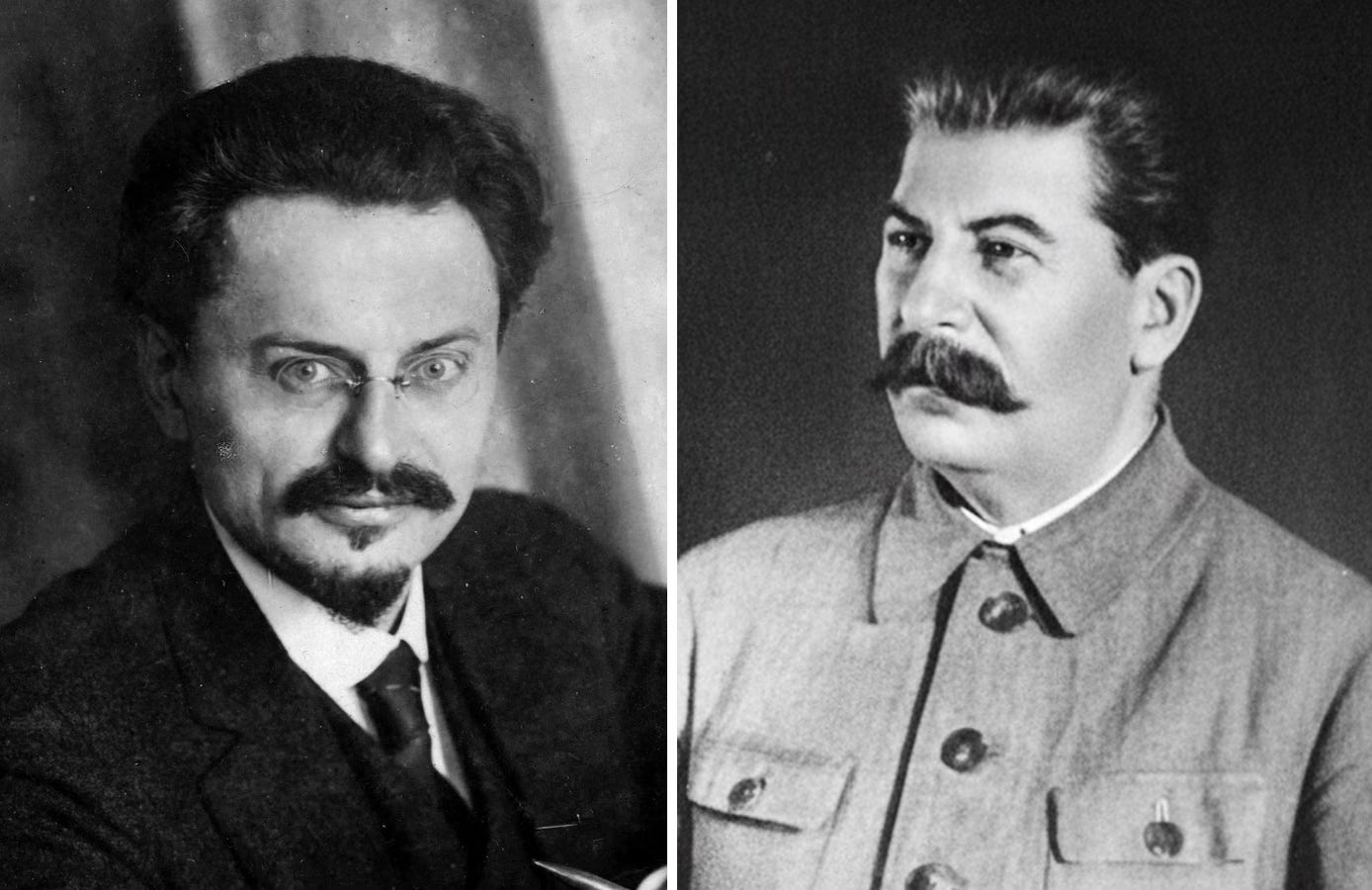
Stalin seethed in Trotsky’s shadow for a time, but cleverly built a web of relationships that ensured his rival’s ouster from the party and eventually the country.
This was a poisonous fight for power, not a principled struggle between moderation and extremism. Both men were comfortable using violence to achieve their ends.
When Stalin emerged victorious, it wasn’t enough for him to strip Trotsky of his honors and rank, to exile him, attack members of his family, place undercover agents in his entourage, kill virtually all of their old Bolshevik comrades, and prosecute and execute tens of thousands of others in the Moscow show trials and purges.
Stalin insisted that Trotsky himself, the leading opponent of the Soviet dictator in the world of socialism, had to die. And so he did.
Trotsky, born Lev Davidovich Bronstein, the son of a well-to-do farming family, had escaped a Siberian exile for his involvement in the Russian Social-Democratic Workers Party during the Tsarist regime (he left his wife and two daughters behind) to travel across Europe. Reaching London, he worked with Vladimir Lenin on the revolutionary journal Iskra (Russian for “spark”).
In 1906, as he was again banished by Russian authorities, Trotsky warned that a Marxist revolution in Russia would perish if it didn’t spread: “Left to its own resources, the working class of Russia will inevitably be crushed by the counter-revolution the moment the peasantry turns its back on it. It will have no alternative but to link the fate of its political rule, and, hence, the fate of the whole Russian revolution, with the fate of the socialist revolution in Europe.” Its motto should be, he wrote: Workers of all countries, unite!
But Communism’s international appeal proved very limited. While Bolshevik revolutionaries eventually seized control of Russia, similar efforts failed in western Europe.
Recognizing that his country’s regime would be isolated, Stalin propounded a new theory in 1924: socialism could succeed in one country.
His argument resonated, to the detriment of Trotsky’s concept of “permanent revolution.” The Soviet Union became a model for a left-wingers around the world. They saw it as an unparalleled experiment in running an economy without capitalism, taking a backward country from feudalism to modernity in one leap.
For years, many intellectuals and artists ignored evidence of Stalin‘s blood-soaked leadership — as bodies piled up in the famine he imposed on Ukraine, his collectivization of Russia’s farms and his persecution of alleged ideological enemies who he claimed were inspired by Trotsky.
Diego and Frida
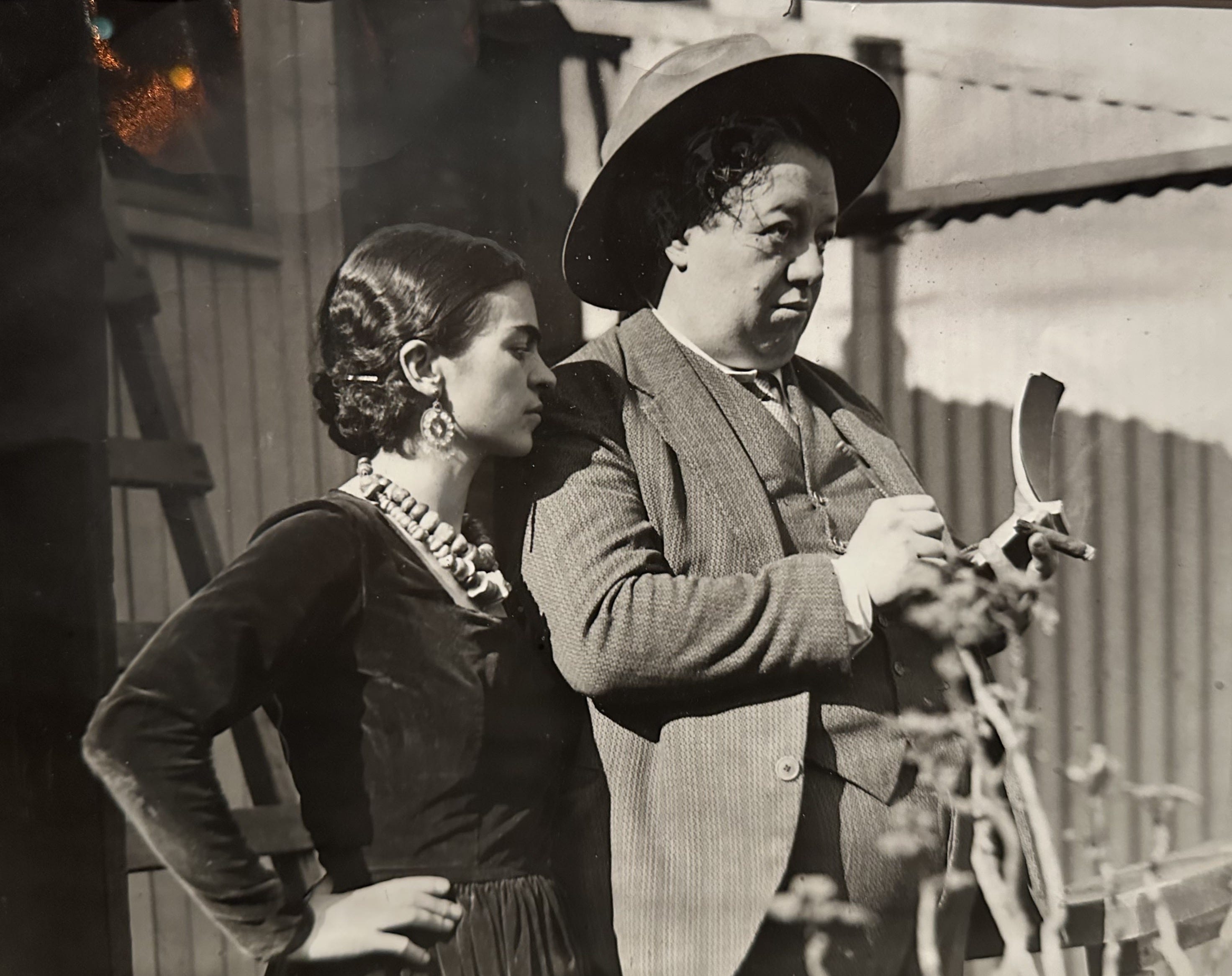
One of the artists who admired the Soviet Union was Mexico’s Diego Rivera. He joined his country’s Communist Party in 1922 and became a leader, as Josh Ireland noted. “At around the same time, Rivera—along with two other artists, Xavier Guerrero and David Alfaro Siqueiros—set up El Machete, the most radical broadsheet in the city.” But Rivera began to lose his taste for revolutionary politics, and after visiting the Soviet Union on the 10th anniversary of the revolution in 1927, he soon decided that his days as a Stalinist were over.
Ireland quoted a description of what happened next at a meeting of the Mexico Communist Party:
Diego arrived, sat down, and took out a large pistol and put it on a table. He then put a handkerchief over the pistol and said: “I, Diego Rivera, general secretary of the Mexican Communist party, accuse the painter Diego Rivera of collaborating with the petit-bourgeois government of Mexico and of having accepted a commission to paint the stairway of the National Palace of Mexico. This contradicts the politics of the Comintern and therefore the painter Diego Rivera should be expelled from the Communist party by the general secretary of the Communist party, Diego Rivera.”
Ireland added, “He then declared himself expelled, stood up, removed the handkerchief, and broke the pistol, which had been made from clay.”
Still, Rivera remained involved in left-wing politics. In 1933, he was hired by Nelson Rockefeller to paint a mural titled “Man at the Crossroads” at New York’s Rockefeller Center. Among the people depicted in the painting was Vladimir Lenin. The mural was destroyed after the artist refused to remove Lenin’s likeness.
When western European nations made clear they no longer wanted to host the exiled Trotsky, Rivera helped persuade Mexico’s president to let him into the country. Rivera’s wife and fellow artist Frida Kahlo, opened her childhood home to Trotsky and his wife Natalia. The two couples became good friends; Trotsky welcomed the warmth of Mexico and grew to love hiking and hunting in the countryside.
Trotsky supported himself with his pen and set out to write the biography of the man he underestimated: Stalin. He even created a “commission” led by the prominent American philosopher John Dewey to review the trumped-up charges leveled against Trotsky in the Moscow trials.
Some gullible journalists weighed in on behalf of Stalin’s crusade. New York Times correspondent Walter Duranty took the claims of treason against Trotsky at face value. He observed that the trials convinced “the whole Soviet Nation that Trotskyism not only is counter revolutionary but also an ally of fascism and a stimulus to war.”
Assessing the trials in his 1995 book, John Dewey and the High Tide of American Liberalism, Alan Ryan wrote, “Most of the accusations were fantastic, the crimes alleged were impossible, the people against whom the accusations had been made had plainly been tortured into confessing, and the accused were to a man people who had given their entire adult lives to the ideals of the Communist society.”
Kahlo and Rivera sat in on the hearings of the Dewey Commission. She wanted to get back at her husband for his affair with her sister Cristina. Frida would sit “as close to Trotsky as possible,” Ireland noted. “Within weeks of the end of the Dewey Commission, what had begun as a gentle flirtation escalated into a full-blown love affair conducted at Cristina’s house. While Rivera remained ignorant (a good thing: Kahlo warned her male lovers that her husband was more than capable of murder), Natalia became jealous and profoundly depressed.”
The friendship between Trotsky and Rivera, two men with titanic egos, ended in acrimony. The revolutionary leader returned gifts Rivera had given him and moved with his wife into a nearby mansion. There, as Ireland noted, a watchtower was soon built over the main gate.
Trotsky believed that Stalin would eventually have him killed, but he wasn’t aware of the relentless efforts by the NKVD to track his every move and the spies they planted in his midst.
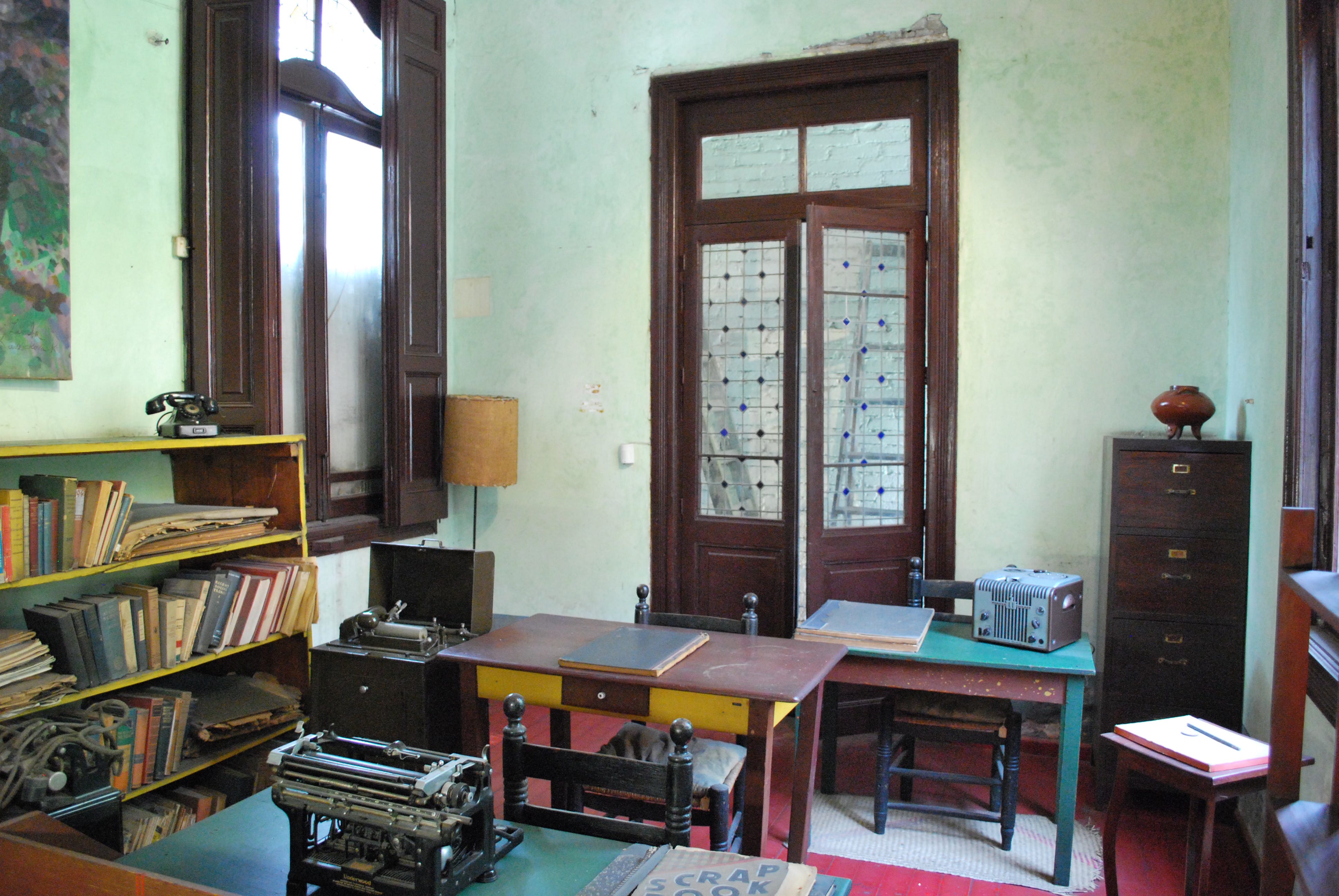
A Trotskyite’s journey
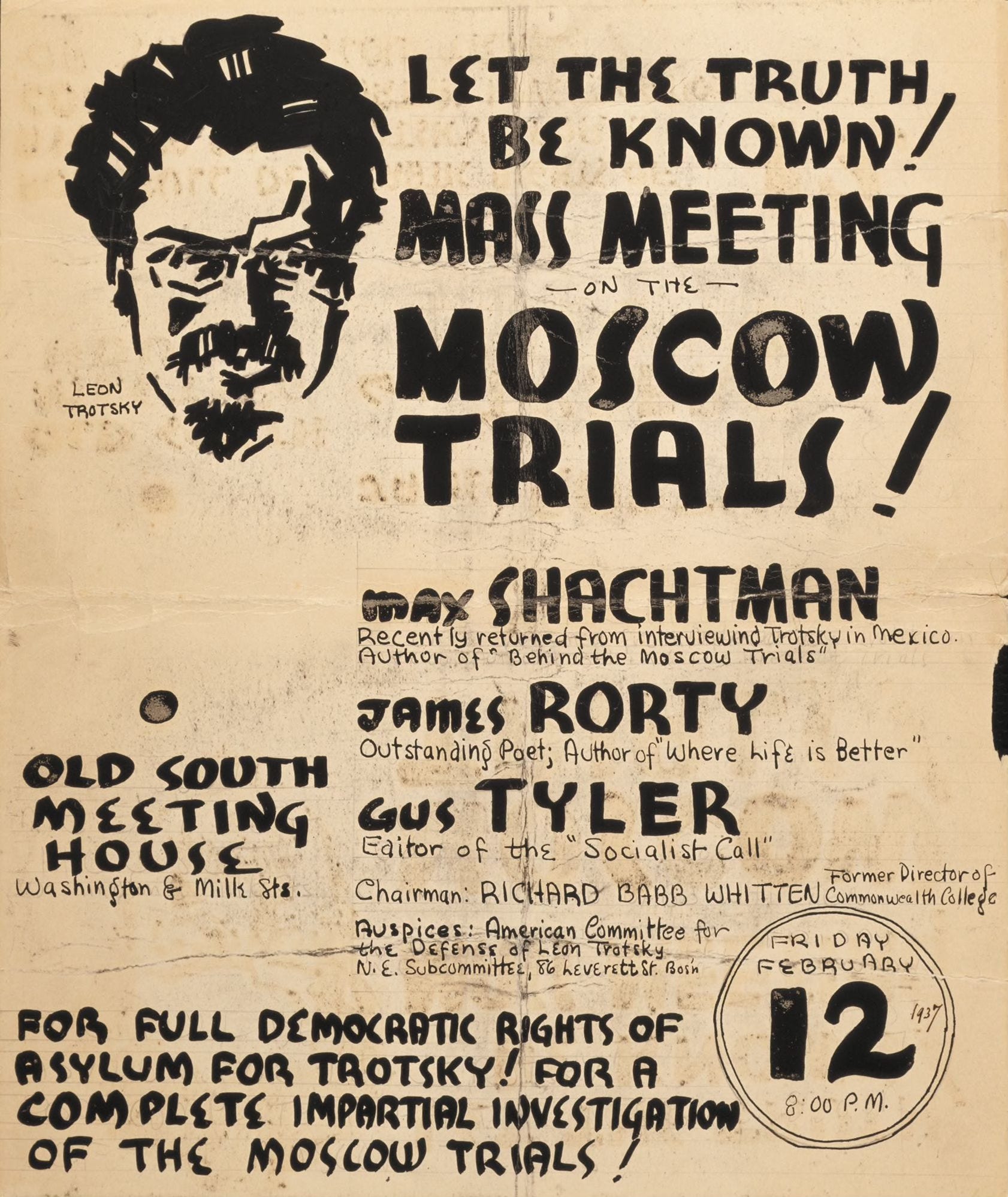
Max Shachtman came to the United States from Warsaw with his parents in 1905 as an eight-month-old. His family settled in New York’s Lower East Side. A high school teacher introduced him to socialist thought, and he grew to admire the accomplishments of Lenin and Trotsky. He was among those who traveled to Mexico to welcome Trotsky and became a close adviser to Natalia after Trotsky’s assassination.
Shachtman had been expelled from the Communist Party USA in 1928 after he and other leaders took Trotsky’s side in the battle with Stalin. He went on to publicly defend Trotsky against Stalin’s charges in the show trials of the 1930s.
But Shachtman broke with Trotsky in the aftermath of the Hitler-Stalin pact of 1939. Trotsky’s view was that the USSR was still a worker’s state, even though a “degenerated” one under Stalin’s dictatorship. Shachtman and his supporters in the newly formed Workers Party disagreed—the Soviet Union was “a new type of exploitative and oppressive society, neither capitalist nor socialist.”
The end of World War II led to diminished interest in left-wing politics, with Shachtman moving to the Long Island suburbs, opening a mail-order business and raising orchids on the side. But he came back to prominence in a debate against the ousted head of the American Communist Party, Earl Browder, Shachtman “brought down the house on that occasion, when, after intoning the list of leaders of foreign communist parties murdered on Stalin’s orders, he pointed suddenly to an ashen-faced Browder and declared, ‘There but for an accident of geography sits a corpse.’”
Perhaps his biggest contribution was the network of disciples he developed. Among them was Michael Harrington, a Yale Law School dropout and onetime Catholic Worker writer from St. Louis. “Michael had a gift for making young people feel that their political choices had a meaning and a future,” wrote Maurice Isserman, author of The Other American: The Life of Michael Harrington.
“Although never an orthodox Trotskyist, Michael admired the exiled Bolshevik leader as one of those historic figures who managed to combine original thought with great deeds.”
Harrington’s 1962 book The Other America awakened many people to the persistence of poverty amid the postwar wealth of the United States and helped set the stage for President Lyndon B. Johnson’s war on poverty. But while Harrington’s ideas were mainstreamed, he remained a committed socialist, though one firmly opposed to Stalinism.
Birth of the DSA
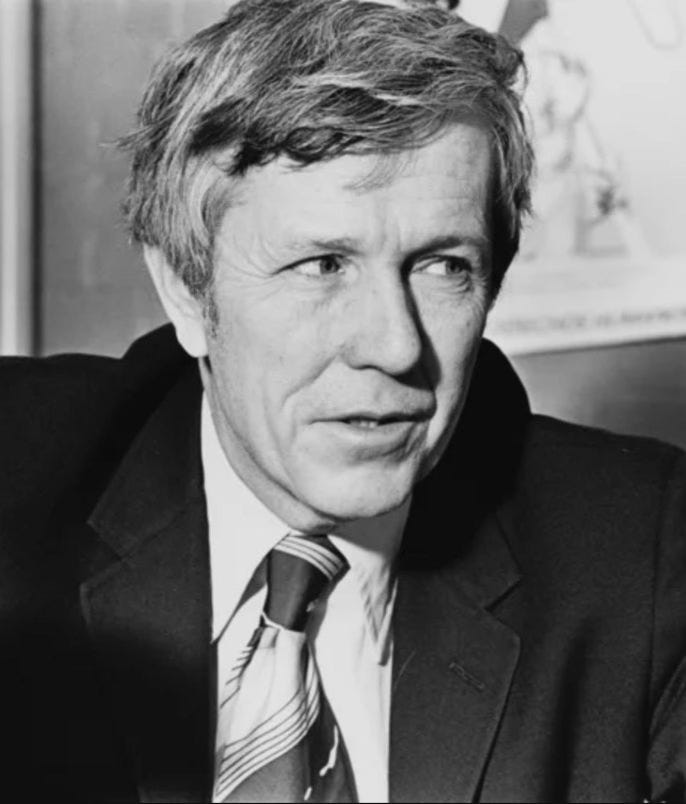
In February 1973, Harrington convened a conference at New York University on “The Future of the Democratic Left,” out of which emerged the Democratic Socialist Organizing Committee, with Harrington as chairman.
“Then in a gesture Michael found both appropriate and a little embarrassing the founders of this newest venture on the Left closed their meeting by singing the old socialist anthem ‘The Internationale,” wrote Isserman.
Michael Harrington made clear his brand of socialism would be “democratic, humanist, and antiwar.” In 1982, Harrington’s DSOC merged with another leftist group, the New American Movement, to form the Democratic Socialists of America. At its height, the merged group had 7,000 members, but that dropped to 5,000 by 1987 as the appeal of socialism continued to wane, Isserman wrote.
Harrington would be astonished to learn that the DSA he created now claims more than 100,000 members. He probably would have approved of much of the organization’s platform, calling for public ownership of corporations, defunding the Pentagon, abolishing ICE, guaranteeing free healthcare and ending “economic warfare” against Cuba, Venezuela and Iran (though he castigated Fidel Castro’s Cuba as a totalitarian regime).
He would have been less comfortable with the DSA’s stance on Israel. In 1975, he called Zionism “the national liberation movement of a Jewish people asserting their right to self-determination,” as Michael Bernick wrote in Tablet.
His final book, Socialism: Past and Future, was published just before his death in 1989. Harrington saluted the vision of “democratic socialization.” He wrote, “But when socialism tried to implement that concept of a new civilization that went beyond simple reform it was sometimes disastrously wrong or else vague and merely rhetorical. The question is: can socialism learn from the defeats and betrayals that resulted from its flawed understanding of its own profound truths?”
He probably would not be surprised that Democratic Socialists have still not answered his final question.
Incredible! Disorder in the modern Democratic Party goes back to a guy named Schachtman who moves to Long Island and opens a mail-order business, growing orchids -- yet! -- on the side. History is merciless and hilarious, too. Thanks, Rich.
Another outstanding column, Rich. I’m glad you mentioned Michael Harrington. I know someone who went to school with him, and we were discussing him yesterday.