

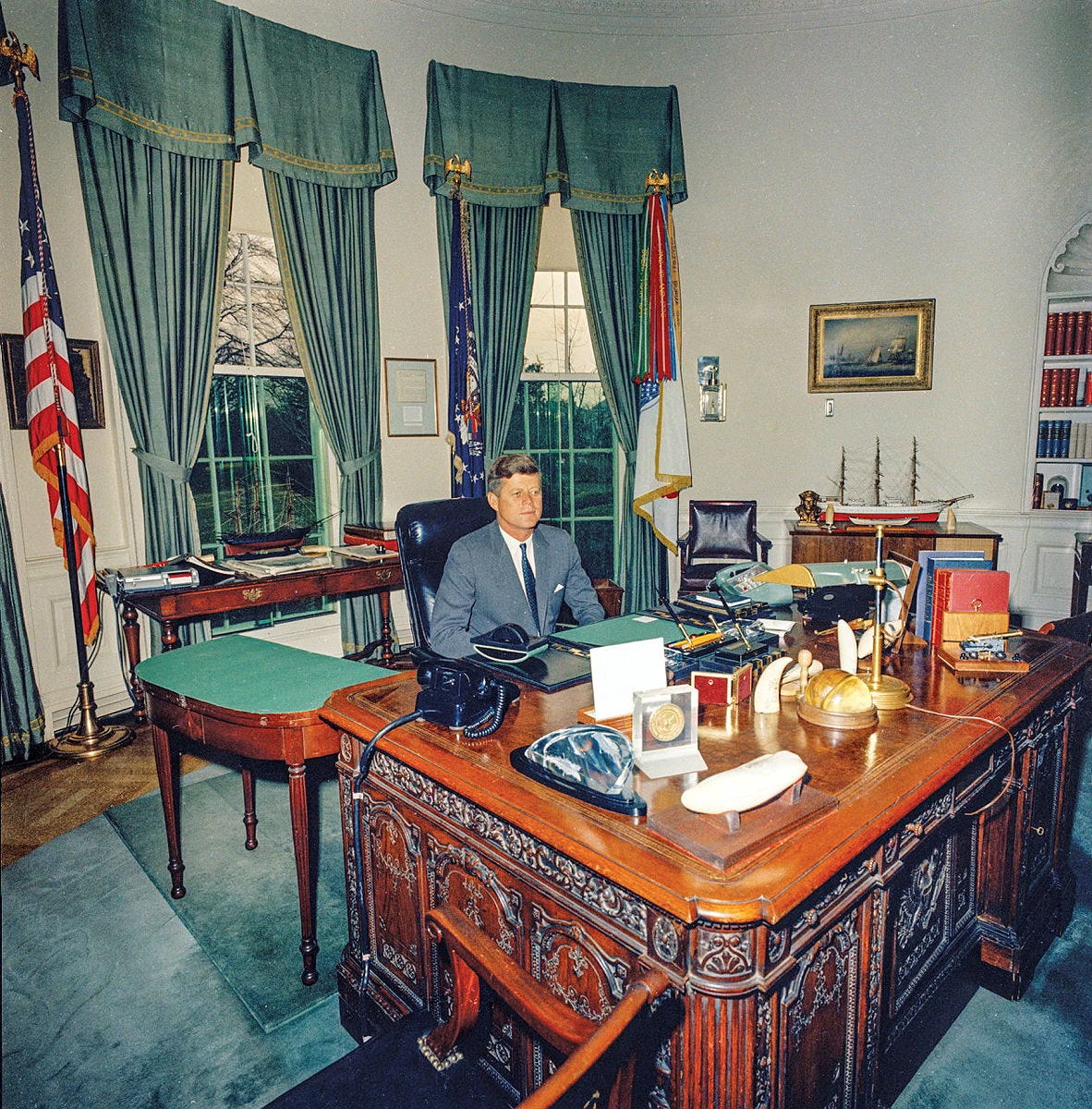
In early February 1961, the White House announced that Jacqueline Kennedy had made a “most interesting discovery.” Aiming to restore a mansion she once labeled a “dreary Maison Blanche,” the new first lady searched for historic objects.
Touring the mansion’s 54 rooms and 16 baths along with a curator from the Smithsonian, Kennedy made her first find: A “massive, richly carved” oak desk that had sat in the ground-floor broadcasting room for eight years.
It was mostly covered by green baize, held in place with scotch tape. Underneath, “the desk was in perfect condition,” according to a Feb. 7 New York Times front-page story which quoted a White House press release.
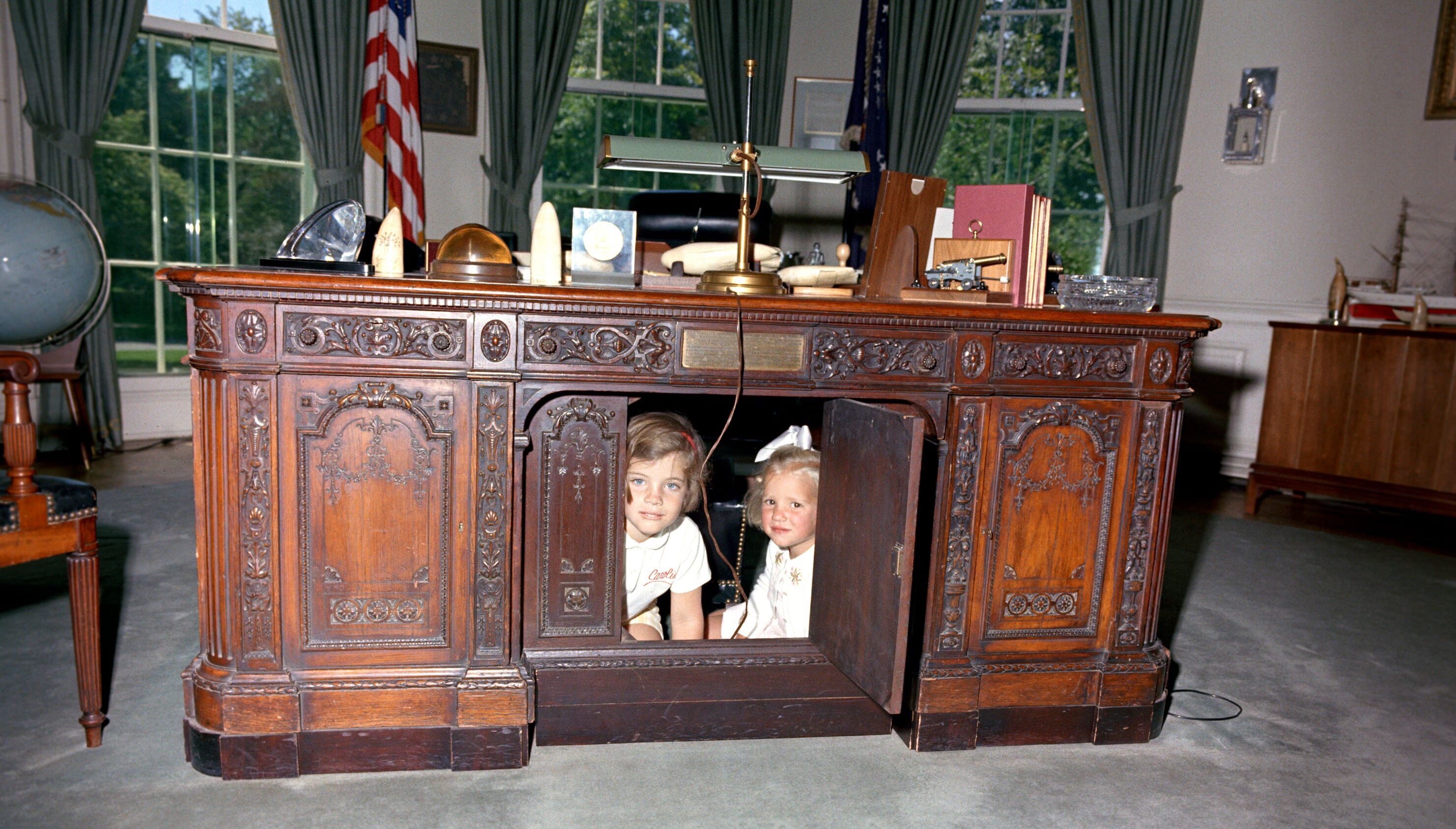
An inscription in black letters set on a gold background explained that the desk was made from the timbers of the HMS Resolute and presented as a gift by Queen Victoria to the president of the United States, who in 1880 was Rutherford B. Hayes.
Jackie Kennedy had the Resolute desk installed in the Oval Office. A famous photo taken for LOOK magazine showed President John F. Kennedy reading papers while his toddler son John Jr. peeked out from a door under the desk. After JFK’s assassination in November, 1963, the desk was exhibited outside the White House.
Fourteen years later, President Jimmy Carter had it reinstalled it in the Oval Office, where President Donald Trump sits as he presides over encounters with reporters, signs executive orders and presses a button that summons a butler to bring him a Diet Coke. On July 6, he symbolically rang the opening bell of the New York Stock Exchange and the Nasdaq from the Resolute Desk, to promote awareness of the “Trump accounts” established for newborns.
The Resolute desk is firmly a part of American history, but it owes its origin to a decades-long quest that fascinated Britons in the 19th century. It is the most Victorian of Victorian stories — involving not only Queen Victoria herself but also Charles Dickens, Alfred Lord Tennyson and Benjamin Disraeli, along with two central characters: Sir John Franklin and Lady Jane Franklin.
Its themes are Victorian values: An obsession for “duty” that Gilbert and Sullivan satirized in The Pirates of Penzance, a zeal for discovery and conquest and a racist arrogance all played their parts in the saga.
New naval mission
When Britain and its continental allies finally defeated Napoleon in 1815, the Royal Navy’s greatest mission disappeared. As a new raison d’être, John Barrow, the second secretary of the Admiralty, advocated rapid exploration of the Arctic, in hopes of finding a lucrative shortcut between the Atlantic and Pacific Oceans.
It was a strategy echoed in the impulse that led Trump to strike a no-bid deal with Finland for 11 icebreakers the U.S. Coast Guard could deploy in the Arctic. Climate change has shrunk the Arctic’s ice, feeding the dream of a shipping channel that would drastically cut the time and cost of moving goods between Atlantic and Pacific ports. Whether such a competitor to the Suez and Panama Canals will ever materialize (and whether the U.S. needs 11 icebreakers) isn’t clear.
The first mission to seek — and fail to find — the northwest passage began in 1818 on HMS Isabella. Many unsuccessful voyages would follow.
But 27 years later, on May 19, 1845, more than 10,000 people crowded the docks of London to see off two famed ships that John Barrow hoped would finally find the passage, noted Martin W. Sandler in his book Resolute.
HMS Erebus and HMS Terror, equipped with steam engines, had been specially fitted out for Arctic exploration, with added oak beams and a hull reinforced with oak, elm and iron, Sandler wrote.
Some veteran Arctic explorers questioned the wisdom of sending such a well-staffed expedition — there were 129 officers and crew — into the ice-choked waters. The Navy made sure to stock the ships with supplies intended to last more than three years, including seven tons of flour, 4,500 gallons of alcohol and 8,000 cans of food, Sandler noted.
Sir John and Lady Franklin
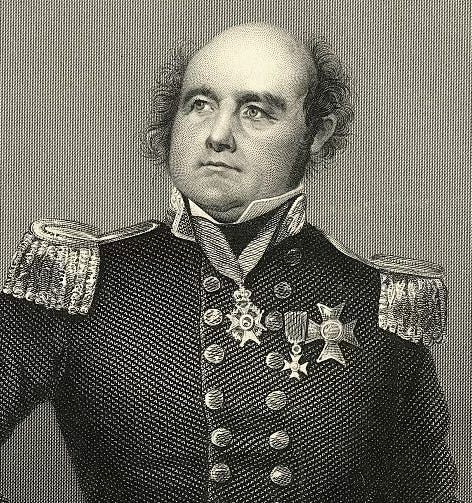
The vessels were put under the command of Sir John Franklin, a veteran of the Battle of Trafalgar. That was not entirely reassuring, since his 1819-21 overland Arctic expedition had resulted in the deaths of 11 crew members.
Franklin earned a reputation for benevolence and honesty, but not for expert leadership. His tenure as governor of the convict colony Van Diemen’s Land, now called Tasmania, was widely criticized.
At 59, he was old for taking on this strenuous Arctic voyage and in bad shape physically. But he had one great asset—his second wife Jane Franklin, an extraordinarily influential figure in British society whose deft political skills kept her husband’s career on an upward trajectory despite his failures.
She made a token effort to conceal her own ambition. Writing to her sister, Jane once confided that “I hope I shall never be talked of as one of your bold, clear, energetic women, fit for anything. I am no doubt possessed of great energy and ardor, but I would rather hide than show it.”
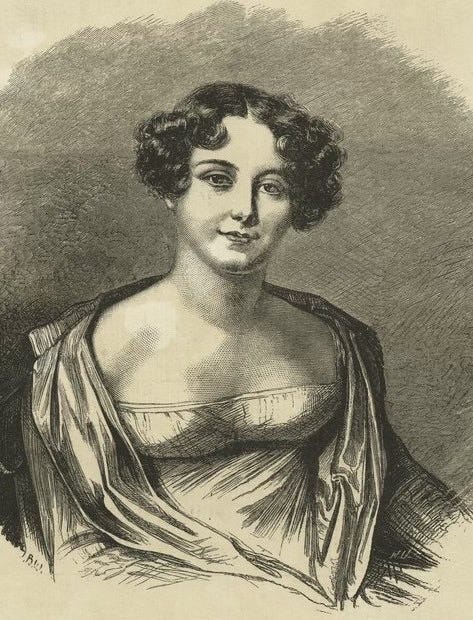
Even so, “Jane Franklin defied every taboo of her day,” Sandler observed. She traveled constantly, read voraciously and cultivated a series of young male proteges. “Most of all, Jane Franklin was a woman determined to get what she wanted, and more than anything else, she wanted to get for her husband what she believed he deserved.”
One person who met Sir John when he was 50 and serving in Van Diemen’s Land, wrote that “he is rather deaf, his hand shakes and he looks nearly seventy.” An American convict wrote, “of all men I ever saw, none ever gloried in such breadth of waistband. I was told he had devoured a whole sheep at a meal.” Those recollections are contained in Alison Alexander’s excellent biography, The Ambitions of Jane Franklin.
After the fanfare of the 1845 departure from London and some letters a few months later, nothing more was heard from Erebus and Terror.
Officials and the public grew increasingly alarmed. What followed was an extraordinary search and rescue effort.
As Alexander noted, the costly “Franklin Search” went on for 12 years and “involved twenty search expeditions, three aborted expeditions, eleven supply expeditions, one relief expedition and four bi-purpose expeditions, 39 in all, sent by the British Admiralty and private interests in Britain and America.”
Franklin’s disappearance was the “greatest mystery of its age,” a sensation followed avidly by newspaper readers across the globe.
Alexander wrote:
The Search (as the family called it, with a capital S) had everything a drama needed. ‘No hunt was ever so exciting’, claimed a British journal: missing men and theories about where they were, continuing action of one sort or another—reports that Franklin was alive, mysterious bottles in Siberia, tinned food found putrid, clairvoyant predictions and so on — and a personification of tragedy in Lady Franklin, the devoted wife giving her all to find her lost husband.
Most of the searchers failed to find any evidence of Franklin’s route, though they wound up charting much of the Arctic region. Ships kept getting stuck in the unpredictable ice, sometimes for years. Some skippers scheduled activities, including games and plays, to keep their crews from going stir crazy in the bitterly cold, sunless winters; other captains proved less resourceful and suffered sullenly along with their crews.
Sailors would see their rations cut as supplies ran low. When starvation threatened, or ships suffered catastrophic ice damage, sailors pulled heavy sledges across the ice in temperatures dipping far below zero. They pursued fresh game, along with clues to what happened to Franklin and other missing explorers.
Five ships to the rescue
In 1852, the Royal Navy sent out a five-ship expedition under the command of Sir Edward Belcher. Among its vessels was HMS Resolute, whose well-respected captain was Henry Kellett.
By contrast, the 53-year-old Belcher was “pompous, quarrelsome, critical of everyone, and arguably the most narrow-minded commander that had ever been sent to the Arctic,” Sandler observed.
Aboard the Resolute, Captain Kellett took refuge for the winter at Dealy Island and sent sledging parties out to find missing British explorers. One party found the crew of HMS Investigator, under Commander Robert McClure. He was generally credited with discovering that a northwest passage actually existed, though his ship got trapped in the ice for two years, and the crew likely wouldn’t have survived but for the rescuers from the Resolute.
Kellett intended to remain in the Arctic, continuing the search for Franklin. But his superior officer was Belcher, who detested the mission and medicated himself liberally with alcohol. He ordered the crew of the Resolute and other ships to abandon their vessels and return to England with him aboard HMS North Star. The Navy court-martialed Belcher after he docked back home in September, 1854, but ultimately concluded that he was within his rights to cut the journey short.
A year later, the American whaling ship George Henry came across a huge ship while picking its way through the ice of the Davis Strait. Captain James Buddington’s men couldn’t get any response when they “gathered at the rail and began shouting across the ice pack to the other vessel,” noted Sandler.
They climbed aboard the mystery ship. “Spying a nameplate, they discovered that they were now standing on the deck of the Resolute,” Sandler added. “Moving ahead, they encountered the unmanned pilot’s wheel. Inscribed in brass letters around it were the words ‘England expects that every man will do his duty.’”
In the abandoned cabin, a dining table was set for a meal. Elsewhere, there were open books, glasses full of wine and cards ready to be played. The whaling ship’s crew soon discovered—and began to enjoy—decanters full of the Resolute’s wine.

The Resolute had drifted more than 1,000 miles in the ice. Buddington wound up piloting the British ship to his home base of New London. The U.S. government purchased the ship, repaired it and sailed it to Britain as a goodwill gesture in 1856.
At the seaport of Cowes on the Isle of Wight, Queen Victoria and Prince Albert visited the ship, which flew both the U.S. and British flags. Told by the American Captain Henry J. Hartstene that the Resolute’s return was a “token of love, admiration and respect to your Majesty personally,” the Queen said, “I thank you, Sir.” She gave the crew £100 to split among themselves.
Victoria’s name was invoked again 24 years later when the ship was broken up and the desk made from its timbers packed into a case of zinc and wood and sent without advance warning to the White House.
What happened
Explorers eventually solved the mystery of the sad fate suffered by John Franklin and his crews. After confronting solid ice at Cape Walker, the ships turned south into Peel Sound, heading for King William Island. On September 12, 1846, the vessels became trapped in the ice.
As Sandler noted, Franklin died of unknown causes nine months later. Twenty three other men died, some perhaps because of lead poisoning or botulism due to improper canning of their food.
The expedition was now under the command of Francis Crozier, captain of the Terror. He decided to abandon the ships and was likely trying to reach the Great Fish River in search of food and possible rescue. It turned out to be a death march on the ice for the rest of the expedition’s officers and crew.
What was truly stunning about Franklin’s voyage and that of most other British Arctic explorers was their failure to consult the people who actually knew how to survive in those harsh conditions — the Inuit. Unlike the British, they didn’t haul hundreds of pounds of gear on sleds, but used dogs to pull them. They didn’t subsist on canned food, but hunted for their survival.
British explorers literally starved to death alongside the Inuit people who could have taught them how to live in the Arctic — if only they had asked. This failure to recognize the shared humanity of the Inuit was not surprising. When John Franklin governed Van Diemen’s Land, where British convicts had displaced the aboriginal population, Jane Franklin obtained two native children, a boy and later a girl, as curiosities she could display. She soon lost interest in both of them.
Alooka
Dr. John Rae, the British explorer who first brought back reliable evidence of what actually happened to the Franklin expedition, was a surgeon who didn’t hesitate to rely on Inuit guides. For his skill on snowshoes, the natives named him Alooka: “he who takes long strides,” Sandler wrote.
He came across a group of Inuit, including a man wearing a British naval cap with a gold band. The natives reported seeing thin white men pulling a sledge and later finding the bodies of about 30 men along with graves. Sandler noted that the Inuit showed John Rae some forks and spoons engraved with the initials of the expedition’s officers, a silver plate inscribed “Sir John Franklin, K.C.B.” and a medal that had been awarded to Franklin bearing the motto, “Difficulties do not terrify.”
Then came the shocker: Rae would write, “From the mutilated state of many of the corpses and the contents of the kettles, it is evident that our wretched countrymen had been driven to the last dread alternative resource—cannibalism—as a means of prolonging existence.”
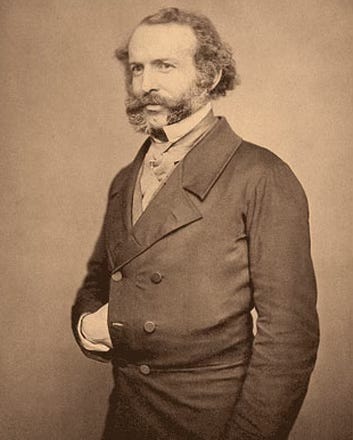
Jane Franklin refused to believe it. So did Charles Dickens, who wrote, “It is in highest degree improbable that such men as the officers and crews of the two lost ships would or could, in any extremity of hunger, alleviate the pains of starvation by this horrible means.” He pointed a finger at the “Esquimaux” natives as the likely culprits.
Sadly, there was ample evidence of British seamen engaging in cannibalism as a last resort, to the point where the practice had a name: the “custom of the sea.” Three decades later, the British courts would hear a landmark case involving the death of a 17-year-old cabin boy, who was killed and partly eaten by three shipmates after the yacht Mignonette was wrecked.
Jane Franklin never gave up her crusade to find out what happened to the expedition led by her husband. She lobbied the Admiralty and the whaling industry to go in search of the Erebus and the Terror. She raised funds for some private expeditions.
She “became the first woman presented with the Royal Geographical Society’s Founder’s Gold Medal,” as Alison Alexander noted. Parliament appropriated £2,000 for a John Franklin statue in London and “his widow supervised the sculptor, casting, inscription and site—Waterloo Place.”
Her final achievement was the placement of a bust of John Franklin in Westminster Abbey, with an inscription by Franklin’s nephew-by-marriage, poet laureate Alfred Tennyson.
It reads:
Not here: the white north has thy bones; and thou,
Heroic sailor-soul,
Art passing on thine happier voyage now
Toward no earthly pole.
Jane Franklin died in 1875. It took 139 more years to locate her husband’s ship. In 2014, underwater archaeologists for Parks Canada, acting with guidance from Inuit natives, found the remains of the Erebus and brought up relics such as the ship’s bell. The ship was found south of King William Island in 36 feet of water. Two years later, they found the wreck of the Terror.
Symbol of folly
The plaque on the Resolute desk says it was “presented by the Queen of Great Britain and Ireland to the President of the United States as a memorial of the courtesy and loving kindness which dictated the offer of the Resolute.”
An alternate account, by historian Stephen Dando-Collins suggested that the desk had been “foisted on the U.S. by Britain’s Prime Minister Benjamin Disraeli as a sly joke.”
Disraeli, a political ally of Jane Franklin, was leading his second government in 1879 when the Admiralty advertised a design competition for a desk to be made from the broken-up hull of the Resolute. The prime minister was peeved at the terms demanded by the U.S. government to settle its claims for reparations after Britain allowed the construction of ships for the Confederacy in the Civil War.
“It is entirely possible that Disraeli, after being re-elected as prime minister… saw an opportunity to give Americans a subtle, ironic, poison chalice of a gift, as a personal salve to the Treaty of Washington’s sting,” wrote Dando-Collins. “The Resolute Desk represented multiple failed attempts to rescue a failed expedition headed by a failed leader. It was, in effect, the very embodiment of failure.”
It is an intriguing theory, but is also only speculation.
What is certainly true is that the Resolute’s mission and its abandonment in the Arctic epitomized the folly of the Victorian era. And now in the form of the desk it may come to symbolize the folly of the American one as well.

How a mistake spread from the White House to the New York Times and the JFK Library

Soon after John F. Kennedy took office as president in 1961, the first lady’s press secretary sent a draft news release to Jacqueline Kennedy for approval.
Loved this piece and the follow up. Howie is right — what a book or series it would make. Chilling to think of Disraeli’s gesture as a kind of karmic Trojan horse!
Terrific column. Thanks Rich!
Leave it to Jacqueline Kennedy to install the historic desk. Imagine what she might say today!