

“Pat, we are just currently getting a look at the World Trade Center,” said Tom Kaminski, WCBS 880’s traffic reporter at about 8:48 AM on September 11, 2001. “We have something that has happened here at the World Trade Center. We noticed flames and an awful lot of smoke from one of the towers…”
Flying in Chopper 880 near the George Washington Bridge, Kaminski reported seeing a fireball three quarters of the way up the north tower.
Like many people, I remember exactly where I was upon first hearing the news: Driving down a hilly road under a cloudless blue sky. I was heading to Newsday’s Long Island newsroom, where I led the business desk.
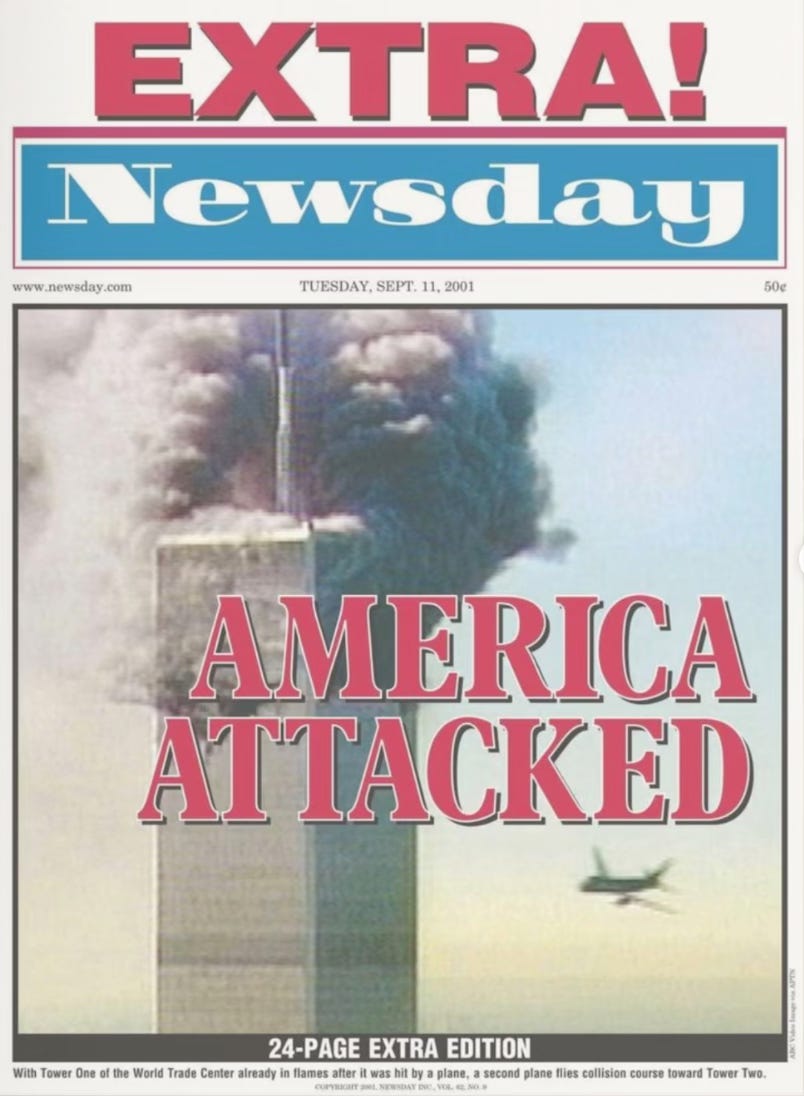
Soon witnesses calling in to WCBS reported that a plane had flown into the north tower. Some called it a commuter plane, others a commercial jetliner. Seventeen minutes after the first impact, another plane hit the south tower. The pilots took no evasive maneuvers and seemed to be deliberately crashing into the buildings. Before long, officials reported that the planes had been hijacked.
As the enormity of the event became clear, Newsday began gearing up to publish an extra edition, something most newspapers hadn’t done in decades.
At my desk, I took a call from reporter Susan Harrigan. Wall Street was Susan’s beat. So when she heard about the emergency, she immediately headed to the Financial District. Susan specialized in investigating shady trading and exposing financial scams but could cover breaking news as well as anyone in the business.
I could tell how upset Susan was as she breathlessly recounted running for her life ahead of debris from one of the collapsing towers. She was understandably in despair and I couldn’t offer any reassurance, except to say we had to tell her story to readers. Susan said she had no way to write it, so I asked her to dictate the account to me.
In Newsday’s extra edition, Susan’s piece noted that she heard a low-flying plane while walking her Yorkshire terrier on Seventh Avenue, not far from Greenwich Village. When she got back to her apartment building, the doorman said a plane had hit the World Trade Center.
“I knew I had to go.”
Susan wrote that she had been interviewing witnesses when a ‘whitish gray cloud’ began ‘mushrooming up from the streets. It was several stories high.”
Now I was a part of the unfolding disaster.
Suddenly, someone screamed, ‘The building is going to fall!’
I knew we weren’t going to be able to outrun it. I was looking for a place to take shelter.
I started to run. I was running south, away from the building. Other people were running beside me. We were pushing one another, but nobody was pushing anybody down.
We were running for our lives.
They tried to get into a nearby building but the revolving doors were locked. Finding refuge in another building, Susan recalled, “Everything turned black outside. The air was thick with debris and ash. I was frightened. I thought I was going to die. I started to think of my family and say a prayer. I managed to think about both. But you’ve only got three seconds. I formed the first words of a prayer.”
Emerging into a “moonscape” outside, “Everything was covered with white ash.”
“I’ve never done interviews before while patting people on the back.”
(Sadly, Susan died in March 2024 at the age of 78)
The toll
Nearly 3,000 people lost their lives n the terror attacks mounted by al Qaeda. A third plane crashed into the Pentagon and a fourth, apparently headed for the U.S. Capitol, crashed into a field in Pennsylvania after heroic passengers fought the hijackers.
Among the dead in New York City were 412 first responders, including 343 NYC firefighters, 37 Port Authority police officers, 23 members of the NYPD, 8 paramedics and 1 member of the New York Fire Patrol. Hundreds of people who worked on the rescue and recovery died in later years of illnesses from breathing in the toxic fumes at Ground Zero.
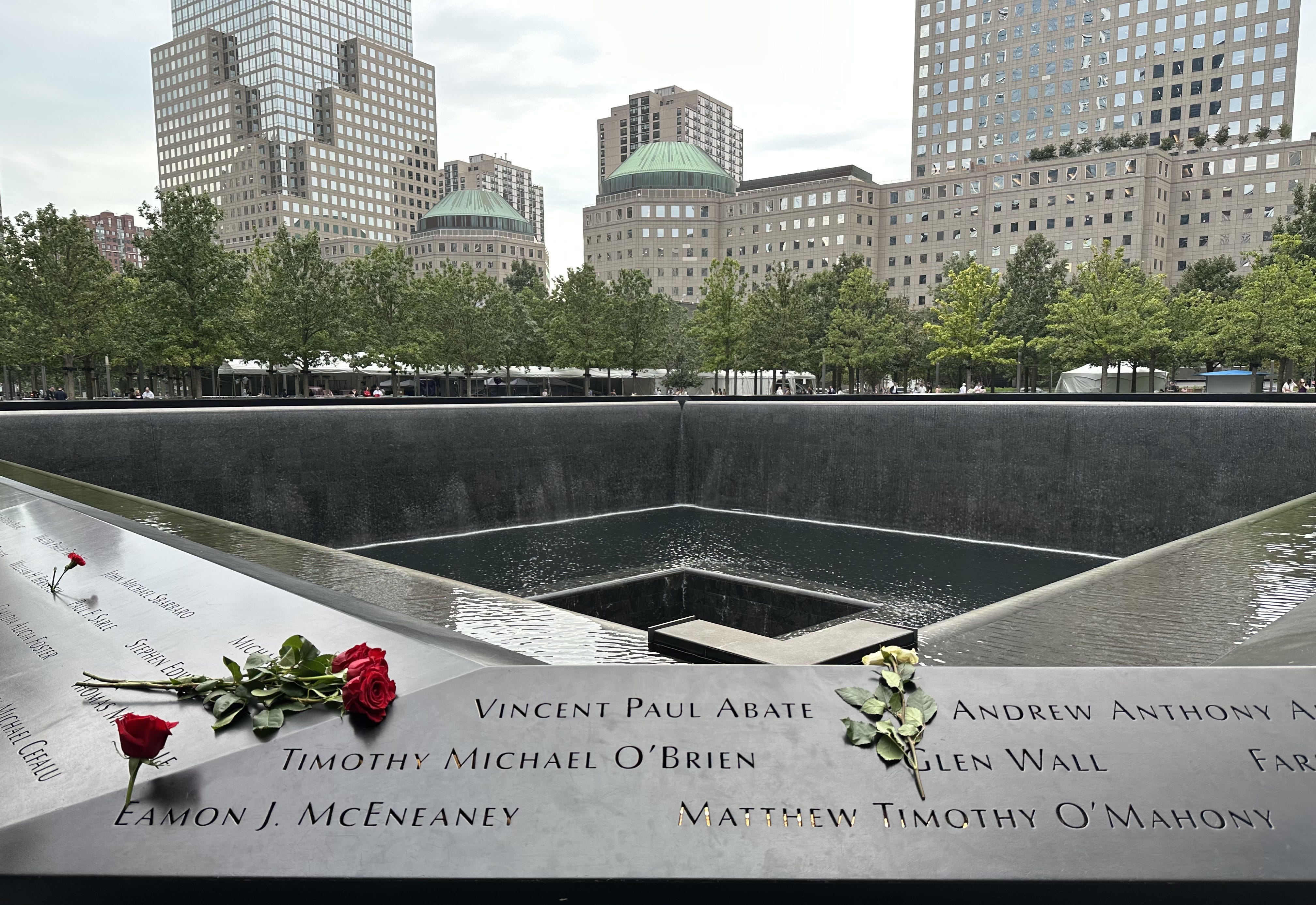
The haunting World Trade Center Memorial, with its twin waterfalls pouring into reflecting pools that together occupy half of the 16-acre site of the original building complex, draws attention to the victims’ absence.
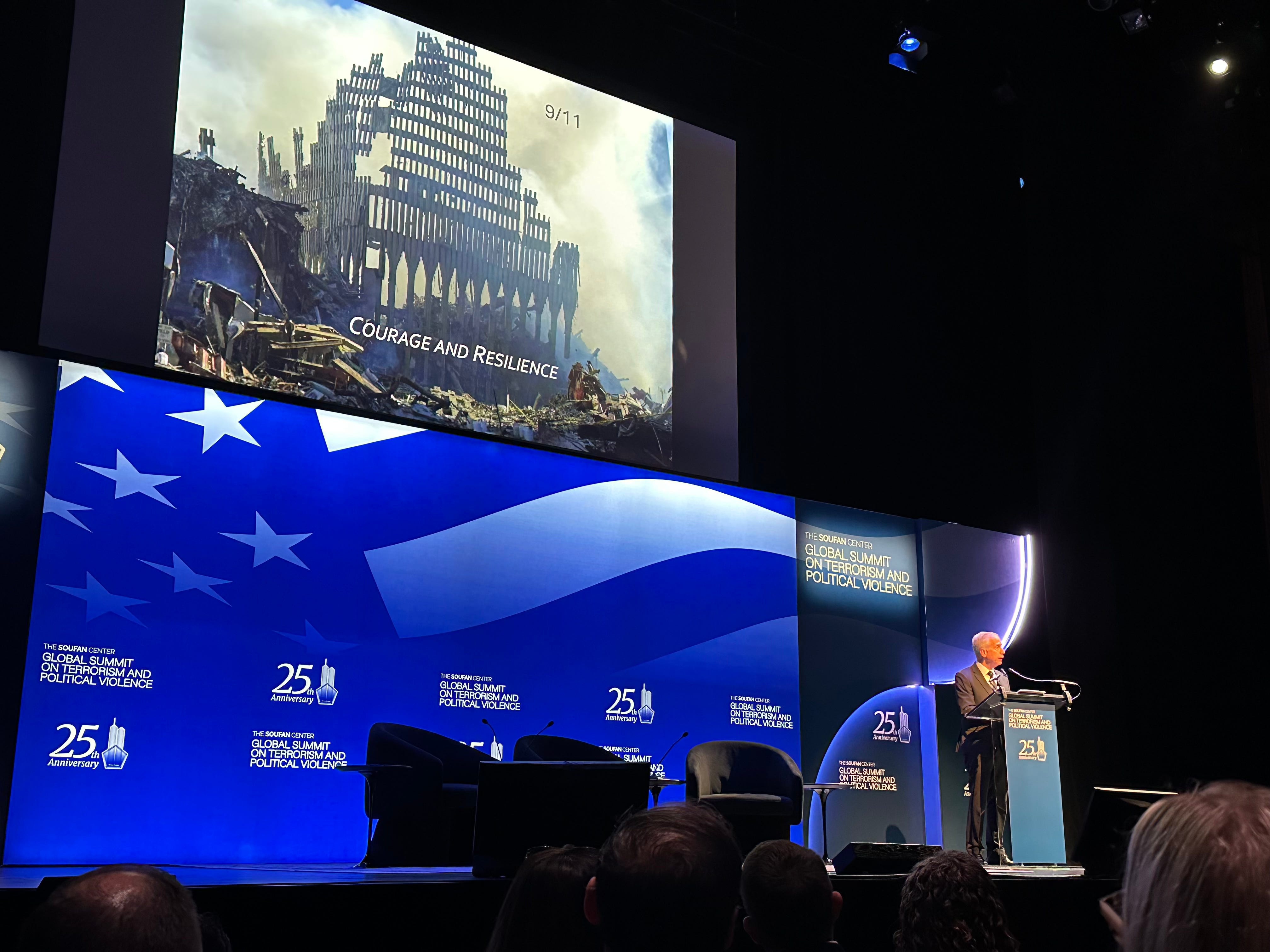
At the Global Summit on Terrorism and Political Violence this week, some shared their memories of that day. Among them was the FDNY’s former first deputy commissioner Joseph Pfeifer. The first fire chief to respond to the emergency, he gave orders to members of the FDNY to ‘Go up, evacuate the building, and then regroup on the upper floors to rescue those who were trapped.” Among those he ordered into the building was a fire lieutenant, his brother Kevin. They never saw each other again.
The courage of the first responders helped save as many as 17,000 people that day.
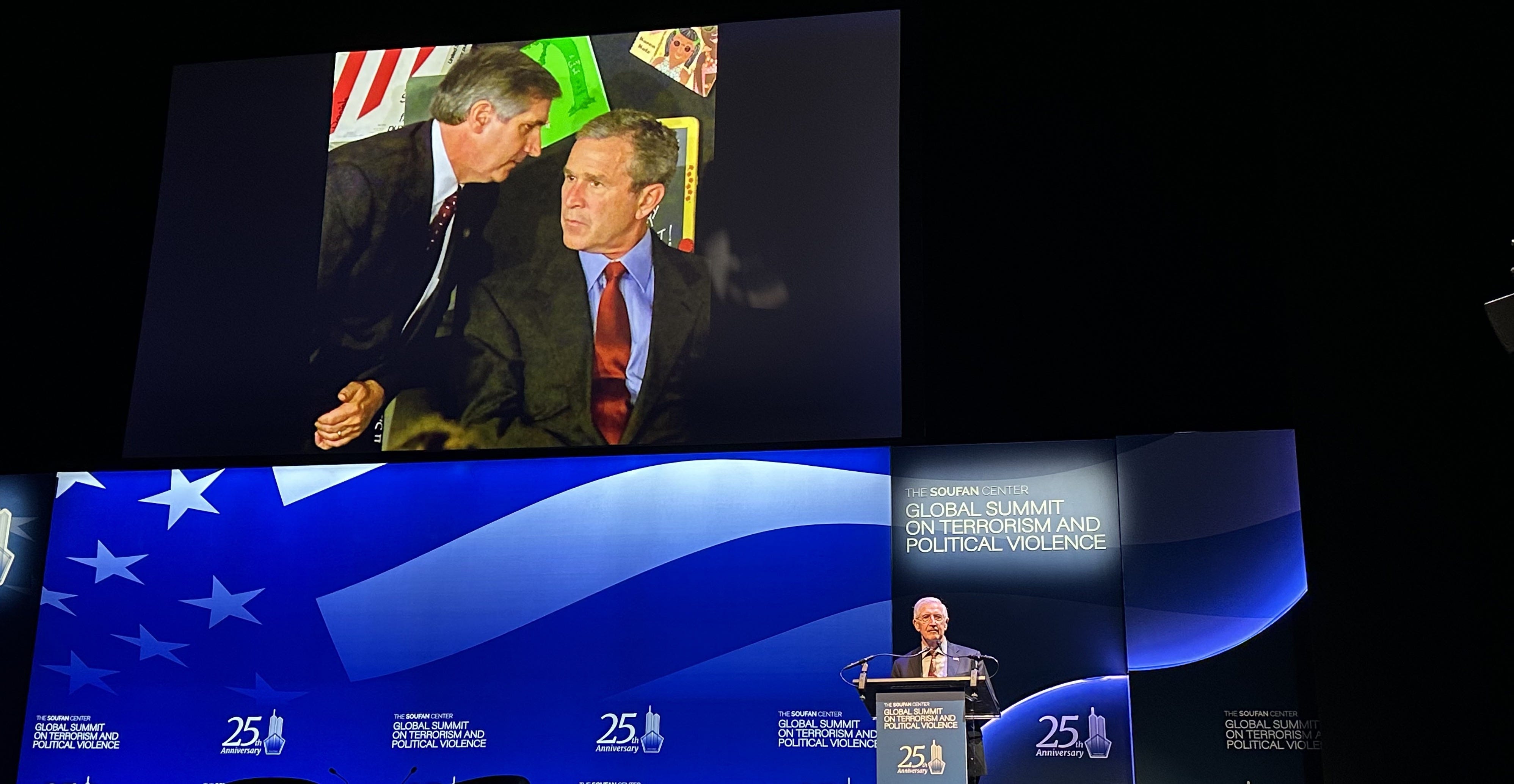
Former White House Chief of Staff Andrew Card recalled whispering in President George W. Bush’s right ear that a second plane had hit the south tower and that “America is under attack.” The president was at the Emma E. Booker Elementary School in Sarasota, FL preparing for a reading event with second graders when he heard the news from Card.
Other participants in this week’s conference, produced by the Soufan Center, explained how radically the world changed after the attacks. Bush declared a global war on terror, which has echoes in today’s war with Iran. America vastly increased security -- from airports to office buildings. Soon there would be a Homeland Security Department and the Patriot Act.
A nation was briefly united in outrage at the attacks, in a determination to find the culprits and in a resolve to rebuild. That unity shattered in the aftermath of Bush’s war of choice against Iraq.
But 10 years later, U.S. special forces found and killed Osama bin Laden in Abbottabad, Pakistan. A single tower, the 1,776-foot tall One World Trade Center, stands near the site of the twin towers. Lower Manhattan has rebounded from the trauma of 9/11, with its population roughly tripling and nearly as many people working there as before the attacks, wrote Peter Grant in the Wall Street Journal.
New York Police Commissioner Jessica Tisch said New York City has experienced more than 70 terror plots since 9/11, with most of them disrupted. The NYPD developed its own extensive counter-terrorism resources.
As much as we would like to be done with terrorism, it isn’t done with us, officials said. A scholar of terrorism, Georgetown University Professor Bruce Hoffman, pointed out that affiliates of ISIS and Al Qaeda still exist. In a September 8 article for CFR.org, Hoffman and Farah Pandith, senior fellows at the Council on Foreign Relations, warned that the U.S. still has a “stunning lack of preparedness to handle mounting new threats and resurgent old ones.” They wrote:
Rapidly evolving technologies such as drones make the U.S. homeland vulnerable to attack by terror groups. Combined with the weaponization of social media by digitally savvy terrorists, the country faces the phenomenon of increasingly lethal autonomous weapons and emerging populations of radicalized youth. An eruption of violence in the Middle East triggered by the October 7, 2023, Hamas terrorist attacks on Israel and the U.S.-Israel war with Iran has further fed extremist sentiment that could be directed at the United States.
Memory and history
In many ways, the world has moved on from September 11, 2001.
The name “World Trade Center” itself has an anachronistic feel in the age of anti-globalization and President Donald Trump’s tariff barriers to free trade.
WCBS 880 is no more.
The golden age of newspapers publishing thick editions crammed with advertising as well as news is long gone, as they lost most of their revenue base to the internet and social media.
The street on which I was driving when I heard the early radio reports offered a clear view of that Tuesday’s sky. Today a canopy of tree branches stands in the way.
It’s tempting to say 9/11 is passing from memory into history. Yet we should resist that. Never forget.
I am still thinking about how you valued her story. And how things move behind the scenes in real-time and how it matters. Also, I looked up the definition of the word anachronistic and I am glad to now have that in my library, very useful. Also the trees having grown is an important detail. Thanks for sharing!
We have similar memories of that day: driving to Newsday on a beautiful day, until it turned into a tragic day. Now we get a chance to write about it from the perspective of a quarter century.